
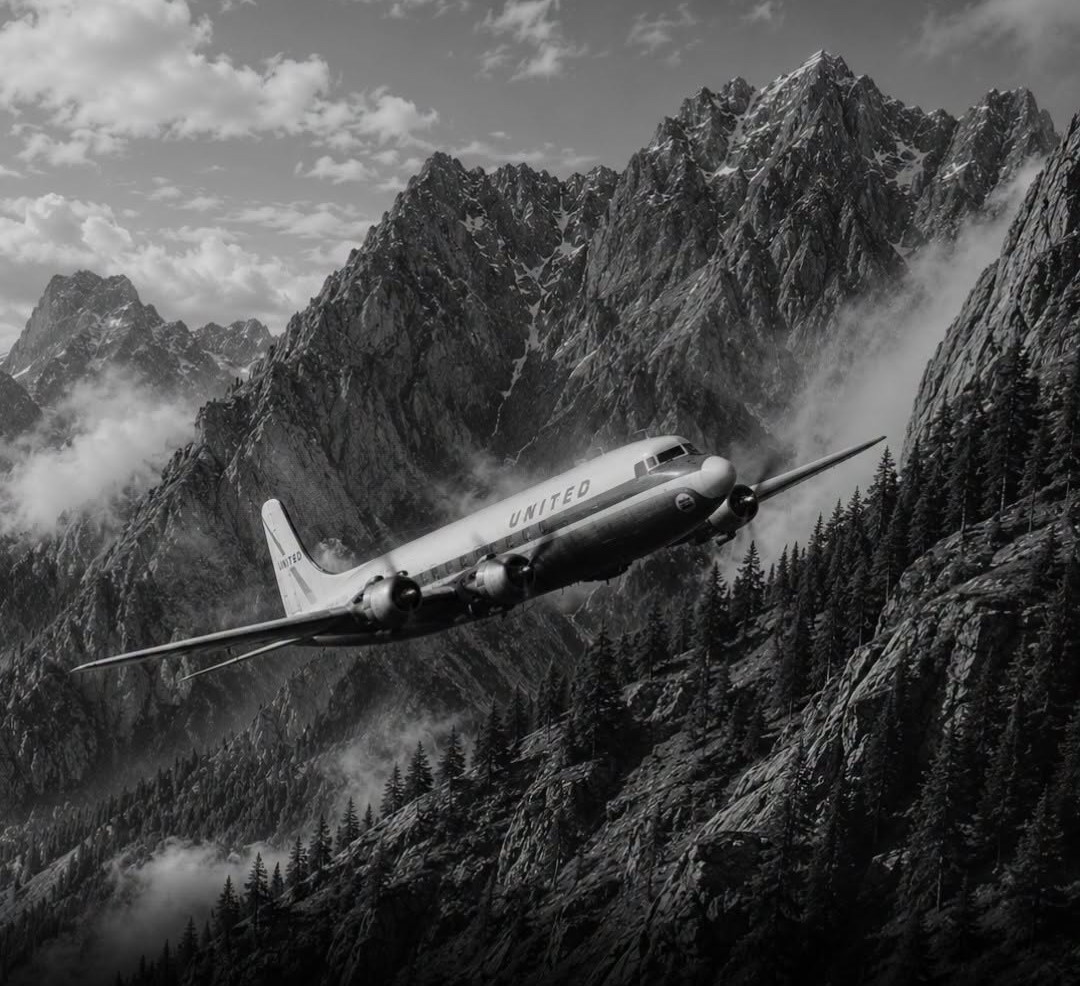
On June 17, 1948, one of the most unusual and tragic accidents in early commercial aviation history unfolded over Pennsylvania. United Air Lines Flight 624, a Douglas DC-6 named Mainliner Utah, was approaching the final stages of a transcontinental journey when a warning of a fire in the aircraft’s cargo compartment triggered a chain of events that ultimately killed all 43 people on board.
The most astonishing revelation from the investigation was that investigators found no evidence of any actual fire. Instead, a false warning, combined with emergency procedures and human factors, created a deadly situation from which the crew could not recover.
Flight 624 was operating a scheduled service from San Diego to New York City, with stops in Los Angeles and Chicago. After a crew change in Chicago, the aircraft departed for New York carrying 39 passengers and four crew members.
The flight climbed normally to its cruising altitude of 17,000 feet and proceeded eastward without any reported problems. Among the passengers were well-known Broadway producer Earl Carroll and actress Beryl Wallace, making the flight one of the more high-profile airline tragedies of its era.
At approximately 12:27 p.m., the crew acknowledged a descent clearance from air traffic control as they prepared for their arrival into New York. Four minutes later, another United Airlines crew monitoring radio frequencies heard fragments of an urgent transmission.
Investigators later determined the transmission likely came from Flight 624 and included references to an emergency descent and the aircraft’s fire extinguishing system. It would be the last indication that something had gone seriously wrong aboard the aircraft.
The sequence of events began when a fire warning activated in the cockpit, indicating a possible fire in the forward cargo compartment. Following emergency procedures, the crew discharged carbon dioxide fire-extinguishing gas into the compartment.
Carbon dioxide was commonly used at the time because it could suppress fires without damaging aircraft structures. However, the emergency checklist required the crew to open cabin pressure relief valves before releasing the gas so that dangerous concentrations could not accumulate inside the aircraft. For reasons that investigators later attributed to the stress and workload of a perceived onboard fire, the crew apparently failed to open those valves.
As carbon dioxide flooded the cargo compartment, some of the gas migrated into the cockpit. The crew, believing they were dealing with a potentially catastrophic fire, initiated an emergency descent toward lower altitude.
Unknown to them, the very system intended to save the aircraft was beginning to incapacitate them. Medical experts later testified that exposure to sufficiently high concentrations of carbon dioxide could cause confusion, impaired judgment, disorientation, and eventually unconsciousness. Investigators concluded that this was exactly what happened aboard Flight 624.
Witnesses on the ground observed the aircraft descending at a relatively shallow angle. As it neared the terrain, the airplane suddenly began climbing and turning to the right. This maneuver may have been an attempt by the partially incapacitated crew to avoid rising ground.
Unfortunately, the aircraft’s path carried it toward even higher terrain near Mount Carmel, Pennsylvania. The climb steepened as the crew struggled to clear the hills ahead. Moments later, the DC-6 slammed into a hillside approximately three miles from Mount Carmel. The impact was immediately followed by a powerful explosion and post-crash fire. All 43 occupants were killed.
The aftermath presented investigators with a difficult challenge. The aircraft was destroyed, there were no survivors, and initial reports from witnesses about smoke trailing from the airplane were inconsistent.
The Civil Aeronautics Board launched an extensive investigation involving aircraft manufacturers, federal laboratories, medical experts, and the Federal Bureau of Investigation. Public hearings were conducted and wreckage was examined in detail to determine whether a fire had truly existed before the crash.
As the investigation progressed, evidence began pointing away from an onboard fire and toward the emergency response itself. Investigators found no physical signs that a cargo compartment fire had ever existed. Components recovered from the wreckage failed to show indications of burning before impact.
This led investigators to conclude that the fire warning had been false. The crew had reacted correctly to the warning itself, but the absence of ventilation allowed carbon dioxide to enter the cockpit and gradually disable those responsible for flying the aircraft.
One of the most important revelations involved the aircraft’s pressure relief valves. Examination indicated that these valves had remained closed. Experts determined that if the valves had been opened as required, dangerous levels of carbon dioxide likely would not have accumulated in the cockpit.
The investigation also highlighted a broader issue: emergency procedures were being designed under the assumption that pilots would execute every step perfectly, even during highly stressful situations. The Board recognized that in a real emergency, critical steps could be missed.
The Civil Aeronautics Board ultimately determined that the probable cause of the accident was the incapacitation of the flight crew by a concentration of carbon dioxide gas in the cockpit.
The Board further concluded that emergency procedures should be redesigned with human limitations in mind, acknowledging that workload, stress, and confusion can lead to mistakes even among experienced crews. The accident became an important lesson in aviation human factors and emergency-system design.
The legacy of United Air Lines Flight 624 extended beyond the tragedy itself. The accident, together with another fatal DC-6 crash involving fire-suppression systems, led to major modifications of the aircraft’s fire detection and extinguishing arrangements.
Designers and regulators increasingly focused on ensuring that safety systems could not unintentionally create greater hazards than the emergencies they were meant to combat. The crash remains one of aviation history’s most sobering examples of how a false warning, a few missed checklist items, and the hidden effects of a safety system combined to create a catastrophe.