
Not every military aircraft earns legendary status—but one bomber continues to dominate the record books decades after its first flight.
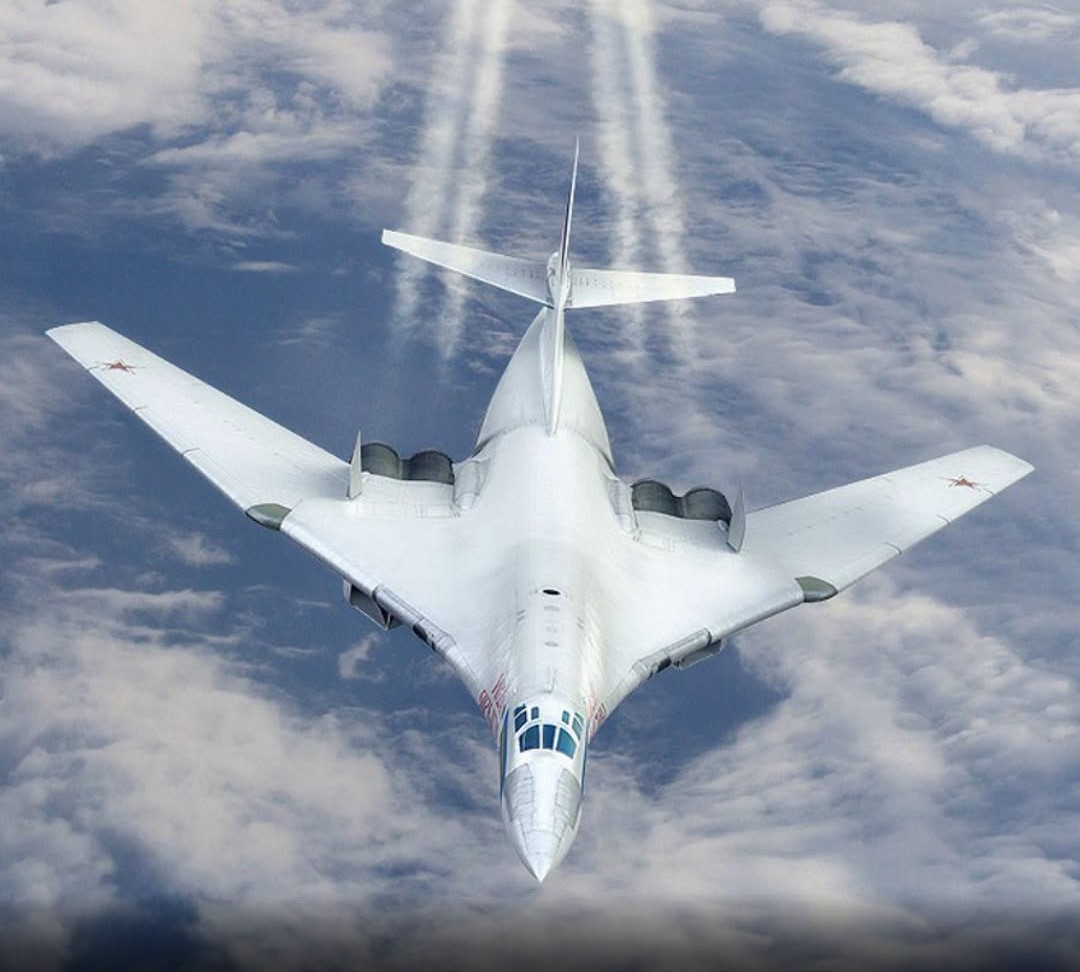
When people talk about the world’s most capable strategic bombers, names like the American B-2 Spirit, the iconic B-52 Stratofortress, or the next-generation B-21 Raider usually steal the spotlight. But if raw power is the benchmark, Russia’s Tupolev Tu-160 “White Swan” stands in a class of its own.
Built during the Cold War to challenge America’s strategic air power, the Tu-160 wasn’t designed around stealth. Instead, Soviet engineers pursued an entirely different philosophy: unmatched speed, enormous payload, and the ability to launch devastating long-range missiles from hundreds or even thousands of kilometers away.
The result? The largest, heaviest, and fastest operational strategic bomber ever built.
Powered by four massive Kuznetsov NK-32 afterburning turbofan engines producing a combined 220,000 pounds of thrust, the Tu-160 can exceed Mach 2 (around 2,220 km/h or 1,380 mph). No operational strategic bomber flying today can match its top speed.
Its size is equally astonishing. With a maximum takeoff weight of approximately 275 tonnes, the White Swan can internally carry up to 45 tonnes (99,000 pounds) of weapons—more than the B-2 Spirit, the upcoming B-21 Raider, and even surpassing the legendary B-52 in several mission profiles.
But perhaps the Tu-160’s greatest strength isn’t dropping bombs—it’s launching them from afar.
Modernized Tu-160M variants are equipped to carry advanced cruise missiles like the Kh-101 for conventional strikes and the nuclear-capable Kh-102. These stand-off weapons allow the bomber to attack targets from thousands of kilometers away without ever entering heavily defended enemy airspace, effectively turning the aircraft into a high-speed flying missile arsenal.
So why are America’s B-2 Spirit and B-21 Raider still considered among the most dangerous bombers on Earth?
The answer is stealth.
Unlike the Tu-160, the B-2 and B-21 are designed to penetrate some of the world’s most advanced air-defense systems while remaining extremely difficult to detect on radar. Their low observable design allows them to strike high-value targets deep inside hostile territory—missions where speed alone cannot guarantee survival.
In other words, these bombers were built to solve different military challenges.
If “power” means sheer speed, engine thrust, payload capacity, and physical presence, the Tu-160 remains unmatched. If survivability inside modern air-defense networks is the priority, stealth bombers like the B-2 and B-21 take the advantage.
More than three decades after entering service, the Tu-160 continues to symbolize an era when overwhelming speed and firepower defined strategic air power. Whether or not it is the most advanced bomber in the world today, there’s little debate that the “White Swan” remains one of the most extraordinary military aircraft ever built.