
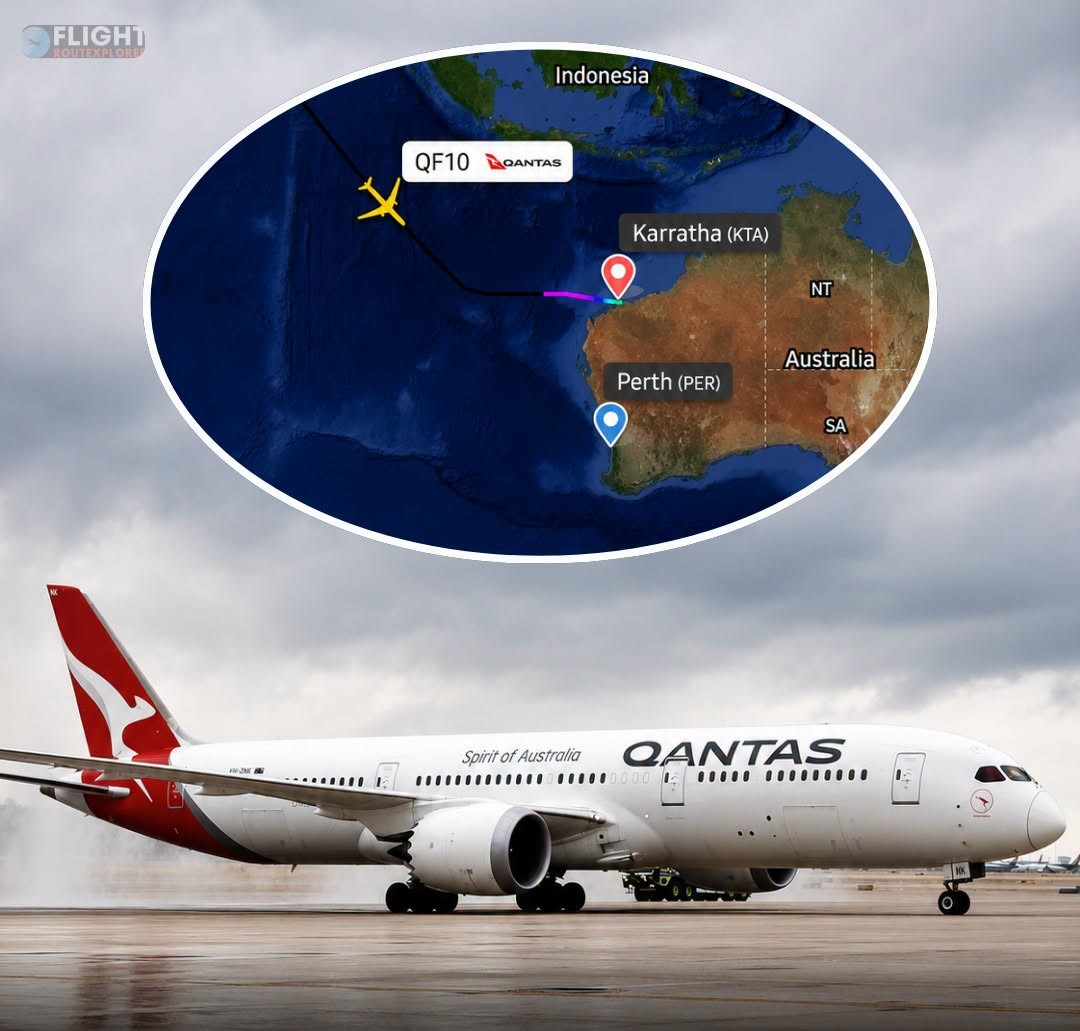
A Qantas Airways flight traveling from London to Perth was forced to make an unexpected emergency landing in the remote mining town of Karratha, Western Australia, after encountering stronger-than-expected headwinds that prevented the aircraft from safely completing its journey.
The Boeing 787 Dreamliner had departed London on what is one of the airline’s longest international routes and was scheduled to arrive in Perth around midday on Tuesday. However, as the flight crossed Western Australia, the aircraft was diverted to Karratha Airport—located approximately 1,520 km (945 miles) northeast of Perth—to refuel before continuing the final leg of the journey.
According to reports, the unusually strong headwinds significantly increased fuel consumption, making it necessary for the pilots to perform a precautionary fuel stop rather than continue toward Perth with reduced fuel reserves. The diversion was carried out safely, and the aircraft remained on the ground for roughly an hour while refueling.
After taking on additional fuel, the Dreamliner departed Karratha and safely landed at Perth Airport at approximately 2:36 p.m. local time. No injuries were reported, and passengers eventually reached their destination with only a few hours’ delay.
Karratha Airport primarily serves Western Australia’s Pilbara mining region and regularly handles fly-in, fly-out workers supporting Australia’s massive mining industry. While it is not a typical destination for international long-haul passenger flights, the airport was well positioned to support the diversion.
The incident highlights one of aviation’s biggest operational challenges—weather. Strong jet streams and headwinds can dramatically increase flight times and fuel burn, requiring pilots and airline dispatchers to make real-time decisions to maintain the highest safety margins.
The diversion comes only days after Qantas showcased its ambitious Project Sunrise initiative, which aims to launch the world’s longest non-stop commercial flights from Sydney to London and New York beginning in 2027.
To make those ultra-long-haul flights possible, Qantas has ordered 12 specially modified Airbus A350-1000ULR aircraft featuring an additional fuel tank that extends their range by approximately 1,000 nautical miles. The aircraft will also carry only 238 passengers—far fewer than a standard A350—to maximize range and passenger comfort on flights lasting up to 22 hours.
Although the fuel stop was unexpected, the safe diversion demonstrates the importance of careful flight planning, conservative fuel management, and the professionalism of flight crews when weather conditions change unexpectedly.