

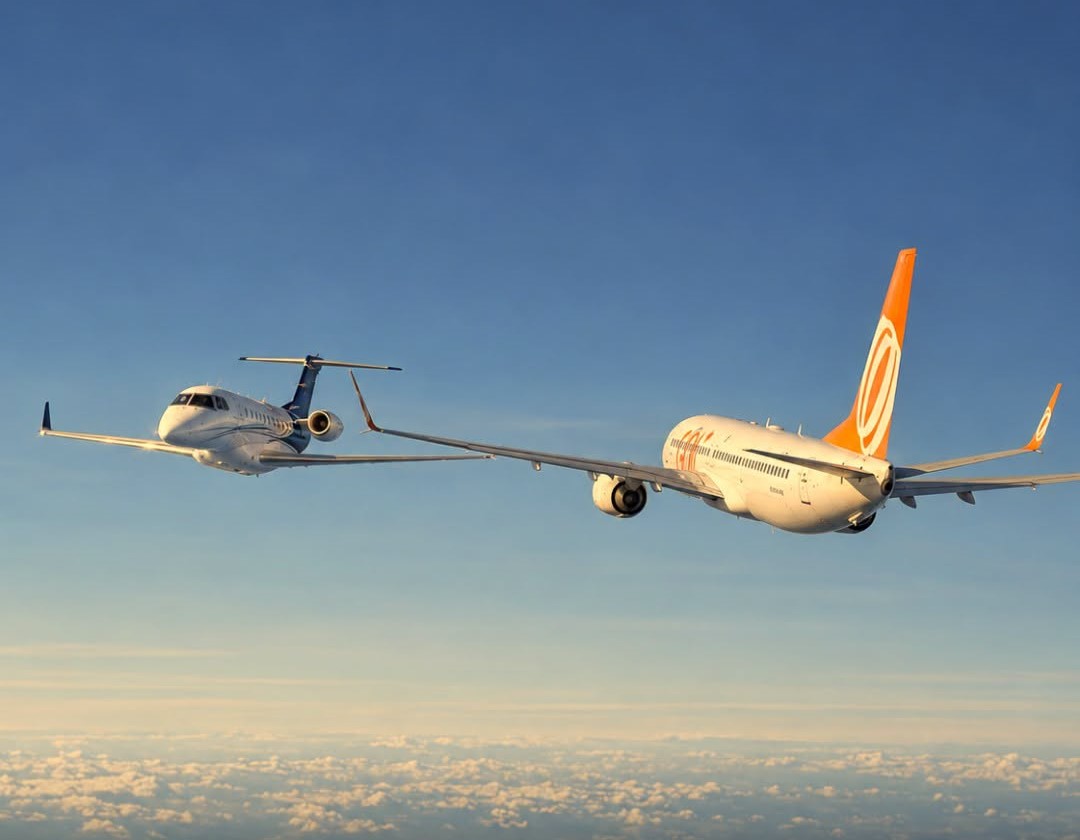
On September 29, 2006, Gol Transportes Aéreos Flight 1907, a Boeing 737-800 registered PR-GTD, departed Manaus for Rio de Janeiro with a planned stop at Brasília. Six crew members and 148 passengers were aboard.
At the same time, a newly delivered Embraer Legacy 600, registered N600XL, was flying from São José dos Campos toward Manaus before continuing to the United States, carrying two crew members and five passengers.
The two aircraft were flying at Flight Level 370, approximately 37,000 feet, on nearly opposite tracks. The Legacy had reached the assigned altitude after departing São José dos Campos and was proceeding northwest.
During the flight, however, a chain of communication and air traffic control problems developed. The Legacy’s transponder eventually stopped transmitting its altitude, while its Traffic Collision Avoidance System was also rendered unavailable. Controllers did not successfully detect and correct the developing conflict.
At about 19:56 UTC, the two aircraft collided over the remote Amazon region of Mato Grosso. The Legacy’s winglet struck the Boeing 737, cutting through a substantial portion of its left wing.
The damage was catastrophic. The 737 broke apart in flight and crashed into dense rainforest near Peixoto de Azevedo. All 154 people aboard were killed.
The Legacy was badly damaged, losing part of its left winglet and suffering damage to its left elevator, but it remained controllable. Its crew declared an emergency and eventually landed at a military airfield. Remarkably, all seven people aboard survived.
The wreckage of the Boeing was found the following day in thick jungle. Recovery teams faced difficult terrain and initially had to reach the site through remote areas of the Amazon.
The disaster triggered a major aviation crisis in Brazil and raised questions about radar coverage, controller workload, pilot training, communications and the effectiveness of collision-avoidance systems.
CENIPA’s final investigation, released in 2008, identified a combination of contributing factors. Investigators found errors in the clearance issued to the Legacy, failures during controller handoffs and shortcomings in the response after radar and communications problems developed.
The investigation also found that the Legacy crew failed to recognize that the transponder had been switched off, leaving the aircraft without effective TCAS protection.
The U.S. National Transportation Safety Board reached different conclusions on some aspects, emphasizing that the pilots were placed on a collision course by air traffic control and treating the Legacy’s loss of TCAS as a contributing factor rather than the direct cause.
The crash became one of Brazil’s deadliest aviation disasters and exposed how several small failures involving pilots, controllers, equipment and procedures could align into a catastrophic mid-air collision.










