
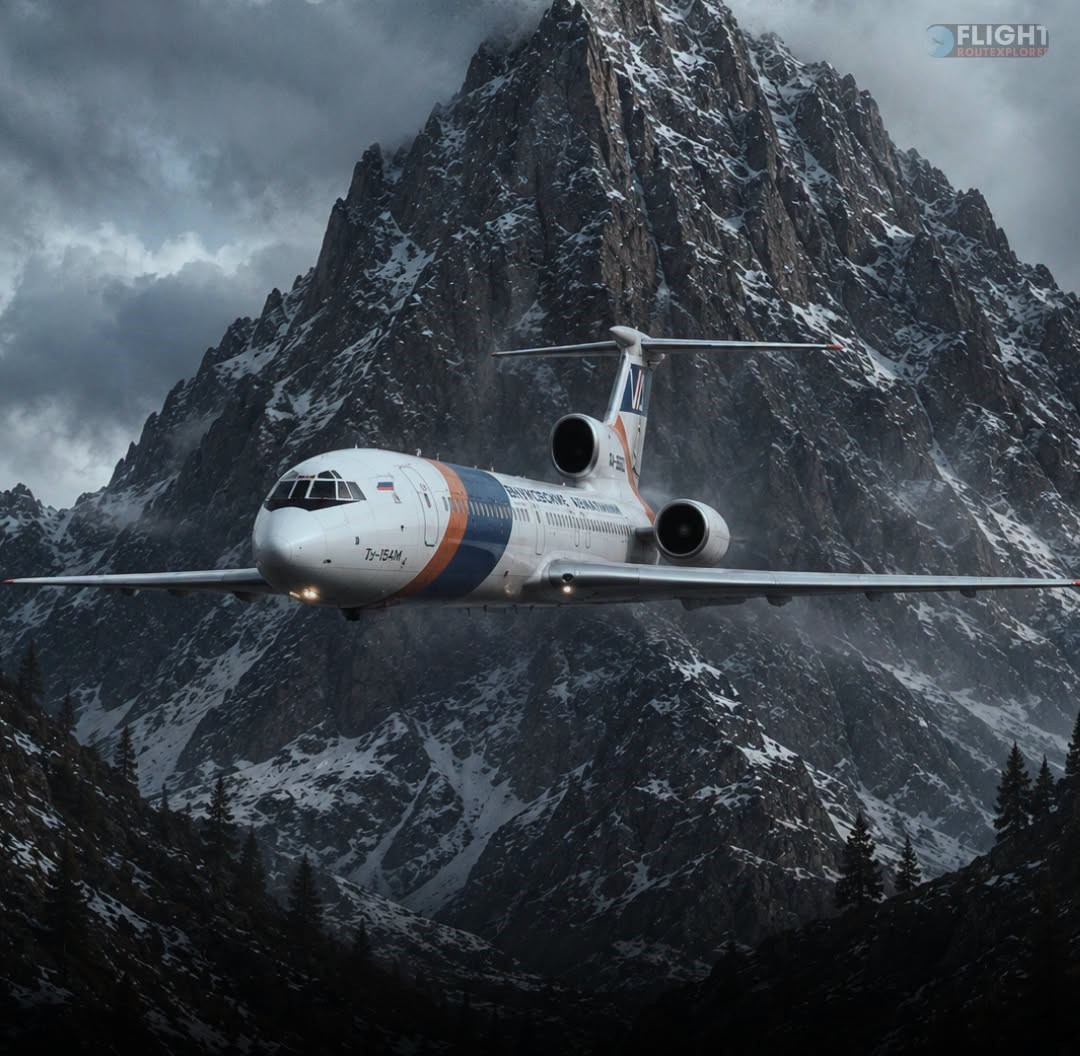
On 29 August 1996, Vnukovo Airlines Flight 2801 was approaching Svalbard Airport in the remote Arctic archipelago of Svalbard when a series of seemingly small navigation errors placed the aircraft directly on a collision course with a mountain.
The Tupolev Tu-154M, carrying 130 passengers and 11 crew members, crashed into Operafjellet during its final approach. There were no survivors.
The accident became the deadliest aviation disaster in Norwegian history and one of the most significant examples of controlled flight into terrain caused by a chain of human and procedural errors rather than a catastrophic mechanical failure.
Flight 2801 was a charter flight arranged by Arktikugol, the Russian state-owned coal-mining company operating settlements in Svalbard. The aircraft, registered RA-85621, had been built in 1987 and was operated by Vnukovo Airlines. On board were Russian and Ukrainian mine workers and their families, including three children.
The flight departed Moscow’s Vnukovo Airport at 04:44 UTC on 29 August. The journey across northern Russia and the Barents Sea initially proceeded normally. The Tu-154 cruised at about 35,000 feet before beginning its descent toward Svalbard Airport, Longyear.
The problems began as the crew prepared for the approach.
Svalbard Airport had a single runway, designated 10/28. On that day, aircraft were using Runway 28 because of the wind and other operational considerations. The airport did not have conventional air traffic control; instead, pilots received information from an aerodrome flight information service, or AFIS.
The crew initially wanted to use Runway 10, but communication difficulties prevented the request from being properly understood. The crew eventually accepted Runway 28 and began preparing for an approach they had not originally expected to fly. The investigation later found that the crew did not conduct a new approach briefing after changing to Runway 28.
The approach itself was particularly demanding. Runway 28 used a localizer approach in which the localizer course was offset from the runway heading. This distinction became critically important.
The aircraft’s horizontal situation indicators were set to the runway’s magnetic heading of 283 degrees instead of the actual localizer course of 300 degrees. The GPS was also configured using the runway heading. According to the investigation, there was no suitable company procedure explaining how the crew should configure the instruments for this offset-localizer approach.
This created a misleading picture of where the aircraft was in relation to the intended approach path.
At approximately 08:10 UTC, Flight 2801 descended through 5,000 feet and reached the Advent approach point. A few minutes later, the aircraft began its turn toward the inbound approach.
The turn was started too late. Instead of establishing itself correctly on the prescribed outbound track, the aircraft ended up to the northeast, or left, of the intended path. The crew compensated for wind drift but did not properly intercept the outbound course.
At 08:17:08 UTC, the crew began the inbound turn. By then, the aircraft was already about 3.7 kilometres left of the intended outbound course. The combination of its position and the prevailing tailwind caused it to pass through the localizer and eventually roll out on the wrong side of the approach centerline.
At 08:17:57, the navigator reported that the aircraft was abeam the eight-mile point and inbound. AFIS replied that the position was correct. That was the final radio communication between the aircraft and Longyear.
Inside the cockpit, however, the crew was becoming increasingly uncertain about its actual position.
The aircraft was eventually flying on a heading of about 290 degrees. The first officer questioned whether the turn had been made at the correct time, and a disagreement developed among the crew about whether they needed to correct left or right.
Instead of establishing a clear position and returning to a safe altitude, the crew made a series of corrective heading changes. At one point, the aircraft was about 2.8 kilometres to the right of the approach centerline while still at 5,000 feet.
The crew continued trying to correct the aircraft’s lateral position rather than abandoning the approach and climbing to a safe altitude.
This was particularly dangerous because the surrounding terrain was rising dramatically.
The aircraft eventually settled on a heading close to 300 degrees, almost parallel to the localizer course, but it was still approximately 3.7 kilometres to the right of the intended approach centerline.
At 08:20:24 UTC, the aircraft began descending.
The Tu-154 was now flying toward mountainous terrain while the crew still did not have a reliable understanding of its exact lateral position. The descent rate was between roughly 900 and 1,260 feet per minute.
At 08:22:05 UTC, the aircraft began another left turn. Almost immediately, it entered turbulence generated by the surrounding mountains.
The aircraft was already dangerously close to terrain.
During the approach, the radio altimeter had activated several times, indicating that the aircraft was getting within 750 metres of the terrain below. The warnings should have provided an additional indication that the aircraft was approaching dangerous terrain.
Then came the final warning.
At 08:22:14 UTC, approximately nine seconds before impact, the Tu-154’s Ground Proximity Warning System activated. The warning continued until the crash.
The crew finally reacted by applying power and pitching the aircraft upward. But by then there was simply not enough time or altitude remaining.
Six seconds before impact, another radio-altimeter warning activated.
At 08:22:23 UTC, Flight 2801 struck the summit area of Operafjellet at an elevation of approximately 907 metres.
The aircraft was about 14.2 kilometres from Svalbard Airport and approximately 3.7 kilometres to the right of the intended approach centerline.
The Tu-154 was destroyed and all 141 people aboard were killed.
The crash site was extremely difficult to reach. The wreckage was scattered across the mountain plateau, with additional debris falling down a steep cliff into the valley. Some wreckage was also covered by an avalanche.
Bad weather, fog and snow made the recovery operation even more difficult.
Norwegian search-and-rescue teams were deployed after the crash was reported. The wreckage was located several hours later, and rescue workers reached the site and confirmed that there were no survivors.
The recovery operation continued for days. By 5 September, all bodies had been recovered from the mountain plateau, while recovery work in the valley was completed two days later. The identification process was conducted in Tromsø, and all victims had been identified by 18 September. The remains were subsequently transported to Russia and Ukraine.
The disaster also had a profound effect on the small Russian communities in Svalbard. At the time, roughly 1,600 people lived in the Russian settlements of Barentsburg and Pyramiden. The communities were isolated from Longyearbyen and did not generally speak Norwegian, complicating communication in the aftermath.
There was also confusion caused by erroneous reports in Russian media claiming that five people had survived.
The investigation became a joint Norwegian-Russian effort. Norway’s Accident Investigation Board took primary responsibility for the investigation, while Russia’s Interstate Aviation Committee participated in examining the flight recorders, conducting a test flight and investigating aspects of the operation and crew.
Investigators ultimately concluded that the aircraft itself had not suffered a failure that caused the crash. Instead, Flight 2801 had become a classic controlled flight into terrain accident: the aircraft was functioning and under the pilots’ control, but the crew unknowingly flew it into mountainous terrain.
The investigation uncovered a chain of mistakes rather than one single error.
The first major problem was the offset localizer approach. The crew had no adequate procedure for correctly setting the approach course on the HSIs. Both instruments were therefore configured incorrectly. Their indications contributed to the crew believing that the aircraft was being displaced in the opposite direction from where it actually was.
The navigator also set the GPS incorrectly while under pressure and did not have enough time to verify the setting. His workload was already high, yet the pilots did not adequately monitor his navigation work.
The investigation also found that the crew did not use the airport’s VHF direction-finding capability to independently verify their position. The pilots were therefore relying heavily on the information presented by their navigation equipment despite growing uncertainty about where the aircraft actually was.
Communication was another important factor.
The Russian crew was not sufficiently familiar with the Norwegian AFIS system. In Russia, the crew was accustomed to a different relationship with air traffic services. At Svalbard, AFIS provided information and advice rather than conventional ATC clearances and instructions.
The crew’s limited English proficiency further complicated communications.
The investigation found that the navigator was handling communications with AFIS, despite this being contrary to normal procedures. This added to his already heavy workload.
Crew resource management was another major weakness.
The captain had insufficient knowledge of modern crew resource management principles, while the crew did not effectively challenge or cross-check the developing navigation problem. The first officer had transferred responsibility for lateral navigation to the navigator even though the navigator was already overloaded.
Most importantly, the crew recognized that something was wrong but did not take the safest available action.
The aircraft should have climbed to a safe altitude while the navigation problem was resolved. Instead, the crew continued the approach while disagreeing about the aircraft’s position and which direction to correct.
That decision proved fatal.
The investigation also found that the pilots did not always have the approach chart directly in front of them, further reducing their situational awareness.
The result was a gradual loss of positional awareness. One incorrect instrument setting led to confusion. The confusion produced incorrect corrections. The incorrect corrections placed the aircraft farther from the intended path. The crew then attempted to correct the problem while descending toward terrain.
By the time the GPWS warning sounded, the aircraft was already too close to the mountain to escape.
The final report therefore did not identify one dramatic mechanical defect or a single catastrophic mistake. Instead, it described a chain of navigation errors, communication difficulties, workload problems, inadequate procedures, weak crew coordination and poor situational awareness that ultimately placed a perfectly flyable aircraft on a collision course with the mountain.
The aftermath extended well beyond the crash site. The accident contributed to the eventual abandonment of Pyramiden by Arktikugol in 1998. Compensation disputes also followed, with relatives of the victims pursuing additional compensation from the airline’s insurance arrangements. A settlement was eventually reached in 1999, and Norway later established a scholarship to help children who had lost a parent in the disaster pursue further education.
Vnukovo Airlines Flight 2801 remains a particularly haunting aviation accident because the aircraft was not brought down by a sudden structural failure, engine failure or loss of control. It descended toward the mountain while the crew was still attempting to solve a navigation problem that could have been resolved simply by stopping the approach and climbing to a safe altitude.
The Tu-154 struck Operafjellet only 3.7 kilometres from the intended approach centerline.
That small distance was the final result of a much larger chain of errors.
On 29 August 1996, 141 people died in one of Norway’s most remote aviation disasters. The investigation showed that the crash was not the consequence of one mistake, but of several small mistakes and missed opportunities that progressively removed the crew’s margin for survival until the final warning came just nine seconds before impact.