
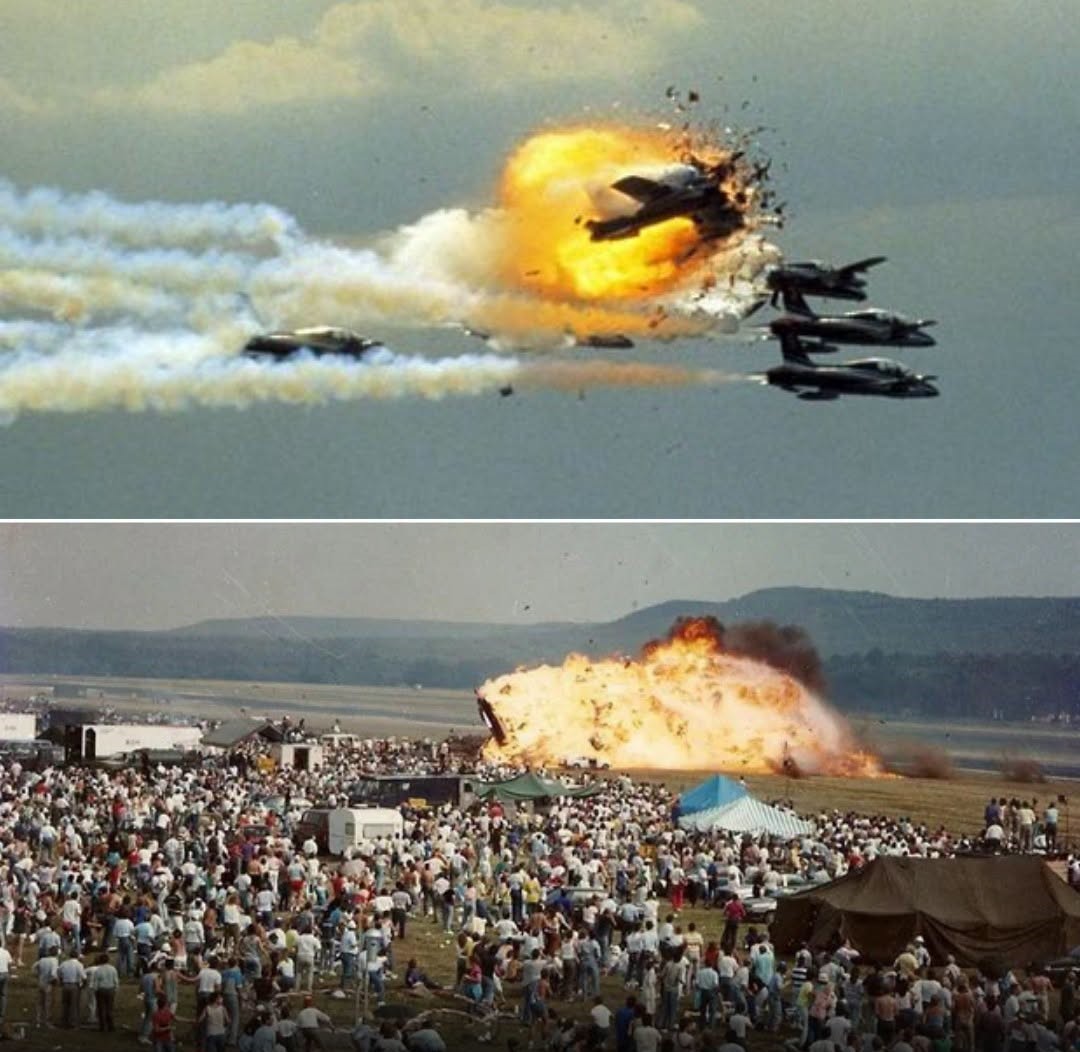
On August 28, 1988, hundreds of thousands of spectators gathered at Ramstein Air Base in West Germany for Flugtag ’88, one of the largest military air shows in Europe.
The event featured aerial displays from several nations, but the highlight of the day was a performance by Italy’s famous aerobatic team, the Frecce Tricolori. What began as a spectacular demonstration ended in one of the worst air show tragedies in history, killing 70 people and injuring more than 1,000 others.
The disaster occurred during the team’s signature maneuver known as the “Pierced Heart.” In this formation, two groups of aircraft fly curved paths to create the outline of a giant heart in the sky, while a solo aircraft flies directly through the center of the heart at the exact moment the formation closes.
The maneuver required extremely precise timing, speed, and altitude, leaving almost no margin for error.
At approximately 3:44 p.m., ten Aermacchi MB-339 jets of the Frecce Tricolori began the maneuver before a crowd estimated at more than 300,000 people. As the heart shape was closing, the solo aircraft, designated Pony 10 and flown by Lieutenant Colonel Ivo Nutarelli, approached the crossing point.
Investigators later determined that his aircraft arrived slightly too low and too fast. As he attempted to pass through the formation, the nose of Pony 10 struck the tail of Pony 1, flown by Lieutenant Colonel Mario Naldini. The impact instantly destroyed Pony 1’s tail section and rendered both aircraft uncontrollable.
The damaged Pony 1 then collided with a third aircraft, Pony 2, flown by Captain Giorgio Alessio. Within seconds, three jets were falling from the sky. Naldini managed to eject, but he was too low for his parachute to deploy fully and was killed when he struck the ground. Pony 2 crashed near the runway and exploded. Meanwhile, Pony 1 slammed into a parked medical evacuation helicopter, killing its pilot and destroying a critical rescue asset before emergency operations had even begun.
The most devastating moment came when Pony 10, already engulfed in flames and out of control, continued forward toward the spectators. The aircraft struck the ground near the viewing area, exploded, and cartwheeled through a fence before plowing directly into the densely packed crowd. It tore across an emergency access road and ultimately crashed into an ice cream stand. The area it struck was considered one of the best viewing locations at the air show and was packed with spectators. From the initial collision in the sky to the moment the burning wreckage entered the crowd, less than seven seconds had elapsed, giving people virtually no time to react or escape.
The immediate aftermath was chaotic. Burning fuel, flying debris, and thick smoke engulfed the crowd. Many victims suffered severe burns, while others were struck by wreckage or injured in the panic that followed. Emergency responders faced enormous challenges. Confusion between German civilian rescue procedures and American military emergency protocols complicated the response. Some injured victims were moved before proper triage could be completed, leading to criticism that the rescue effort lacked coordination during the crucial first minutes after the crash.
All three Frecce Tricolori pilots involved in the collision were killed. On the ground, dozens died immediately while many others succumbed to their injuries in the following days and weeks. The final death toll reached 70 people, including the three pilots and a helicopter pilot, while more than 1,000 spectators were injured, making it the deadliest air show accident in history at the time.
Investigators studied numerous photographs and video recordings of the accident. Their findings concluded that the disaster was caused by a pilot error during the execution of the “Pierced Heart” maneuver. Pony 10 entered the crossing point at an incorrect altitude and speed, resulting in the collision with Pony 1. There was speculation that Nutarelli may have lowered his landing gear in a final attempt to slow the aircraft before impact, but investigators found no conclusive evidence proving this theory. Other claims involving technical failure or sabotage were examined over the years but never supported by evidence. The official conclusion remained that an error during a highly demanding low-altitude aerobatic maneuver triggered the chain of events.
The catastrophe had a profound impact on aviation safety and air show operations across Europe. Germany temporarily banned military aerobatic displays, and many countries reassessed how air shows were organized. New rules increased the distance between performing aircraft and spectators, restricted certain high-risk maneuvers, and improved emergency planning for large aviation events. Rescue agencies also revised procedures to ensure better coordination between military and civilian responders during major emergencies.
More than three decades later, the Ramstein air show disaster remains a defining lesson in aviation safety. It demonstrated how a tiny error during a complex maneuver can escalate into a catastrophe within seconds and changed the way air shows are conducted around the world. What was intended to be the most spectacular moment of the day became a tragedy remembered as one of the darkest chapters in aviation exhibition history.