
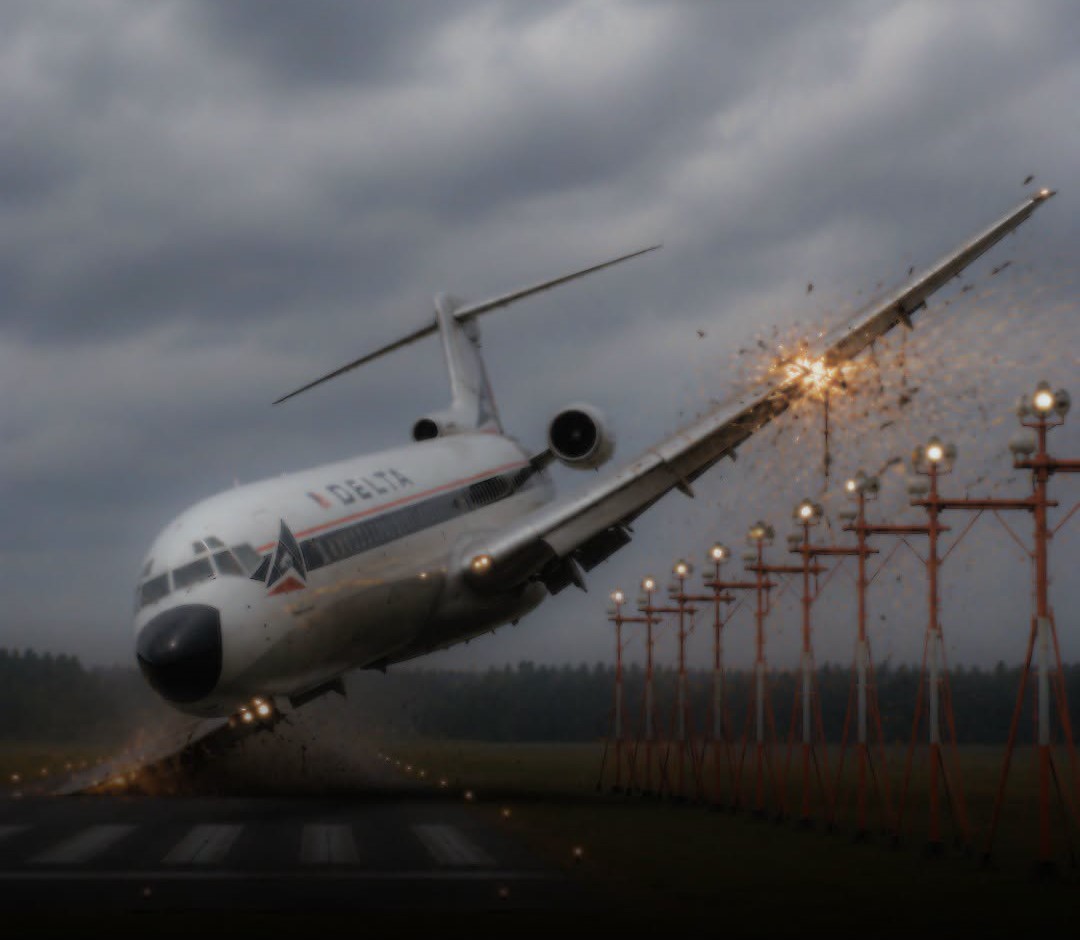
On August 31, 1988, Delta Air Lines Flight 1141 was preparing for what should have been a routine flight from Dallas/Fort Worth International Airport to Salt Lake City.
Instead, the Boeing 727 would become airborne in a dangerously misconfigured condition, roll violently, strike an airport antenna and crash in one of the most revealing takeoff accidents of the 1980s.
What made the disaster particularly disturbing was that the aircraft had a warning system specifically designed to prevent exactly what happened — but that system failed to sound.
The aircraft, a Boeing 727-232 Advanced registered N473DA, had arrived at DFW from Jackson, Mississippi, earlier that morning. For the second leg, 101 passengers and seven crew members were aboard.
At about 8:30 a.m., Flight 1141 left the gate and taxied toward Runway 18L. Because an American Airlines DC-10 had departed ahead of them, the Delta crew was instructed to wait for wake turbulence to dissipate. The crew even requested a longer delay before takeoff, and the request was approved.
But while waiting, something was happening inside the cockpit that investigators would later consider critically important. The cockpit voice recorder captured extensive conversation unrelated to operating the aircraft.
The crew and a flight attendant discussed the recorder itself, previous crashes and even joked about what they might say if their aircraft crashed. They also talked about subjects ranging from the presidential election to drink mixes. Federal rules required a “sterile cockpit” during critical phases of flight, but the crew did not maintain that discipline.
Eventually, Flight 1141 was cleared for takeoff. The initial acceleration appeared normal. Then, almost immediately after the main landing gear left the runway, the aircraft began to roll violently. The right wing dropped, and the tail briefly struck the runway. About 650 feet later, the right wingtip also contacted the pavement. The 727 was struggling to fly because its wings were not configured for takeoff.
The aircraft’s engines then began experiencing compressor surges as the pilots continued attempting to raise the nose. But the investigation found that the engines had not suffered a catastrophic failure. Instead, the high angle of attack created enormous aerodynamic drag, preventing the aircraft from accelerating and climbing normally. With the flaps and leading-edge slats retracted, the 727 simply did not have the required takeoff performance.
The disaster unfolded incredibly quickly. Roughly 900 feet beyond the end of Runway 18L, the right wing struck the airport’s ILS localizer antenna array. The impact ignited leaking fuel and severely damaged the wing. The aircraft continued forward for another few hundred feet before hitting the ground, sliding sideways and breaking apart. A trail of wreckage extended for hundreds of feet, while fire rapidly spread through the aircraft. From liftoff to the first ground impact, only about 22 seconds had passed.
Fourteen people ultimately died, including 12 passengers and two flight attendants. Most of the fatalities were caused by smoke inhalation rather than the initial impact. Seventy-six people were injured, while 18 passengers escaped with no injuries. One survivor managed to escape but then attempted to re-enter the burning aircraft to help his wife and other passengers. He suffered severe burns and died 11 days later.
The investigation eventually uncovered the central mistake: the crew had failed to extend the flaps and slats to their required takeoff positions. Evidence from the wreckage showed the flap mechanisms remained fully retracted, while the cockpit voice recorder contained announcements indicating that the crew believed they had configured the flaps. Critically, investigators could not find the expected sounds of the flap lever actually being moved.
There was another crucial failure. The Boeing 727’s takeoff warning system was designed to sound an alarm when takeoff power was applied while the aircraft was improperly configured. But Flight 1141’s warning never activated. Investigators determined that the system had an intermittent problem that had not been detected or corrected during the aircraft’s previous maintenance. A later FAA inspection of 1,190 Boeing 727s found 35 anomalies involving the takeoff warning system.
The NTSB concluded that the accident had two primary causes: inadequate cockpit discipline, which led to the failure to properly configure the aircraft, and the failure of the takeoff warning system to alert the crew.
Delta’s slow response to known cockpit-management problems and insufficient FAA action were identified as contributing factors. One NTSB member went further, arguing that failures in Delta’s management and the FAA’s oversight should be considered directly causal.
Perhaps the most haunting finding was that the crash was not necessarily inevitable. Investigators determined that the 727 could have had marginal climb capability even with its flaps and slats retracted if the pilots had avoided exceeding the stick-shaker angle of attack or had applied maximum power within about three seconds of the initial stall warning. In other words, several opportunities to recover still existed during those final seconds.
The accident also had an unusual legacy. The cockpit voice recordings were widely broadcast after the crash, exposing the crew’s casual conversations and jokes before takeoff. The public controversy became one of the factors behind later restrictions on releasing cockpit voice recordings, meaning that subsequent investigations generally released transcripts rather than the actual recordings. Flight 1141 therefore became more than a tragic takeoff accident: it became a lasting lesson in cockpit discipline, checklist compliance, warning-system reliability and the danger created when several small failures line up at exactly the wrong moment.