
On 30 August 1984, Cameroon Airlines Flight 786 was preparing for what should have been a routine domestic flight from Douala to Garoua, with a stop at Yaoundé. Instead, before the aircraft had even become airborne, a catastrophic engine failure turned the Boeing 737 into a burning wreck at Douala International Airport.
The accident involved a Boeing 737-2H7C registered TJ-CBD. There were 109 passengers and seven crew members aboard, making 116 people in total. The aircraft was operated by Cameroon Airlines and was taxiing for departure when disaster struck. Although the aircraft was completely destroyed by fire, most of the people aboard managed to escape. Two passengers died.
The flight was scheduled to leave Douala, Cameroon, and ultimately reach Garoua, with Yaoundé as an intermediate stop. The aircraft was a Boeing 737-200, a type that was widely used around the world at the time. Nothing about the flight initially suggested that it would become a major aviation accident.
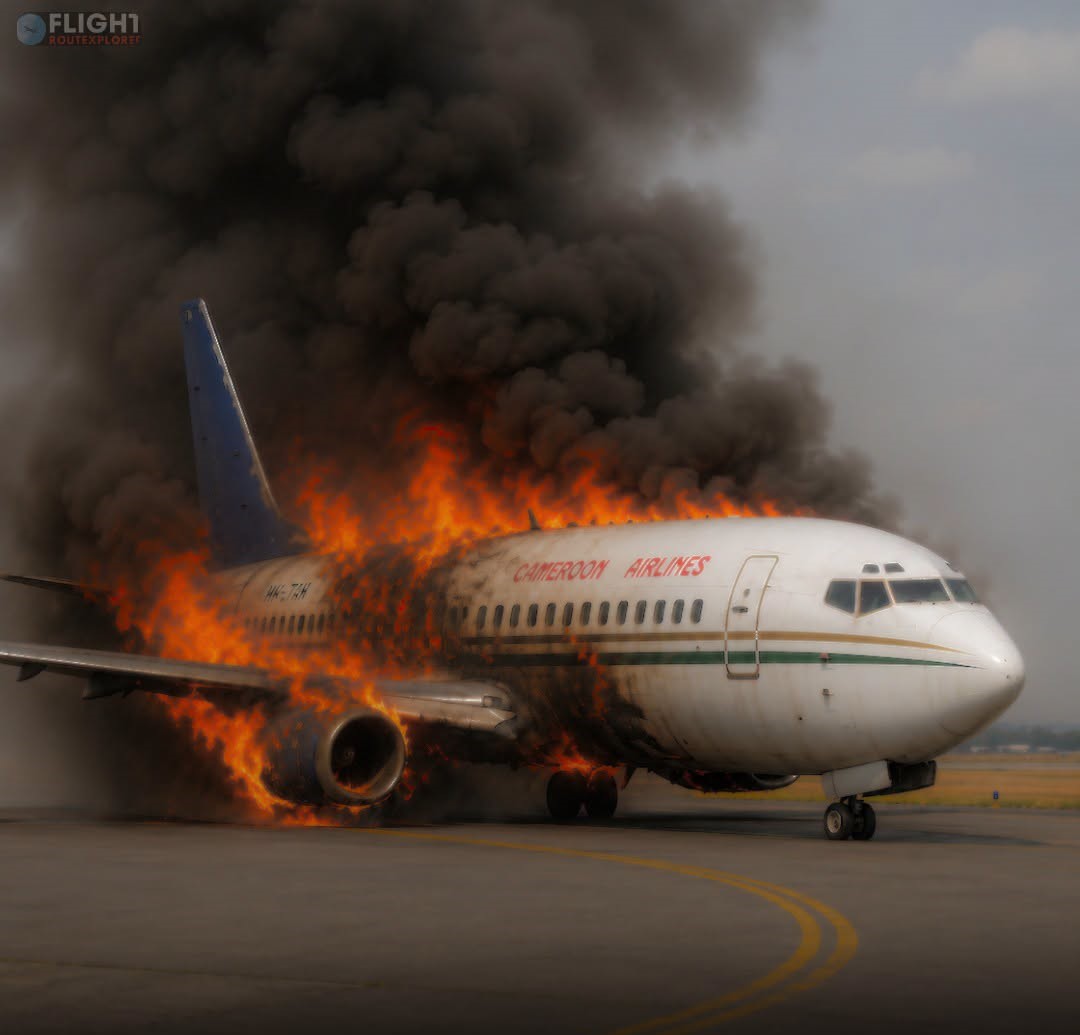
As the aircraft taxied toward the runway, its right-hand No. 2 engine, a Pratt & Whitney JT8D-15, suffered a catastrophic internal failure. A high-pressure compressor disk broke apart inside the engine. The failure was not contained within the engine casing, meaning pieces of the rapidly rotating compressor escaped at enormous speed.
The consequences were devastating because the escaping fragments did not remain confined to the engine area. They struck and damaged the right wing and penetrated the aircraft’s integral fuel tank. A large quantity of fuel consequently began leaking from the damaged tank onto the ground beneath the aircraft.
Then the fuel ignited.
The aircraft was suddenly engulfed by a rapidly developing fire while it was still on the airport surface. There had been no crash in the conventional sense: the Boeing had not fallen from the sky, struck terrain or overrun a runway. The initiating event was an engine failure during taxiing, followed by structural damage to the wing and fuel tank and the ignition of leaking aviation fuel.
The crew stopped the aircraft and an emergency evacuation began. The fact that the aircraft was still on the ground was crucial. Passengers and crew had an opportunity to escape rather than being trapped in an aircraft that had crashed at high speed.
According to the currently documented accident record, all 116 occupants evacuated, but two passengers died as a result of the fire outside the cabin. The aircraft itself could not be saved. The flames consumed the Boeing 737, leaving it completely destroyed and eventually classified as a total loss.
Contemporary reporting initially produced considerable confusion about the number of casualties. A United Press International report published on the day of the accident said early casualty estimates ranged from two dead to 24 people unaccounted for. Initial reports also contained conflicting information about the number of passengers and crew aboard and how many people had been hospitalized.
There was also an early suggestion that the fire might have been caused deliberately. A caller claiming to represent an anti-government organization said that a bomb had been planted on the aircraft. However, investigators and officials subsequently focused on the fuel leak and mechanical failure rather than sabotage. Contemporary reporting said investigators concluded that a fuel leak, rather than a bomb, had caused the fire.
The technical chain of events was particularly significant. The high-pressure compressor disk in the No. 2 engine disintegrated, fragments escaped from the engine, the fragments damaged the right wing and perforated the integral fuel tank, fuel leaked onto the ground and the leaking fuel ignited. This sequence transformed an engine failure into a major aircraft fire.
An important detail from the British Civil Aviation Authority’s later analysis is that there was no impact damage involved in the initial destruction of the aircraft. The report describes the event as a right-engine failure that caused significant damage to the engine and the right wing, with compressor fragments perforating the integral wing tank. The resulting fuel leak ignited and destroyed the aircraft.
The accident therefore demonstrated one of the most dangerous characteristics of an uncontained engine failure. An engine does not necessarily have to lose power completely to create a catastrophic situation. If a component breaks apart and fragments escape the engine casing, those fragments can damage critical aircraft structures, including fuel tanks, hydraulic systems or flight-control components.
In Flight 786’s case, the aircraft was fortunate in one important respect: it was still on the ground and had not yet accelerated to takeoff speed. The crew could stop the aircraft and begin an evacuation. That helped explain why the destruction of the aircraft did not result in the loss of most of the people aboard.
The investigation, however, left an important question unanswered: why did the compressor disk fail in the first place?
The documented accident sequence establishes what happened after the compressor failure, but the precise underlying reason for the compressor failure was never determined. The current accident record explicitly states that the cause of the engine failure has never been established.
That unresolved question became one of the most intriguing aspects of the accident’s aftermath. Years later, retired Cameroon Airlines chief pilot Jean Louis Angounou was quoted discussing the accident and saying that the exact cause had never been established because investigations in Cameroon sometimes began without being completed. His comments were published in an interview originating from a 2009 discussion and republished in 2024.
This means that there is an important distinction between the immediate cause and the deeper cause. The immediate mechanical event is well documented: the high-pressure compressor disk failed and broke apart. The resulting fragments punctured the fuel tank, fuel escaped and caught fire. But the precise reason the compressor disk failed remains unresolved in the available record.
The accident also attracted attention because of the speed with which a seemingly survivable mechanical failure became an aircraft-destroying fire. The aircraft had not crashed, and the passengers were able to evacuate, yet the combination of an uncontained engine failure and a ruptured fuel tank created conditions in which the entire Boeing 737 was consumed.
There is some inconsistency in older contemporary news reports concerning the number of fatalities. A Washington Post report published the following day referred to three deaths, while the later aviation accident databases and the CAA analysis identify two fatal injuries. The Aviation Safety Network’s registration database lists two fatalities, and the British CAA report specifically states that two occupants suffered fatal injuries from the fire outside the aircraft. For that reason, the established aviation-record figure is two fatalities.
The final picture is therefore stark. On 30 August 1984, Cameroon Airlines Flight 786 was taxiing at Douala with 116 people aboard when its right-hand Pratt & Whitney JT8D-15 suffered an uncontained high-pressure compressor failure. Compressor fragments penetrated the right-wing fuel tank, fuel poured out and ignited, and the Boeing 737 was rapidly engulfed by fire. The crew and passengers evacuated, but two passengers died and the aircraft was destroyed.
Perhaps the most curious part of the story is that the accident happened before Flight 786 had even taken off. A catastrophic engine failure that might have become a deadly airborne emergency instead unfolded on the taxiway, giving the people aboard a narrow opportunity to escape. Yet despite extensive examination of the sequence, the fundamental reason the compressor disk failed was never conclusively established.
More than four decades later, Flight 786 remains a striking example of how an aircraft can be destroyed without ever leaving the ground—and how a single internal engine component can turn a routine taxi into a life-threatening emergency within moments.