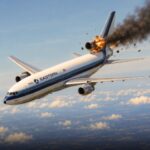

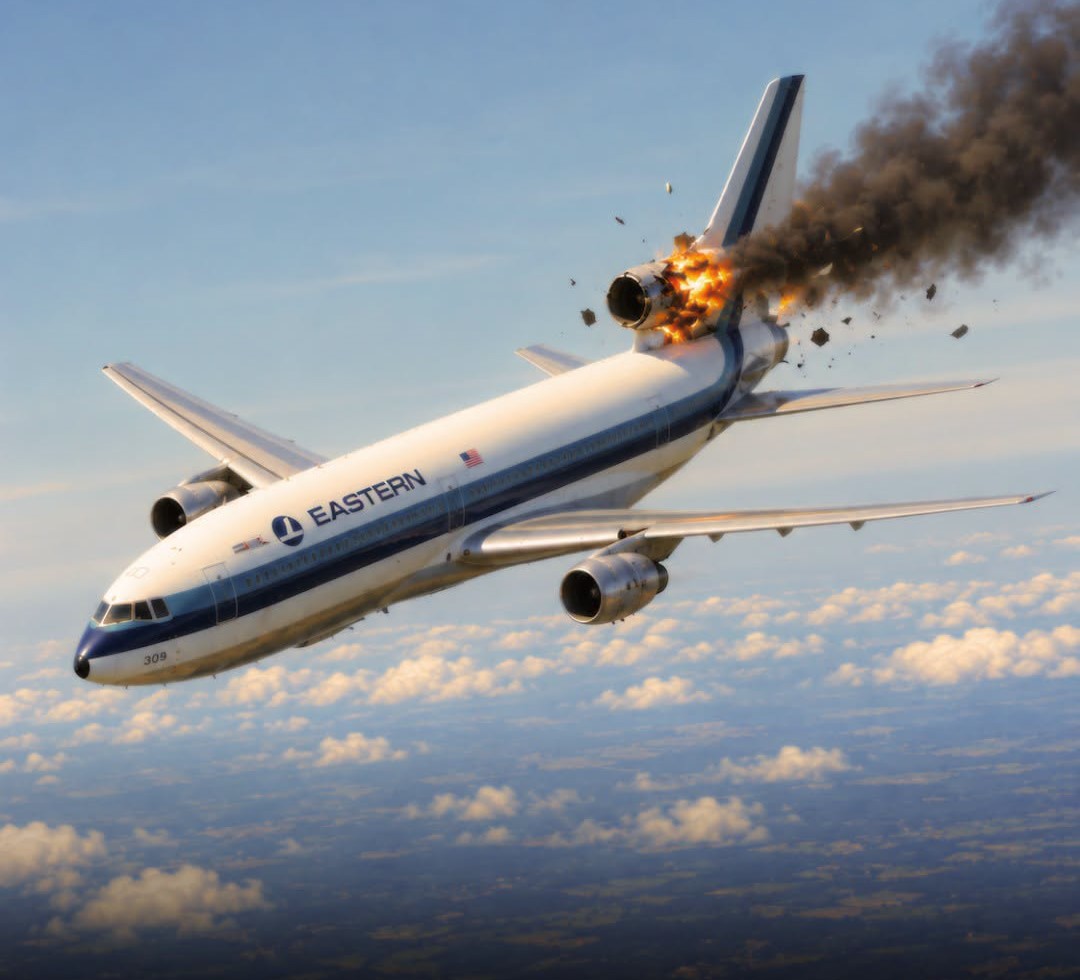
On September 22, 1981, Eastern Air Lines Flight 935 departed Newark International Airport in New Jersey for Luis Muñoz Marín International Airport in San Juan, Puerto Rico, carrying 190 passengers and 11 crew members aboard a Lockheed L-1011 TriStar registered N309EA.
What began as a routine flight quickly became a critical emergency during the climb.
The aircraft took off at about 11:25 a.m. using reduced thrust. At approximately 800 feet, the crew briefly received a vibration warning associated with the No. 2 engine.
The indication disappeared, but the flight engineer noticed unusually high readings from part of the engine’s rotating assembly. Shortly afterward, an oil-filter pressure warning appeared.
The crew reduced power on the engine and monitored it carefully. By 2,000 feet, the engine indications appeared normal, and the crew continued climbing.
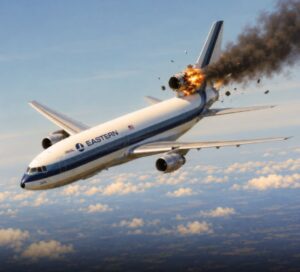
As Flight 935 passed through approximately 10,000 feet, the situation suddenly changed. The crew heard and felt a powerful explosion accompanied by severe aircraft buffeting. Numerous warning and caution lights illuminated almost simultaneously.
The No. 2 engine had suffered a catastrophic failure, and hydraulic systems A, B and D were lost at the same time.
The loss of three hydraulic systems was particularly serious because the L-1011 relied on hydraulically powered flight controls. The failure also jammed the captain’s and first officer’s rudder pedals in the neutral position.
With much of the aircraft’s normal control capability compromised, the crew immediately declared an emergency and requested to divert to John F. Kennedy International Airport in New York.
The crew began an emergency descent and dumped approximately 48,000 pounds of fuel to reduce the aircraft’s landing weight. Despite the extensive loss of hydraulic power, the pilots were able to retain limited control using the remaining flight-control functions, including portions of the spoilers, ailerons and horizontal stabilizer. They also used differential thrust from the two surviving engines to help control the aircraft.
At 12:12 p.m., Flight 935 touched down safely on Runway 22L at JFK. The aircraft was substantially damaged, but none of the 201 people aboard were killed or injured. There was also no injury or property damage on the ground.
The subsequent investigation by the National Transportation Safety Board revealed that the No. 2 Rolls-Royce RB211-22B engine had suffered a catastrophic internal failure.
The investigation determined that inadequate lubrication caused excessive heat to build up in the engine’s low-pressure location bearing. The bearing deteriorated and failed, allowing lubricating oil to enter the fan-shaft area, where it ignited.
The resulting fire overheated the fan shaft and fan fail-safe shaft. Both eventually failed, allowing the engine’s fan module to move forward and break apart. The displacement of the fan module caused extensive damage that severed or disabled hydraulic systems A, B and D and also affected the rudder-control system.
Although Flight 935 is sometimes described as a crash, it did not crash. It was a serious in-flight accident involving an uncontained engine failure, followed by a successful emergency landing. The incident demonstrated how quickly a single engine failure could overwhelm multiple aircraft systems—and how the crew’s handling of a severely degraded aircraft could prevent a potentially catastrophic outcome.
The damaged L-1011 was repaired and returned to service. It continued flying with Eastern until 1988, was later sold to Air Transat and eventually scrapped in 2001. Flight 935 remains a notable example of an airliner surviving a major engine failure that simultaneously eliminated three of its four hydraulic systems.