
12 Lives Lost in Seconds: NTSB Releases Preliminary Findings in Fatal Missouri Skydiving Plane Crash
The National Transportation Safety Board (NTSB) has released its preliminary investigation into the devastating June 14, 2026, crash of a Pacific Aerospace 750XL skydiving aircraft near Butler Memorial Airport in Missouri, offering new insight into one of the deadliest skydiving aviation accidents in recent years. The tragedy claimed the lives of the pilot and all 11 skydivers on board.
The aircraft, operated by Skydive Kansas City, was conducting its third parachute jump flight of the day after successfully completing two earlier missions without incident. The pilot had performed a normal preflight inspection, checked weather conditions, and documented wind speeds at various altitudes before beginning operations. The aircraft was also refueled shortly before the accident, with fuel quality checks showing no signs of contamination.
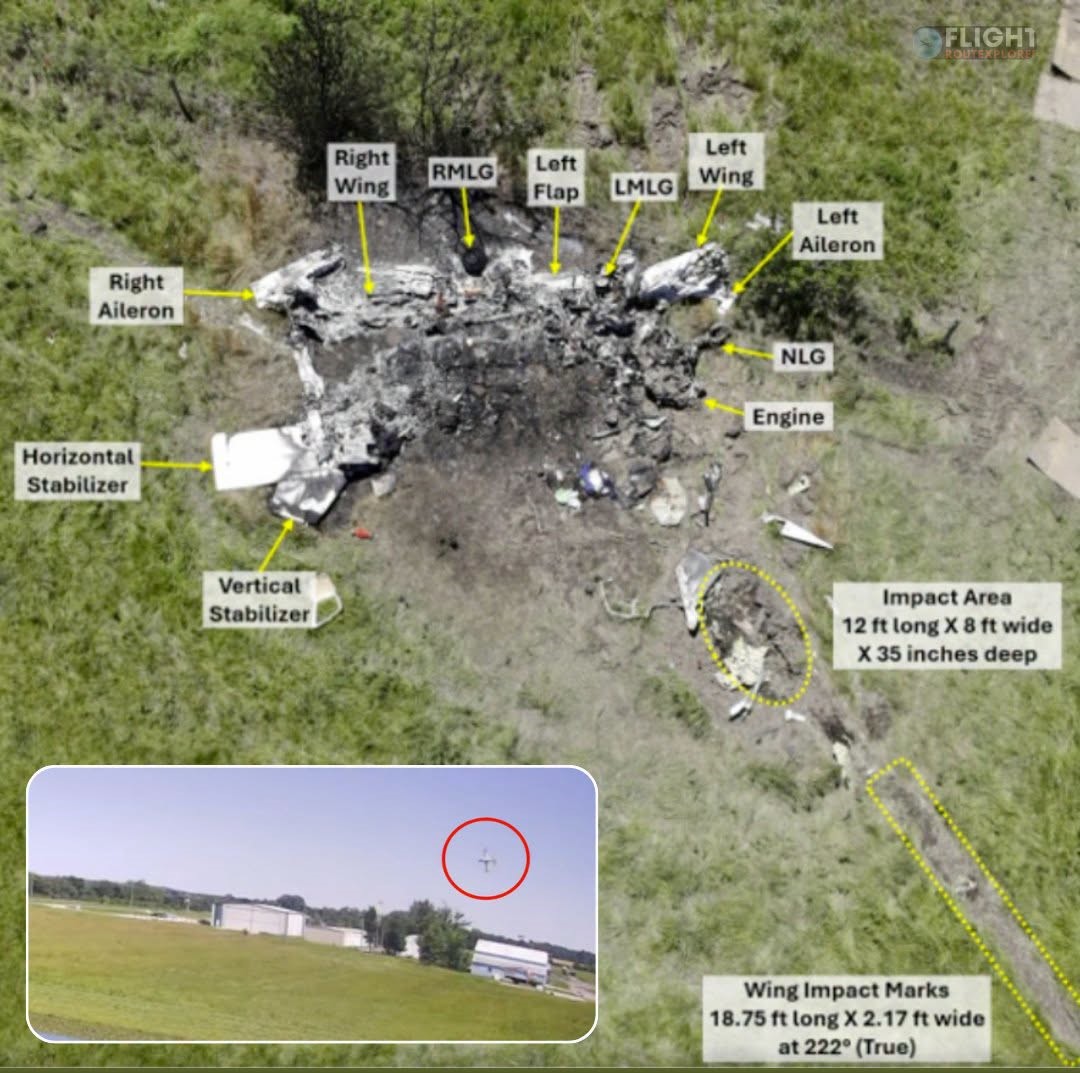
At approximately 11:25 a.m., the aircraft departed Butler Memorial Airport and began its initial climb. Security camera footage captured the aircraft making a gradual left turn shortly after takeoff. The turn continued to tighten until the aircraft reached an extremely steep bank, with its wings nearly perpendicular to the ground. Moments later, it entered a nose-down descent and crashed into a grassy field only a few hundred feet from the airport’s designated skydiving landing zone. A massive post-impact fire engulfed the wreckage, leaving no survivors.
Investigators found no evidence that the aircraft suffered an engine failure before impact. Examination of the Pratt & Whitney PT6A-34 turboprop engine showed it was producing power when the aircraft struck the ground, and investigators found no pre-impact mechanical malfunctions that would have prevented normal operation.
The investigation also determined that the aircraft was operating within its certified weight and balance limits. Fuel samples collected before and after the accident were clean, eliminating fuel contamination as an early area of concern. Despite extensive fire damage, investigators recovered all major structural components of the aircraft, while flight control cables have been sent for detailed laboratory examination.
Several damaged GoPro cameras recovered from the wreckage are also being analyzed in hopes they may provide crucial evidence about the aircraft’s final moments. Investigators are examining flight control systems, trim settings, and other components to determine what caused the aircraft to lose control so soon after takeoff.
Weather conditions at the time of the accident were favorable, with clear skies, excellent visibility, and only light northerly winds, suggesting the crash was not caused by adverse weather.
The pilot was an experienced commercial aviator with more than 4,100 flight hours and was described by the operator as safety-conscious and conservative in his decision-making. He had previously flown both Cessna 182 and Cessna 208 aircraft during earlier jump seasons without reported concerns.
The report also highlights a broader aviation safety issue. Skydiving flights conducted under Part 91 regulations are not required to carry cockpit voice recorders or flight data recorders, nor do operators require FAA-issued operating certificates or FAA-approved training programs. As a result, investigators must rely heavily on physical evidence, surveillance footage, and recovered electronic devices to reconstruct the accident sequence.
The NTSB emphasized that this is only a preliminary report and no probable cause has been determined. The investigation remains ongoing as specialists continue analyzing recovered components and electronic evidence to understand what led to the catastrophic loss of control.