
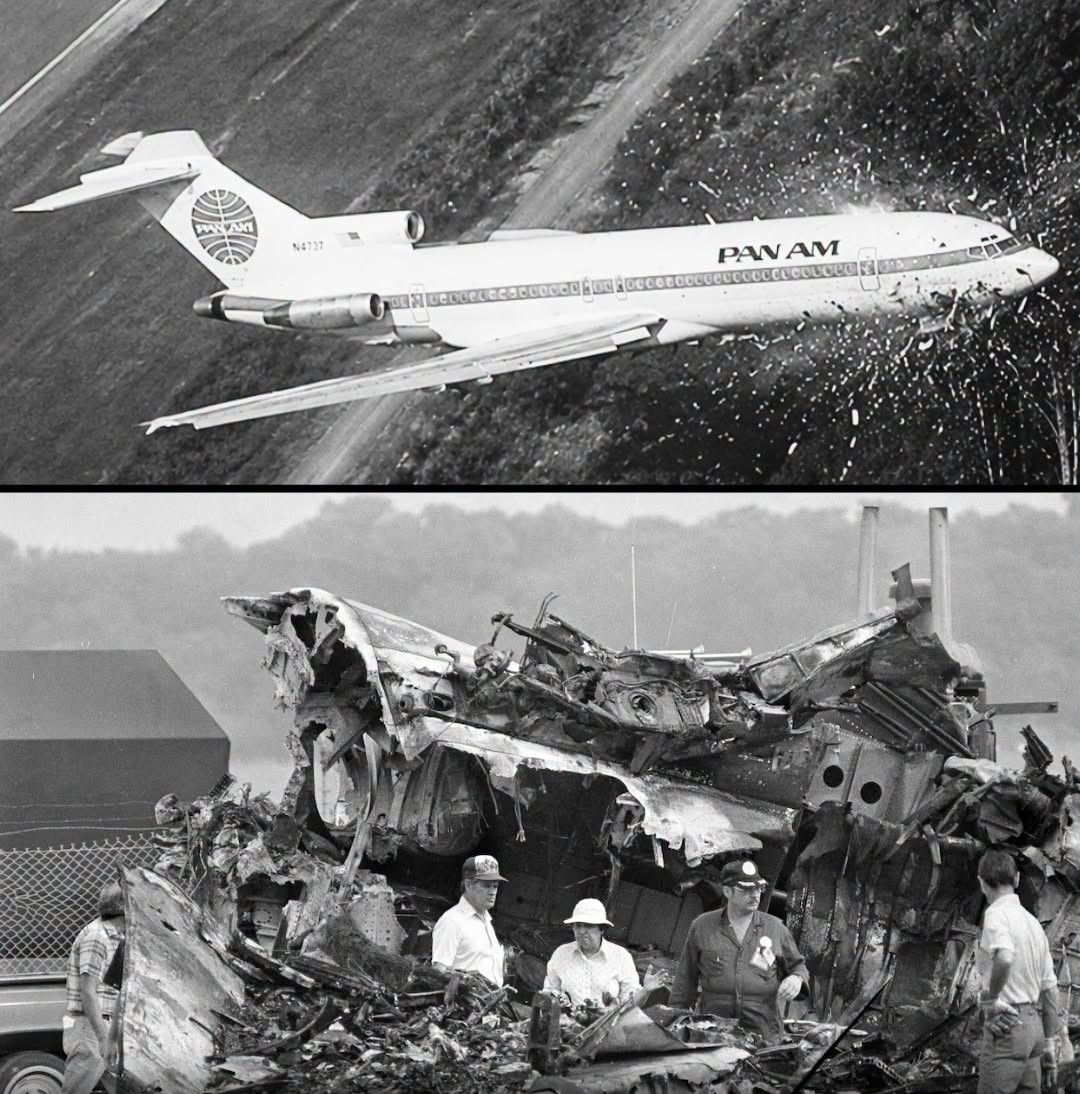
On July 9, 1982, what should have been a routine domestic flight turned into one of the deadliest aviation disasters in Louisiana’s history. Pan American World Airways Flight 759, a Boeing 727-235 operating from Miami to Las Vegas with a scheduled stop in New Orleans, crashed moments after departing New Orleans International Airport (now Louis Armstrong New Orleans International Airport).
The tragedy claimed the lives of all 145 people aboard the aircraft and eight people on the ground, making a total of 153 fatalities. The accident forever changed how the aviation industry detects and responds to one of the most dangerous weather phenomena known to pilots: microburst-induced wind shear.
Flight 759 arrived in New Orleans as part of its scheduled journey from Miami before preparing for its next leg to Las Vegas. During the afternoon, thunderstorms had begun developing around the airport, a common occurrence during Louisiana’s humid summer months.
While the weather appeared challenging, it did not initially seem severe enough to halt flight operations. However, hidden inside one of the storm cells was an intense and rapidly developing microburst that neither pilots nor controllers fully understood at the time.
As the crew prepared for departure from Runway 10, the weather began changing rapidly. Initially, surface winds were reported as light, but conditions deteriorated within minutes. While Flight 759 was taxiing, air traffic controllers advised another aircraft that the airport’s Low-Level Wind Shear Alert System (LLWAS) had detected wind shear in part of the airport area. The Pan Am crew heard these transmissions over the radio.
Concerned about the changing conditions, the first officer requested an updated wind report. Controllers advised that winds had shifted dramatically, blowing from the east-northeast at 17 knots with gusts reaching 23 knots.
They also informed crews that wind shear alerts had appeared across all quadrants of the airport and remarked that the airport seemed to be “right in the middle of everything.” The captain responded by instructing the crew to allow the aircraft to accelerate to a higher airspeed during takeoff and switched off the air conditioning packs, allowing maximum engine thrust for departure.
Just moments before Flight 759 entered the runway, another aircraft landing at New Orleans reported experiencing wind shear about 100 feet above the ground during its final approach. Despite the warning, the full severity of the developing microburst was still unknown because existing weather detection technology could not precisely identify the location or intensity of the dangerous winds affecting the departure path.
At approximately 4:07 p.m. local time, Flight 759 began its takeoff roll. The Boeing 727 accelerated normally and rotated into the air. Initially, everything appeared routine as the aircraft climbed to between 95 and 150 feet above the ground.
Within seconds, the situation changed catastrophically.
The aircraft first encountered a strong headwind that briefly improved its lift. Almost immediately afterward, it flew into the core of a microburst where a powerful downdraft forced air downward while the headwind rapidly transformed into a decreasing headwind and eventually a tailwind. The sudden loss of lift dramatically reduced the aircraft’s climb performance at the exact moment it had the least altitude and the least time to recover.
The Boeing 727 stopped climbing and began descending despite the crew’s attempts to maintain flight. The aircraft struck a line of trees approximately 2,376 feet beyond the end of the runway while still about 50 feet above the ground. It continued through the trees before crashing into a residential neighborhood in Kenner, roughly 4,610 feet beyond the runway’s end. The impact destroyed numerous homes before the aircraft erupted into a massive explosion and fireball.
The devastation on the ground was immense. Entire houses were destroyed or heavily damaged, vehicles caught fire, and debris was scattered across multiple city blocks. Residents rushed to help, but the intense post-crash fire made rescue efforts nearly impossible. All 145 passengers and crew members lost their lives, along with eight residents on the ground. Several others suffered serious injuries, while many families lost their homes in addition to loved ones. The crash remains one of the worst disasters ever to strike the New Orleans metropolitan area.
Investigators from the National Transportation Safety Board immediately launched an extensive investigation involving meteorologists, flight performance specialists, air traffic control experts and aircraft engineers. The aircraft itself showed no evidence of mechanical failure before the crash. Both engines were producing power, and there were no indications of structural problems or system malfunctions that could have prevented normal flight.
The investigation concluded that the primary cause of the accident was the aircraft’s encounter with a microburst-induced wind shear during liftoff and initial climb. The intense downdraft combined with the rapidly decreasing headwind caused such a severe loss of lift that the pilots had little chance of recognizing the danger and responding quickly enough before the aircraft struck the trees. Investigators also determined that the limited capability of the airport’s wind shear detection technology contributed to the disaster because it could not provide controllers and pilots with clear, real-time information about the exact hazard developing along the departure path.
The investigation further revealed significant shortcomings in aviation weather services at the time. Although wind shear alerts had been transmitted, the available equipment could only indicate that wind conditions were changing somewhere around the airport. It could not pinpoint where the dangerous microburst was located or how severe it had become. Weather information available to the crew was also limited by the technology of the era, making it difficult to accurately assess the rapidly changing conditions during departure.
The tragedy became a major turning point in aviation safety. The Federal Aviation Administration accelerated research into microbursts and low-level wind shear, leading to the widespread installation of improved Low-Level Wind Shear Alert Systems and Terminal Doppler Weather Radar at major airports. New pilot training programs were introduced to teach flight crews how to recognize and escape wind shear encounters during takeoff and landing. Modern commercial aircraft were also equipped with predictive and reactive onboard wind shear warning systems capable of alerting pilots before or during hazardous encounters.
The Kenner disaster, together with several other wind shear accidents during the 1980s, fundamentally reshaped aviation weather safety around the world. Today, pilots routinely receive detailed wind shear warnings, controllers have access to sophisticated Doppler radar data, and airports can suspend departures whenever dangerous microburst conditions are detected. These advancements have significantly reduced the likelihood of another tragedy like Pan Am Flight 759.
More than four decades later, the crash remains deeply remembered in Louisiana. Memorials honor the 153 victims, while the lessons learned from that invisible storm continue to protect millions of airline passengers every year. The legacy of Pan Am Flight 759 lives on not only through remembrance, but through the countless lives saved by the safety improvements that followed one of aviation’s most devastating weather-related disasters.