
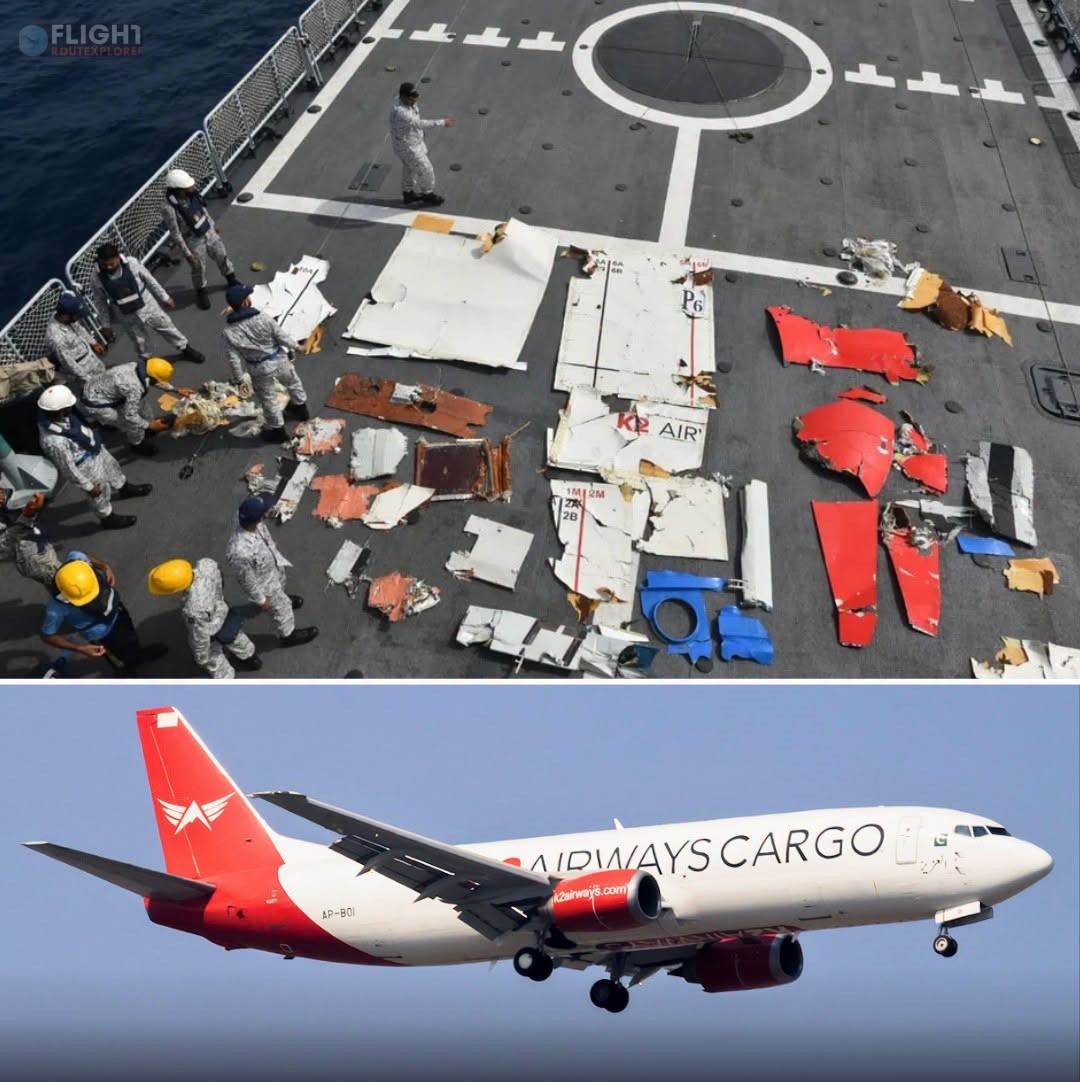
Pakistan’s July 7 K2 Airways cargo plane crash has entered a critical phase as the families of the five crew members are urging authorities to seek international assistance to recover the aircraft’s flight recorders from the Arabian Sea. They say finding the cockpit voice recorder and flight data recorder is essential to uncovering what happened during the aircraft’s final moments and to ensure a transparent investigation.
The Boeing 737 freighter crashed into waters nearly 3,000 meters (9,800 feet) deep while flying from Sharjah, United Arab Emirates, to Karachi, Pakistan. Although floating debris was recovered shortly after the accident, locating and retrieving the black boxes from such extreme depths would require specialized deep-sea equipment and expertise that Pakistan may not possess on its own. Aviation experts say a recovery mission would likely need assistance from foreign governments or companies experienced in deepwater aircraft investigations.
Families of the crew have expressed concern over the lack of public updates regarding the search. Captain Rizwan Idris’ son, Yashib Rizwan, said the search must continue using every available resource, both locally and internationally, emphasizing that a transparent investigation is the only way to provide answers. Similar appeals have been made by the family of flight engineer Muhammad Arif Siddiqui, who believe international support should be requested if necessary.
Time is becoming a major concern because the underwater locator beacons attached to the flight recorders are designed to transmit acoustic signals for only about 30 days after a crash. With every passing day, the chances of detecting those pingers become smaller, making the search significantly more difficult.
Investigators are also examining reports of a navigational system problem shortly before the accident. According to Pakistan’s airports authority, the pilots reported a navigation system issue at 9:18 p.m. local time. Air traffic controllers attempted to assist the crew, but within three minutes radar showed the aircraft descending rapidly before communication was lost.
Flight tracking data revealed an unusual sequence during the aircraft’s final moments. The freighter reportedly lost around 5,000 feet in less than a minute, briefly climbed approximately 6,000 feet in about 30 seconds, and then entered a catastrophic dive from an altitude of more than 36,000 feet before crashing into the sea.
Attention has also focused on recent maintenance performed in Sharjah. The aircraft had remained there for about 10 days while awaiting a replacement part from the United States following a maintenance issue. According to the captain’s family, one of the aircraft’s Inertial Reference Units (IRU), a critical component that provides position, speed, and attitude information to cockpit instruments, had been replaced before the flight. Aviation experts caution that while an IRU malfunction can seriously affect flight operations, especially during night flights over the ocean with few visual references, it is far too early to conclude that the replacement played any role in the crash. Aircraft accidents are typically caused by multiple contributing factors, making the recovery of the flight recorders vital.
The situation has drawn comparisons to previous deepwater investigations such as Air France Flight 447 in 2009 and Adam Air Flight 574 in 2007. In both cases, international cooperation and sophisticated underwater search technology were required to locate and recover the black boxes from the ocean floor, providing investigators with crucial evidence that ultimately explained the causes of the accidents.
For the families, recovering the flight recorders is about more than determining the technical cause of the crash. It is about ensuring accountability, preserving confidence in aviation safety, and giving loved ones the answers they have been desperately waiting for.