



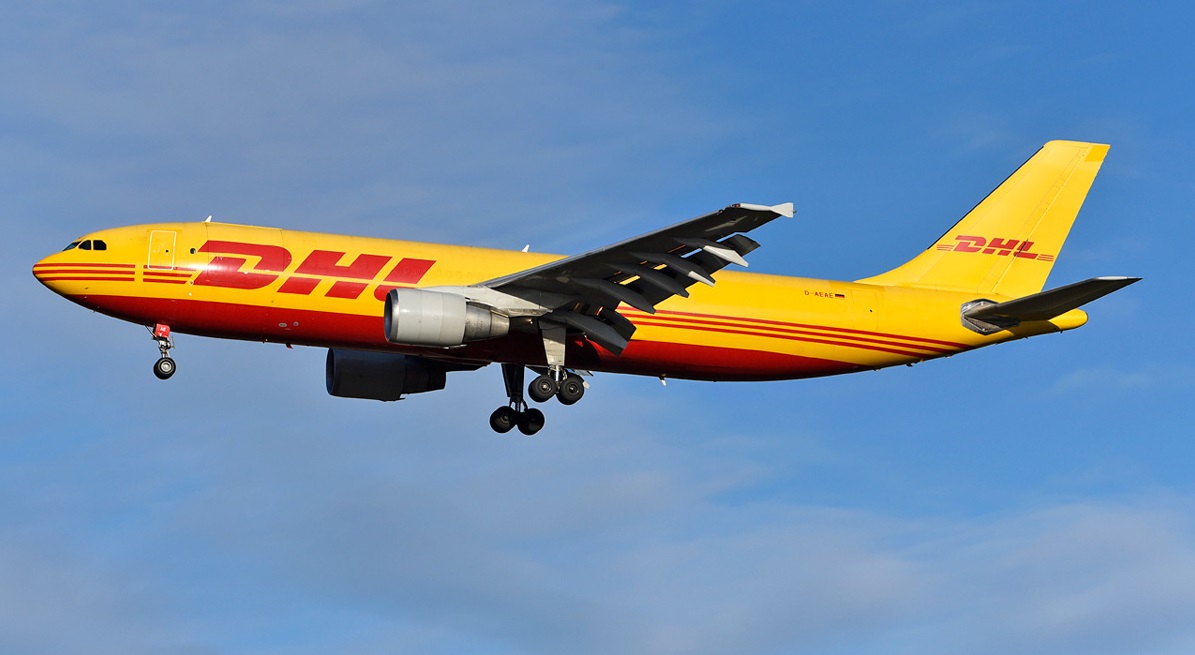
Nov 26th 2020 : An EAT Leipzig–operated Airbus A300-600 freighter flying on behalf of DHL was involved in a serious incident during takeoff from Brussels, resulting in a prolonged runway closure and a multi-year investigation that ultimately traced the event to an incorrect pitch trim setting.
The aircraft, registered D-AEAI, was operating flight QY-841 from Brussels, Belgium, to Vitoria, Spain. At approximately 18:11 local time (17:11 UTC), the aircraft was accelerating for takeoff from runway 25R.
During the takeoff roll, at a high speed of around 150 knots, the crew initiated a rejected takeoff. The decision was taken during rotation, at a point when the nose gear had already lifted off the runway. The aircraft decelerated heavily, applied reverse thrust, and came to a stop approximately 360 meters (1,200 feet) short of the runway end, around 2,920 meters (9,600 feet) from the start of the takeoff roll.
As a consequence of the intense braking, eight main landing gear tyres deflated, leaving the aircraft disabled on the runway. Airport emergency services responded immediately and attended to the aircraft. There were no injuries reported.
Runway 25R remained unavailable for more than 10 hours, reopening at approximately 04:31 local time (03:31 UTC) the following morning. Brussels Airport announced that during the closure, runway 19 was used for departures and runway 25L for landings, significantly affecting airport operations overnight.
Belgium’s Air Accident Investigation Unit (AAIU) classified the occurrence as a serious incident and opened a formal investigation, with Germany’s BFU assisting as the state of registry in accordance with ICAO Annex 13.
Initial statements from the airline indicated that the crew experienced difficulties becoming airborne, prompting the rejected takeoff. At the time of the decision, the crew assessed that the aircraft’s speed was still low enough to safely abort, despite being close to or beyond the decision speed. The airline confirmed that the issue was not related to cargo loading.
Crew reports later confirmed that acceleration during the takeoff roll appeared normal. During rotation, the aircraft’s nose pitched up, but the aircraft did not lift off as expected. Vibrations were also reported shortly before V1, drawing the crew’s attention toward engine parameters and increasing time pressure during the decision-making process.
Subsequent analysis revealed that no technical malfunction was present. Instead, investigators identified an incorrect pitch trim setting as the primary cause.
Standard operating procedures at the operator required the pitch trim to be set to +1.0 units nose-up after landing. However, maintenance actions prior to the flight had resulted in the trim being set to –1.1 units nose-down. The load sheet for departure correctly calculated a required trim of +1.1 units, but the trim wheel itself only displays UP and DN, not positive or negative values.
Both +1.1 and –1.1 units fall within the green band for takeoff, leading the crew to misrecognize the incorrect trim position. Expectation bias also played a role: seeing the trim wheel near “1,” the Pilot Flying assumed it was correctly set nose-up without confirming the direction.
Simulator tests conducted during the investigation demonstrated that pilots encountering this configuration experienced significantly higher control column forces during rotation, and most were not immediately aware of the underlying cause. Despite the abnormal feel, simulations confirmed that successful liftoff was fully feasible, albeit requiring substantially greater pitch force.
Final Conclusions
In its final report, Belgium’s AAIU concluded that the probable causes of the serious incident were:
- The abnormal control column forces during rotation, caused by an inadequate pitch trim setting.
- The pitch trim having been left at 1.1 units nose-down during maintenance, instead of the required nose-up position.
- A maintenance procedural deviation, as the Aircraft Maintenance Manual required the trim to be placed in neutral after operational tests.
- Misrecognition and expectancy bias during checklist execution, leading the crew to overlook the incorrect trim direction.
Investigators also identified as a risk factor the decision to reject the takeoff after V1, categorizing it as an incorrect action selection under high time pressure. Notably, the aircraft was determined to have been airborne for approximately one second at the moment the abort decision was made.
Safety Implications
The incident underscores how human factors, expectation bias, and subtle interface design limitations can combine to defeat multiple safety barriers. While no injuries occurred, the event illustrates the narrow margins involved in high-speed rejected takeoffs and highlights the importance of clear trim indication, rigorous checklist discipline, and alignment between maintenance and flight crew procedures.