
He had already boarded the plane. Then, suddenly, a supervisor approached him and pulled him off.
The reason?
His T-shirt.
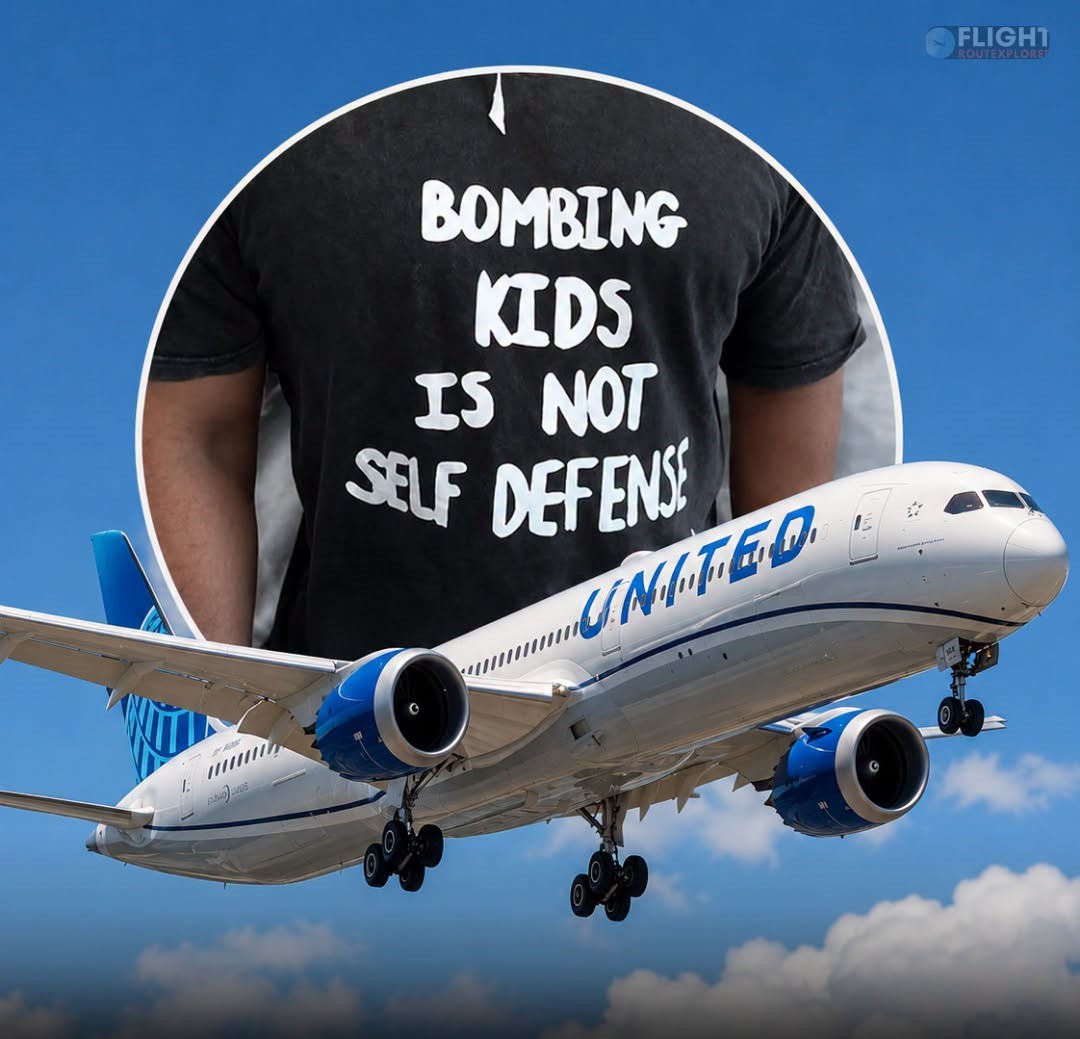
Sam Saadeh, a New Jersey man from Linden, says he was preparing to fly from Atlanta to Newark Liberty International Airport on June 4, 2026, when a United Airlines flight attendant allegedly found the message printed across his shirt “offensive.”
The message read:
“B**bing kids is not self defense.”
What happened next left Saadeh confused, upset and humiliated.
According to him, a supervisor pulled him from the aircraft shortly after boarding and delivered a clear ultimatum.
“Either you change your shirt or you can’t get on this flight.”
Saadeh couldn’t understand why.
“He was like, ‘Hey, the flight attendant finds your shirt offensive,’ and I was like, ‘Why?’”
But with his flight on the line, Saadeh says he eventually changed his shirt.
United allowed him to fly as scheduled.
Yet the controversy didn’t end when the plane landed.
After arriving in Newark, Saadeh approached airline personnel looking for one simple answer: What exactly was offensive about the message?
He claims he still couldn’t get a specific explanation.
“She kept saying, like, ‘You could see how the shirt is offensive.’ I was like, ‘I can’t see how the shirt is offensive.’”
Then Saadeh asked the question now fueling debate over the incident:
“Do you think kids shouldn’t be b**bed, or kids should be b**bed? Like, what are you offended by?”
Saadeh, who is of Palestinian descent, says the message has a deeper meaning for him and is intended to advocate for children.
The incident comes amid intense international debate over civilian deaths in Gaza. A recent United Nations report said more than 20,000 children had been killed, while the Israeli government has rejected allegations that it deliberately targets civilians.
United Airlines has responded with a brief statement:
“This customer flew as scheduled after changing his shirt.”
The airline’s published rules state that passengers may be denied transportation if they are “not properly clothed, or whose clothing is lewd, obscene or offensive.”
But that’s where the controversy gets complicated.
Who decides what is “offensive”?
A flight attendant? The airline? Other passengers?
And can a message opposing the b**bing of children cross that line?
Saadeh has now filed an official complaint with the U.S. Department of Transportation and says he is consulting lawyers.
As for the shirt?
He says he’s going to keep wearing it.
“At the end of the day, this shirt, to me, is very clear that I think b**bing kids is wrong.”
One T-shirt. One flight attendant’s objection. One ultimatum before takeoff.
Now the incident is sparking a much bigger debate.