
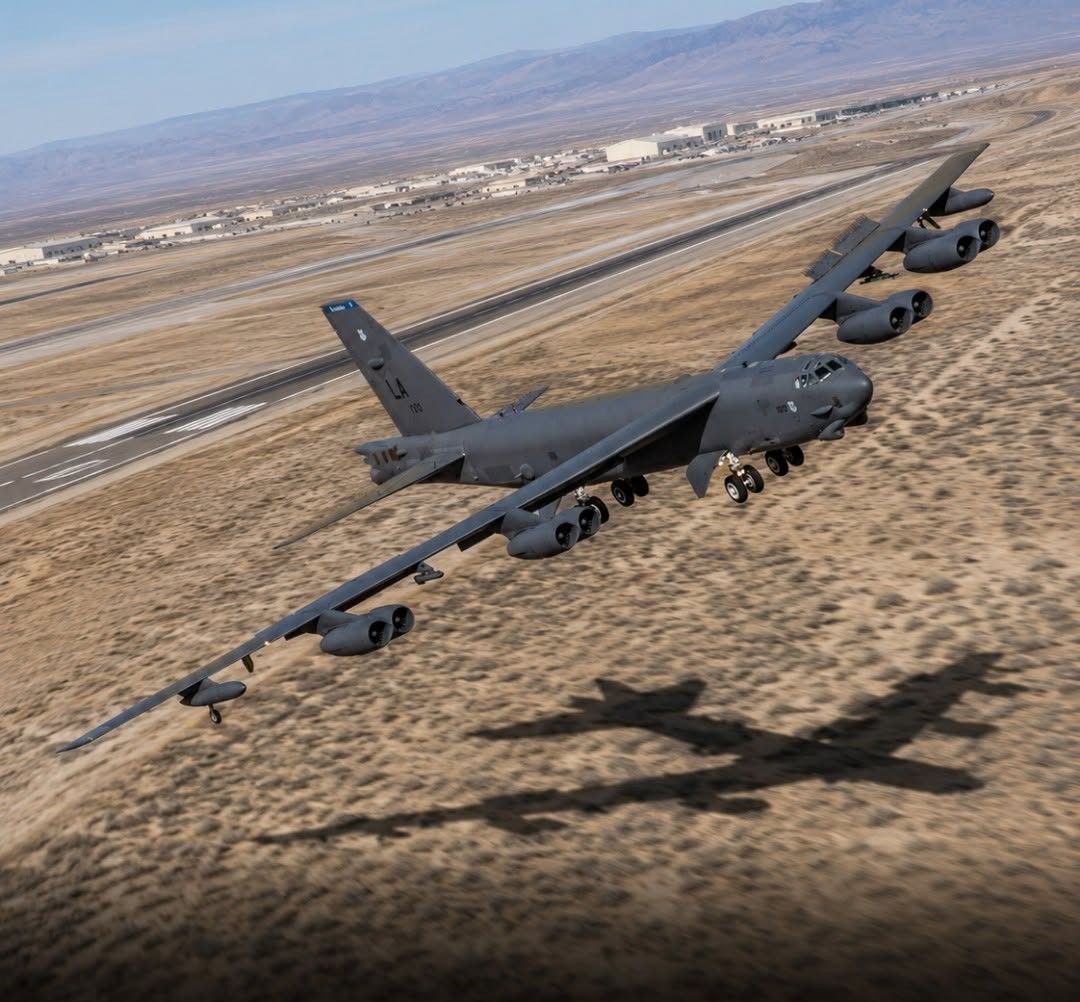
The B-52 involved in a deadly crash during a test flight at an Air Force base in California made a sharp right and then nearly completed a 180-degree turn before plunging to the ground at nearly a mile a minute, limited tracking data shows on Tuesday (June 16, 2026).
All eight people aboard were killed in Monday’s (June 15) fiery crash of the Boeing B-52 Stratofortress, which was taking part in a routine mission as part of an overall programme to keep the long-running aircraft flying for decades to come.
It was not yet clear what caused the plane to crash shortly after takeoff, and officials at Edwards Air Force Base said it could take up to six months to complete the investigation.
The airfield remained closed on Tuesday (June 16). Crews were making the crash site safe for search and recovery teams to enter, after fires flared up overnight, said Mike Paoli, a spokesperson for the 412 Test Wing at Edwards.
The flight tracking that was available on Tuesday (June 16) shows the bomber turning to the northeast right after taking off and nearly completing a sharp turn before crashing on another runway, according to AirNav Systems.
The data that comes from a system called multilateration doesn’t show precise altitude and speed information, but it does show the plane fell to earth at a rate of descent of 5,056 feetper minute — nearly 10 times as fast as a plane normally descends when preparing to land.
The aircraft was supporting a “radar modernisation programme,” Col. James Hayes, the deputy commander for the 412 Test Wing, said on Monday (June 15). In 2025, Boeing sent a B-52 to Edwards with a modernised radar system that is key to keeping the bomber in the air through at least 2050, nearly a century after it first entered service.
A test team planned to conduct ground and flight test activities on the aircraft throughout 2026 to feed a production decision, the Air Force said in a 2025 news release. The modern Active Electronically Scanned Array (AESA) radar system replaced the aircraft’s antiquated radar for efficacy. It was unclear if that was the same aircraft involved in Monday’s (June 15) crash.
AESA replaced 1960s radar technology and offers improved navigation and targeting capabilities, according to a 2023 news release from Raytheon, which designed the new system for the Air Force’s entire B-52 fleet.
The way the B-52 crashed so quickly after takeoff without getting very high or going far makes aviation safety expert Jeff Guzzetti suspect some kind of flight control malfunction.
It’s possible the controls were rigged wrong after maintenance, he said, or a catastrophic engine problem or a failure of a piece of equipment that was being tested.