
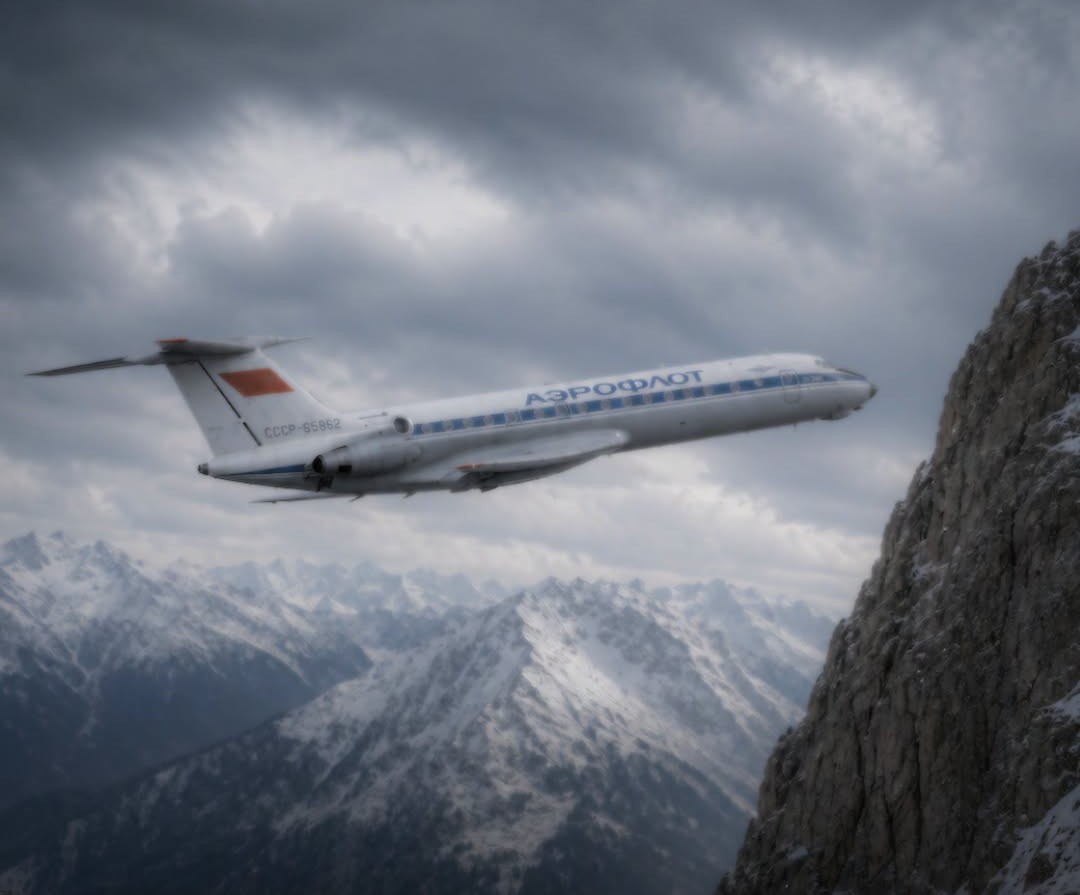
On This Day In 1983: Aeroflot Flight 5463 Flew Toward a Mountain — and the Crew Had Just 23 Seconds to Escape
On 30 August 1983, Aeroflot Flight 5463 was approaching Alma-Ata, the present-day Almaty in Kazakhstan, when a chain of navigation mistakes, unsafe air traffic control instructions and failures in cockpit decision-making placed the aircraft directly over mountainous terrain. The most chilling detail came in the final moments: the aircraft’s ground-proximity warning system sounded about 23 seconds before impact, yet the crew did not immediately begin the emergency climb. By the time they attempted to pull the aircraft upward, there were only one or two seconds left.
Flight 5463 was a scheduled Soviet domestic passenger service operated by Aeroflot’s Kazan division. The aircraft was a Tupolev Tu-134A, registered CCCP-65129, which had been built in 1978. It was flying from Kazan to Alma-Ata with a scheduled stop at Chelyabinsk. On board were 84 passengers, including 16 children, and six crew members.
The aircraft departed Chelyabinsk’s Balandino Airport at about 20:03 local time. It climbed to a cruising altitude of 10,200 metres and initially continued normally. However, problems had already begun before the aircraft reached the Alma-Ata area.
While passing through the control area of Balkhash Airport, the crew incorrectly reported that they had already left the controlled area when they were still about 48 kilometres from its boundary. The controller detected the mistake and corrected it.
More importantly, the crew’s preparation for the approach to Alma-Ata was incomplete. Important information concerning obstacles around the airport, the approach procedure, the altitude for the first turn and procedures for diverting to an alternate airport had not been properly reviewed.
As the aircraft approached Alma-Ata, the crew received instructions concerning its position and was told to proceed toward the third turn of the approach pattern. However, the method of entering the approach that was being used was not part of the approved procedure for the airport.
Then another critical navigation error occurred. The crew was supposed to take a heading of 140 degrees but mistakenly selected 199 degrees instead. The approach controller noticed the deviation and instructed the crew to take the correct 140-degree heading.
The aircraft was then cleared to descend to 2,100 metres.
Another aircraft, an Ilyushin Il-62, was also approaching Alma-Ata. Because of the Tu-134’s deviations from its intended track, the Il-62 eventually moved ahead of it in the approach sequence. Controllers altered the instructions for both aircraft, and the Tu-134 was eventually directed toward the distant outer marker and cleared to descend to 1,800 metres.
At approximately 20:10, the Tu-134 was reported to be 40 kilometres from the airport. Control was transferred to the airport’s circle controller, who instructed the crew to descend toward 900 metres at the outer marker.
Two minutes later, the aircraft was about 24 kilometres from the airport and substantially displaced from the intended approach pattern.
During a right-hand turn toward a heading of 230 degrees, the crew switched off its autonomous navigation system while leaving the lateral channel of the autopilot operating. The aircraft subsequently ended up inside the rectangular approach pattern and only about 4.5 kilometres from the runway centreline.
The crew reported that it was flying a heading of 230 degrees at an altitude of 900 metres. The circle controller instructed it to take a heading of 240 degrees while remaining at 900 metres.
This was when the danger became extreme.
The aircraft was approximately 30.7 kilometres from the runway and about 5 kilometres laterally from the runway centreline. Beneath and ahead of it was mountainous terrain. In this sector, the minimum safe altitude was approximately 4,620 metres.
Despite this, the circle controller instructed the crew to perform the fourth turn and descend to just 600 metres.
The aircraft was therefore being directed to fly thousands of metres below the published minimum safe altitude for the mountainous area.
The crew knew that it was approaching mountainous terrain, but instead of rejecting the unsafe instruction, it continued with the manoeuvre.
The controller then asked the crew to identify its position. The crew replied that it was on a heading of 140 degrees and had reached 600 metres. The controller instructed the aircraft to continue turning toward a heading of 40 degrees.
The Tu-134 was now flying dangerously low over the mountains surrounding Alma-Ata.
At 20:17:02, the aircraft’s ground-proximity warning system activated.
The warning was an unmistakable indication that the aircraft was dangerously close to terrain.
But instead of immediately initiating a climb, the crew spent valuable seconds trying to determine why the warning had activated. The aircraft continued flying toward the mountain.
Approximately 23 seconds after the warning began, the crew finally attempted to climb.
By then, there was almost no altitude remaining to recover.
At approximately 20:17:25, Aeroflot Flight 5463 struck the western slope of Dolan Mountain, about 36 kilometres from Alma-Ata Airport.
The aircraft was travelling at approximately 370 km/h. It struck the mountainside with a relatively shallow flight attitude, rather than diving steeply nose-first into the terrain.
The impact destroyed the aircraft and triggered a fire.
All 90 people aboard were killed: all six crew members and all 84 passengers. There were no survivors and no casualties on the ground.
The weather was not exceptionally poor. Visibility at the accident site was about 10 kilometres. However, it was nighttime, and the aircraft was flying over mountainous terrain. Cumulonimbus clouds were present in the area at significant altitudes, adding to the difficulty of maintaining accurate situational awareness.
The investigation did not identify one single mistake as the cause. Instead, it uncovered a chain of failures involving the flight crew, air traffic controllers and the wider airport operating system.
The crew had not properly completed its pre-approach preparation. It had already made navigation errors earlier in the flight and had incorrectly selected the 199-degree heading instead of 140 degrees. It subsequently found itself outside the prescribed approach pattern.
The circle controller then made an extremely serious error by instructing the aircraft to perform the fourth turn and descend to 600 metres while it was outside the approved approach area and over mountainous terrain.
The minimum safe altitude in that sector was approximately 4,620 metres.
The investigation found that the controller’s instruction to descend to 600 metres was a major factor in the accident.
There was also a failure of supervision on the ground. The acting flight manager responsible for supervising air traffic-control operations did not adequately monitor the controller’s actions, allowing the dangerous sequence of instructions to continue.
The crew’s reaction to the ground-proximity warning was another decisive factor.
The warning gave the pilots roughly 23 seconds in which to respond. Had an immediate emergency climb been initiated, the outcome might have been different. Instead, the pilots initially tried to understand the warning rather than immediately treating it as a terrain emergency.
When the climb was finally initiated, only a second or two remained before impact.
The investigation also identified broader organizational and procedural weaknesses.
The crew’s knowledge of the Alma-Ata area and its surrounding obstacles was considered insufficient. The controller’s knowledge of the terrain was also inadequate. Radio communication procedures and phraseology were not consistently followed, while navigation and approach systems were not used effectively enough to maintain a reliable picture of the aircraft’s actual position.
The airport’s operational documentation also had shortcomings. The boundaries of the takeoff and landing zones were not clearly defined, and the list of obstacles in the airport’s operating instructions was incomplete.
These weaknesses were particularly dangerous at Alma-Ata because the airport was surrounded by mountainous terrain. Maintaining strict altitude and approach-path discipline was essential.
The final investigation therefore did not simply conclude that the pilots “flew into a mountain.” The crash was the result of a cascading breakdown in several layers of aviation safety.
The aircraft deviated from its prescribed approach.
The crew made navigation and procedural mistakes.
Air traffic control issued an unsafe descent instruction.
The aircraft was allowed to continue toward mountainous terrain at an altitude dramatically below the safe minimum.
Supervisory personnel failed to intervene.
And when the aircraft’s terrain-warning system finally issued an emergency warning, the crew did not react immediately.
The disaster was therefore a classic example of controlled flight into terrain. The aircraft remained capable of flying, but the flight crew and air traffic-control system lost sufficient awareness of where the aircraft was in relation to the surrounding terrain.
The tragedy of Flight 5463 is particularly striking because there were multiple opportunities to prevent the crash.
The aircraft was not suffering from a catastrophic mechanical failure. The weather did not make the approach impossible. The pilots had a functioning ground-proximity warning system. Regulations allowed the crew to reject a controller’s instruction if they believed it endangered the aircraft. Air traffic controllers had the responsibility to keep the aircraft within a safe approach path.
Yet one error followed another.
A navigation mistake placed the aircraft away from its intended track. An unconventional approach sequence compounded the problem. An unsafe descent instruction put the aircraft dangerously close to the mountains. The crew accepted the instruction instead of challenging it. Ground supervision failed to correct the situation. Finally, the terrain warning came too late for the delayed reaction to save the aircraft.
At 20:17:25 on 30 August 1983, the chain of errors ended when the Tupolev Tu-134A struck Dolan Mountain.
Ninety people died.
What makes Aeroflot Flight 5463 especially haunting is that the final warning came with enough time to potentially change the outcome. The ground-proximity warning system sounded approximately 23 seconds before impact. But those seconds disappeared while the crew tried to understand what was happening.
By the time they finally pulled up, the mountain was already almost directly ahead.
The crash became a stark example of how aviation disasters can develop without a single catastrophic failure. Instead, a series of seemingly manageable mistakes can progressively remove one safety barrier after another until there is no time left to recover.