

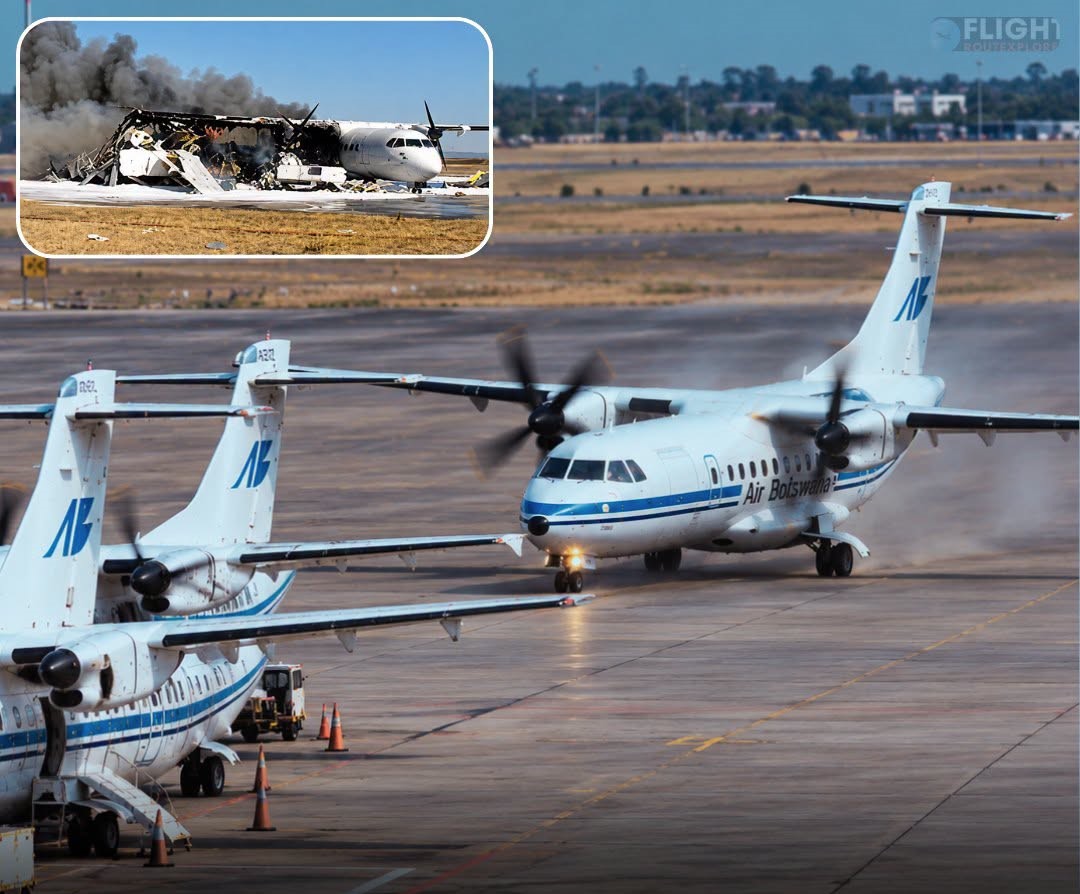
On October 11, 1999, a shocking incident at Sir Seretse Khama International Airport in Gaborone, Botswana, devastated the national airline’s fleet after a pilot deliberately crashed a stolen passenger aircraft into two parked airliners.
The incident killed one person, the pilot himself, but left Air Botswana facing a major operational crisis.
The aircraft was an ATR 42-320, registration A2-ABB, manufactured in 1988 and powered by two Pratt & Whitney Canada PW121 turboprop engines. The pilot, Chris Phatswe, was an Air Botswana employee who had been placed on medical leave after failing a physical examination approximately two months earlier.
He had been declared medically unfit to fly and was not authorised to operate the aircraft.
In the early morning, Phatswe gained access to the parked turboprop and took off without permission. Instead of following a scheduled route, he circled the airport for approximately two hours, communicating with air traffic control and repeatedly expressing his intention to kill himself.
The alarming situation prompted authorities to evacuate the airport terminal as a precaution, while officials attempted to persuade him to land safely.
During the airborne standoff, Phatswe threatened to crash into an Air Botswana building, reportedly citing a grievance against the airline’s management. He demanded to speak with Ian Khama, Botswana’s then vice-president.
Negotiations were led by officials including General Tebogo Masire, then deputy commander of the Botswana Defence Force. When Phatswe was informed that people were inside the threatened building, he changed his stated plan.
As the aircraft’s fuel began running low, Phatswe eventually landed successfully. However, the crisis was far from over. Rather than surrendering to airport security, he taxied the aircraft at high speed towards the parking apron, deliberately driving it into two other Air Botswana ATR 42-320 aircraft, registrations A2-ABC and A2-AJD.
The collisions caused catastrophic damage, and all three aircraft were destroyed. Phatswe died in the incident, while no other fatalities were reported.
The circumstances pointed to deliberate action rather than a conventional mechanical failure or loss of control. Accounts of the incident highlighted Phatswe’s medical grounding, reported grievances and repeated suicide threats.
Airport security was also criticised as reportedly inadequate, raising serious questions about how an unauthorised pilot could access and take off in an airliner.
The consequences were severe. The three destroyed ATR 42s were Air Botswana’s only operational aircraft at the time. Its fourth aircraft, a BAe 146, was already grounded because of technical problems.
The destruction of the turboprops effectively crippled the national carrier’s operations, turning a single pilot’s deliberate act into one of the most extraordinary incidents in Botswana’s aviation history.










