

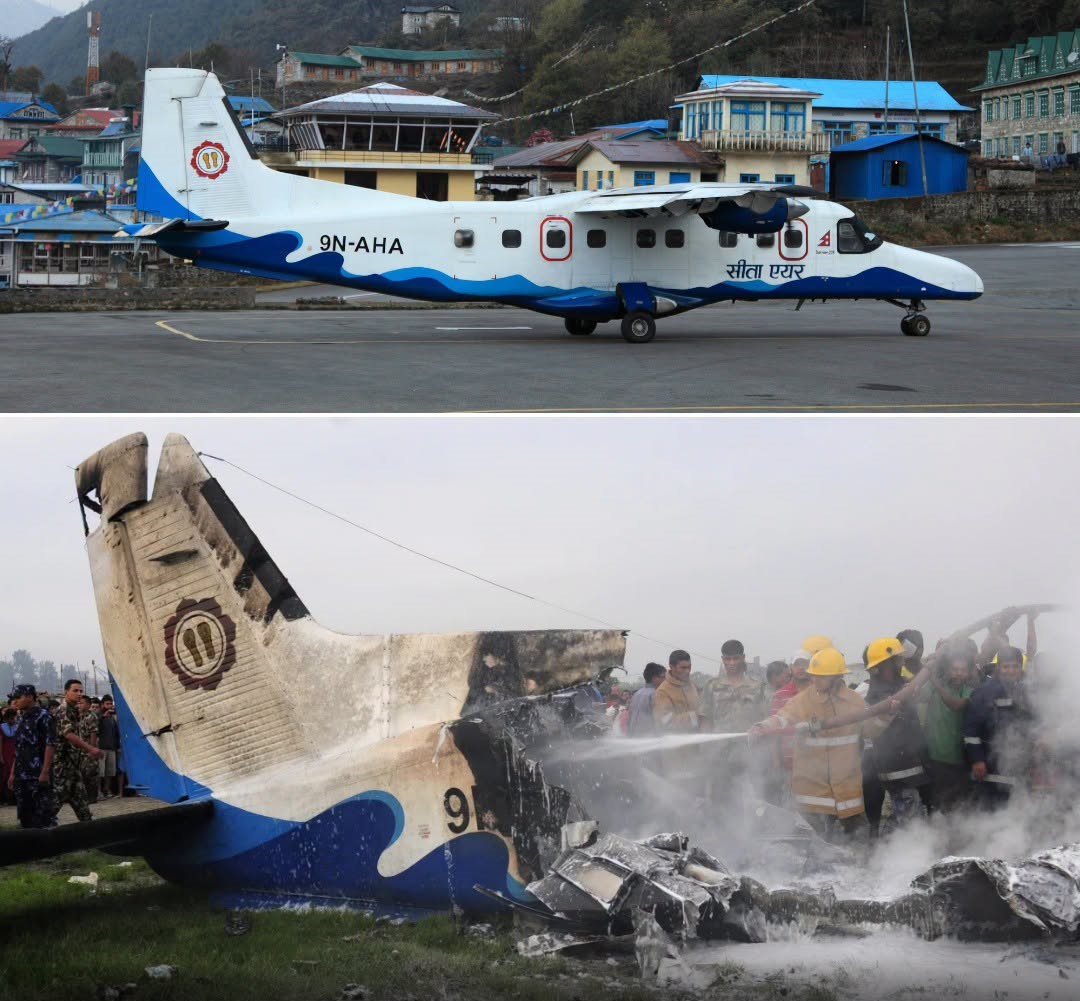
On September 28, 2012, Sita Air Flight 601 was preparing for a short domestic journey from Tribhuvan International Airport in Kathmandu to Lukla, carrying 16 passengers and three crew members.
The Dornier 228, registered 9N-AHA, departed at about 6:17 a.m. in good weather, but within seconds the routine flight turned into a desperate emergency.
During the takeoff roll, the aircraft suffered a progressive reduction in available thrust. Investigators later determined that the power loss began at around 70 knots, below the aircraft’s calculated V1 speed of 83 knots.
The crew apparently did not recognize the developing problem and continued the takeoff. The aircraft finally became airborne at about 86 knots, but its speed began falling almost immediately.
At roughly 50 feet above the ground, the crew reported technical problems and indicated that the aircraft may have been affected by a bird strike.
The aircraft climbed only to about 100 feet before losing the ability to maintain safe airspeed. Stall warnings sounded as the speed dropped through the high-60-knot range. The aircraft began turning left, descended rapidly and eventually departed controlled flight.
Flight 601 crashed approximately 420 metres beyond the runway area near the Manohara River. The Dornier struck the ground and caught fire, destroying much of the forward fuselage.
Rescue teams, soldiers and local residents rushed toward the wreckage, but the severity of the impact and post-crash fire left no survivors. All 19 people aboard were killed, including seven British, five Chinese and seven Nepali nationals.
The early investigation focused heavily on a bird strike. A black kite was found near the runway and evidence indicated that a bird had been struck by the propellers. CCTV footage also captured a flash near the right engine.
However, investigators found no bird remains inside either engine and no evidence that either engine had completely failed.
The final investigation produced a more complicated picture. Both engines were still producing some power, but the aircraft was unable to generate enough thrust to maintain flight.
The investigation found that the power reduction was gradual and therefore may not have been recognized by the crew in time. The aircraft’s speed fell below V2 after takeoff, while its low altitude left virtually no margin for recovery.
Investigators also found discrepancies in the aircraft’s recorded loading. About 80 kilograms of luggage had been loaded despite the load sheet stating that no luggage was carried.
The aircraft was therefore heavier than declared, although investigators concluded that the loading discrepancy alone could not explain the severe loss of performance.
The investigation ultimately could not establish with certainty what caused the abnormal thrust reduction. It concluded that insufficient thrust, the aircraft’s inability to maintain speed, and the subsequent stall at very low altitude led to the fatal crash.
The accident remains a striking example of how a seemingly minor power problem immediately after takeoff can become catastrophic when an aircraft has almost no altitude or speed margin.










