

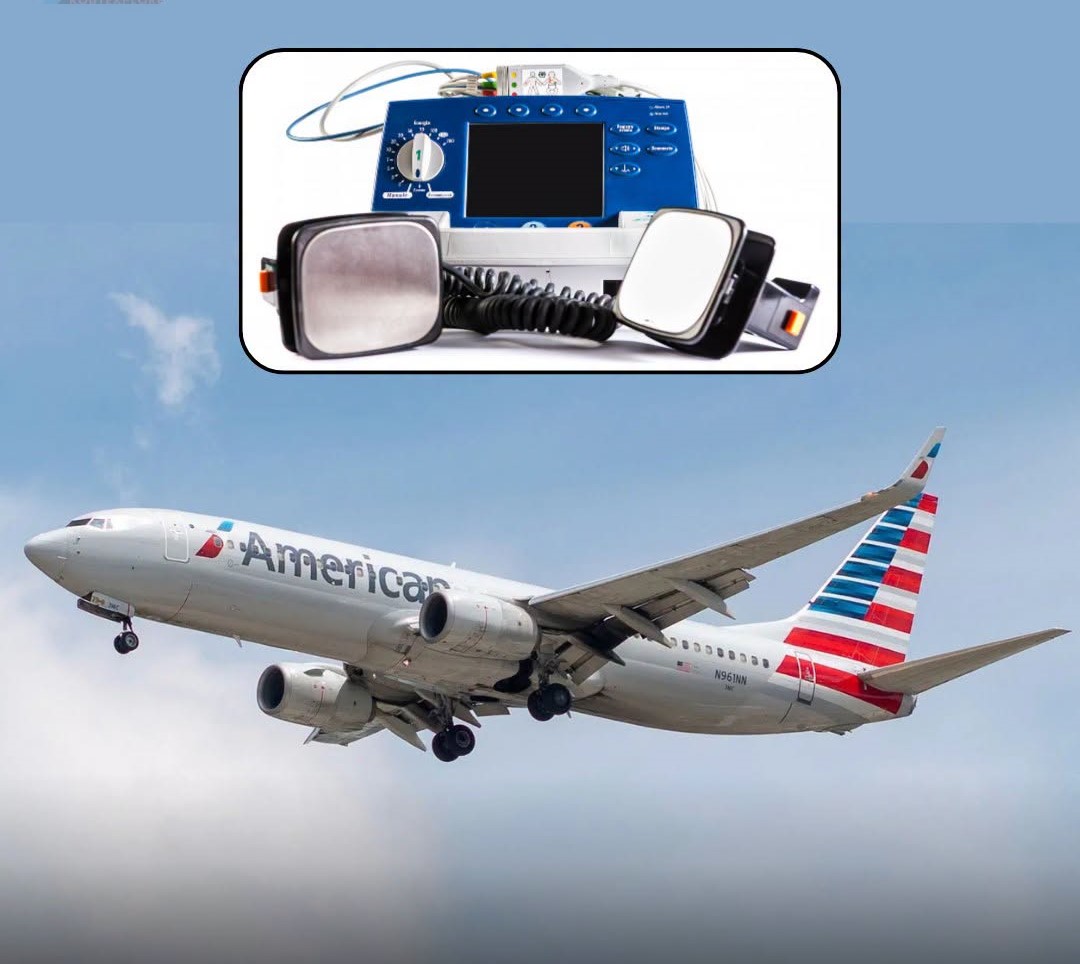
A court has ruled that a faulty automated external defibrillator (AED) was not proven to have caused the death of 14-year-old Kevin Greenidge aboard an American Airlines flight — preventing his family from pursuing damages under the Montreal Convention.
The case dates to June 4, 2022, when Kevin was traveling with relatives on American Airlines Flight AA-614 from San Pedro Sula, Honduras, to Miami.
After a lengthy weather delay, Kevin began experiencing severe breathing difficulties shortly after takeoff. His condition deteriorated at cruising altitude, and he became unconscious.
Passengers and family members moved him toward the rear of the aircraft, where an off-duty registered nurse and a surgical resident began CPR. Flight attendants brought the aircraft’s AED, which initially detected asystole — a heart rhythm with no detectable electrical activity that cannot be treated with a defibrillation shock.
After about eight minutes of CPR, the AED detected a shockable rhythm. A flight attendant pressed the shock button. Although the AED’s internal logs recorded that a shock was delivered, witnesses disputed whether they actually saw a shock occur.
Kevin’s family sued American Airlines under Article 17 of the Montreal Convention, arguing that the alleged failure of the AED and the crew’s response constituted an “accident” that contributed to his death.
A previous court had already ruled that the crew’s response could not be classified as an accident under the convention. The Fifth Circuit Court of Appeals upheld that ruling but sent the AED issue back for further consideration.
U.S. District Judge Mark T. Pittman then examined whether the allegedly defective AED was both an “accident” and a cause of Kevin’s death.
The family’s medical expert, Dr. Corwin Warmink, testified that Kevin would likely have survived if the AED had worked properly. But Judge Pittman found that the studies cited by the expert did not establish that conclusion. The evidence showed that while some children suffering cardiac arrest may survive to reach hospital after successful defibrillation, the likelihood of ultimately leaving hospital alive was significantly lower.
The court concluded that the evidence did not establish that a functioning AED would probably have prevented Kevin’s death.
Judge Pittman emphasized that the ruling does not mean airlines are free to operate aircraft without functioning emergency equipment. Aviation regulators can still penalize carriers for defective equipment.
Instead, the court’s decision focused specifically on causation under Article 17: an airline can be liable for the harm caused by an accident, but the plaintiff must establish that the accident actually caused the death or injury.
The ruling means Kevin’s family cannot recover the damages they sought from American Airlines on the basis that the allegedly defective AED caused his death.










