

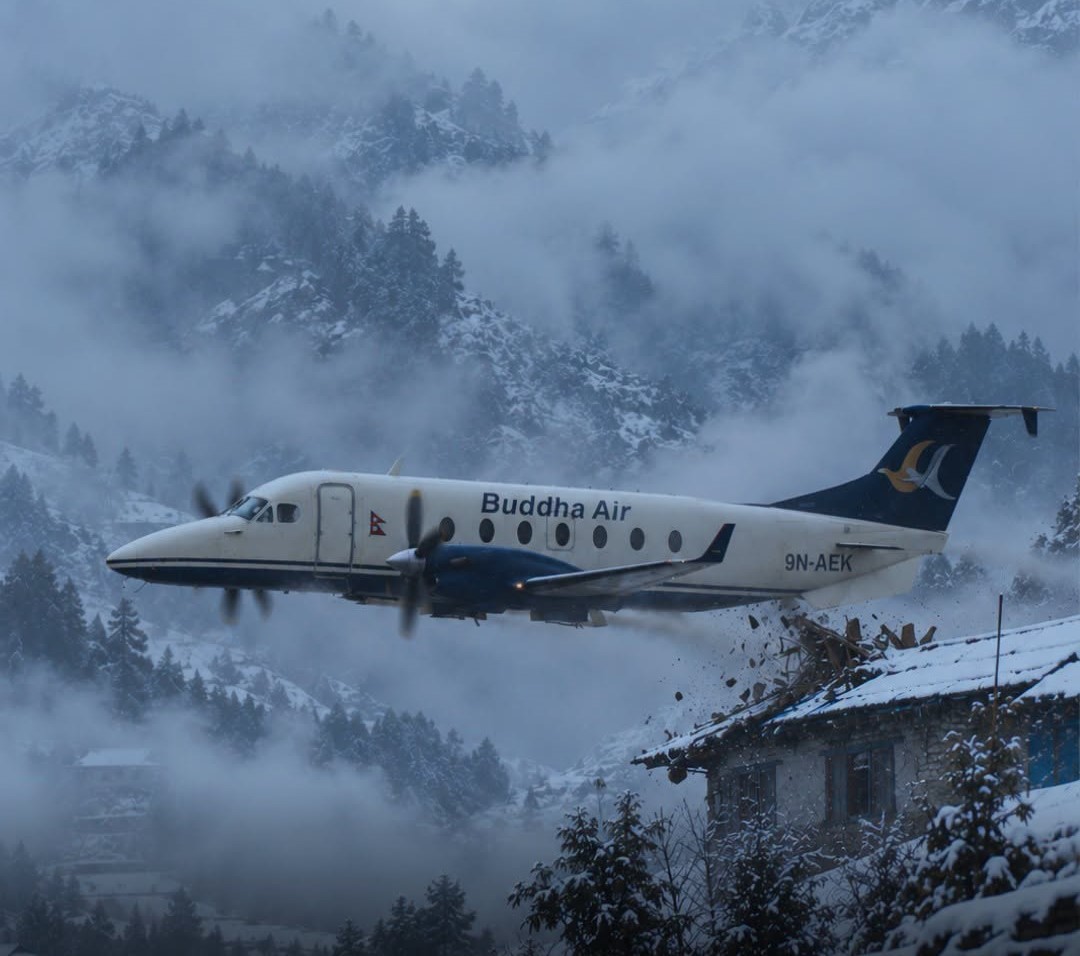
On September 25, 2011, Buddha Air Flight 103 departed Tribhuvan International Airport in Kathmandu for an Everest sightseeing flight.
The aircraft was a 13-year-old Beechcraft 1900D, registered 9N-AEK, carrying 16 passengers and three crew members. The sightseeing flight was intended to give passengers views of Mount Everest and the Himalayan range before returning to Kathmandu.
The aircraft completed part of the sightseeing journey, but deteriorating weather conditions forced the crew to abandon the planned mountain viewing and return toward Kathmandu.
The flight was being conducted under Visual Flight Rules, meaning the crew was expected to maintain visual reference with the surrounding terrain and conditions.
As the aircraft approached Kathmandu, the weather became increasingly difficult, with clouds and reduced visibility in the mountainous area.
The crew was cleared to descend toward 6,000 feet for the approach to Runway 02. However, the aircraft descended below that altitude and was subsequently recorded at about 5,000 feet.
The critical moment came roughly two minutes before the expected landing. Flight 103 entered a cloud bank, losing the visual references that were essential during the VFR approach.
Instead of remaining above the prescribed minimum altitude, the aircraft continued descending in poor visibility. At approximately 5,400 feet, it struck terrain near Bishankhunarayan in Lalitpur District, southeast of Kathmandu.
Witnesses reported that the aircraft struck the roof of a house before hitting trees and the hillside. The impact destroyed the aircraft and a post-crash fire followed. Initially, reports said 18 people had died and one passenger had survived.
The survivor, however, later succumbed to injuries, bringing the final death toll to all 19 occupants.
The 16 passengers included 10 Indian nationals, two Americans, one Japanese national and three Nepalese passengers. There were no survivors.
The subsequent investigation identified a combination of human and operational factors rather than an aircraft mechanical failure as the central cause. Investigators found that the first officer had only about 18 hours of experience on the Beechcraft 1900D. The captain had also been assigned to the flight at short notice after flying the previous day and had insufficient rest.
Investigators concluded that fatigue affected cockpit management and that the captain delegated flying duties to the relatively inexperienced first officer during a demanding approach.
The crew also failed to follow standard operating procedures requiring the aircraft to remain above 6,000 feet in the area. Cockpit coordination was found to be deficient, with the captain frequently providing distracting advice rather than maintaining clear procedural coordination.
The accident was classified as controlled flight into terrain, in which an otherwise functioning aircraft is unintentionally flown into terrain. The investigation produced several safety recommendations, including requirements for operators to install terrain-awareness or ground-proximity warning systems, along with improvements to pilot training, visual navigation aids, safety oversight and operational procedures.
Buddha Air Flight 103 became a stark reminder of the dangers of continuing a visual approach into deteriorating weather in mountainous terrain. The investigation showed how several factors — fatigue, limited aircraft-type experience, altitude deviation, poor visibility and inadequate cockpit coordination — combined within minutes to turn a routine sightseeing flight into a fatal accident.










