

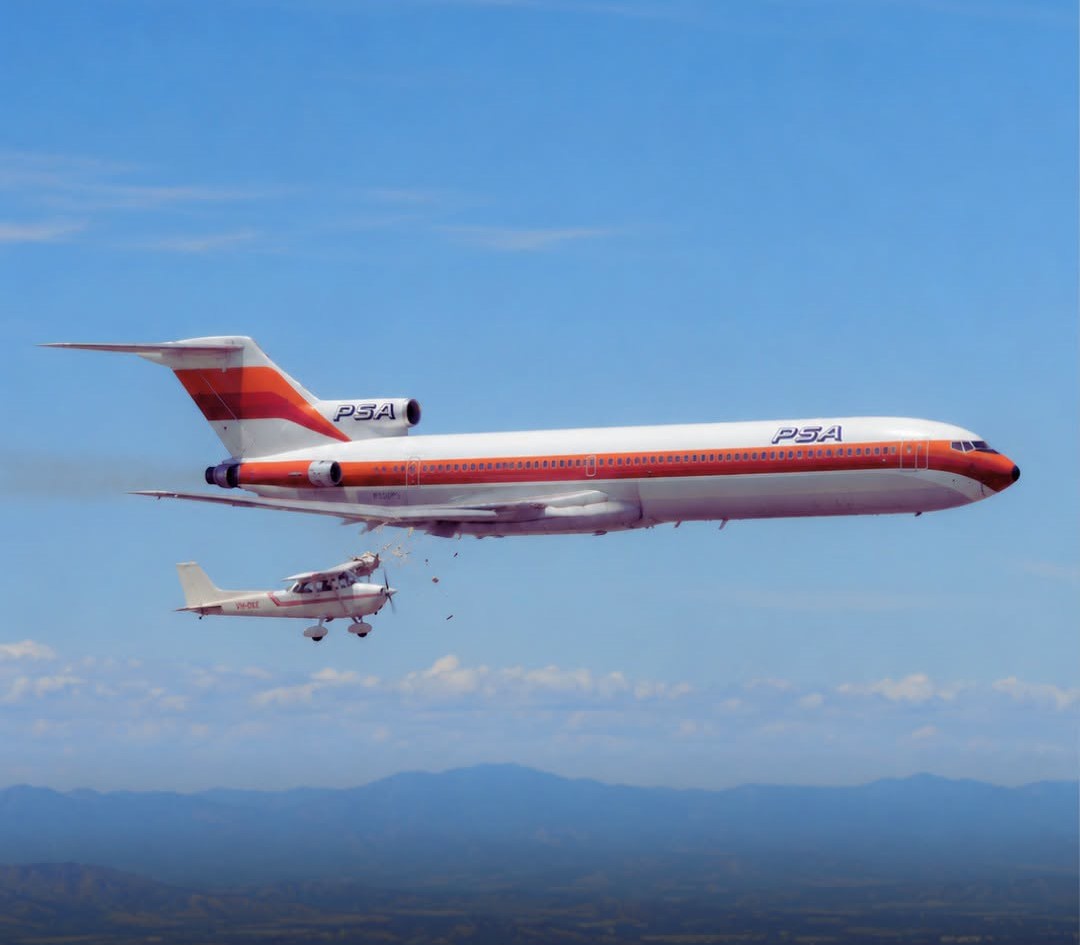
On September 25, 1978, Pacific Southwest Airlines Flight 182, a Boeing 727-214 registered N533PS, was approaching San Diego’s Lindbergh Field after flying from Sacramento via Los Angeles.
The aircraft was carrying 135 people and was being flown by an experienced crew under clear weather conditions with about 10 miles of visibility.
At the same time, a Gibbs Flite Center Cessna 172, N7711G, was conducting an instrument-training flight near the airport with two people aboard.
The Cessna had completed practice approaches at Lindbergh Field and was climbing northeast under the control of San Diego Approach. The controller instructed the Cessna to remain below 3,500 feet and fly a heading of 070 degrees.
Meanwhile, Flight 182 was making a visual approach to Runway 27. Approach Control warned the Boeing crew about the Cessna, reporting it ahead of them. The PSA crew acknowledged the traffic and reported that they had it in sight. They were then instructed to maintain visual separation from the smaller aircraft and contact Lindbergh Tower.
The situation became critical during the final minutes of the approach. After changing configuration and maneuvering for landing, the PSA crew lost sight of the Cessna. Instead of telling air traffic control that visual contact had been lost, the crew believed the smaller aircraft had passed behind them.
The tower again warned Flight 182 about the Cessna, but the crew still did not have it in sight. The two aircraft were now converging in the same area, with the Boeing approaching from behind and above.
At approximately 9:01:47 a.m., the Boeing 727 collided with the Cessna at about 2,600 feet over San Diego. The 727’s right wing struck the Cessna, destroying the smaller aircraft and severely damaging the airliner.
Flight 182 then descended rapidly toward the residential North Park neighborhood. About 20 seconds later, the Boeing slammed into a residential area near the intersection of Dwight and Nile Streets, producing a massive explosion and fire.
All 135 people aboard Flight 182 and both occupants of the Cessna were killed. Seven people on the ground also died, bringing the total fatalities to 144. Nine people on the ground were injured, while 22 homes were damaged or destroyed.
The scale of the disaster sent emergency crews across the neighborhood, with a large portion of the San Diego Fire Department deployed to the crash site.
The NTSB investigation found that the central cause was not a single mechanical failure but a breakdown in visual separation and air traffic control procedures.
Investigators determined that the PSA crew failed to comply with the clearance requiring them to maintain visual separation and notify the controller when they lost sight of the Cessna.
Investigators also identified contributing factors involving ATC procedures, the Cessna’s failure to maintain its assigned heading, and the controller’s handling of a conflict alert.
The tragedy exposed weaknesses in the way aircraft were being separated around busy airports. At the time, controllers could use visual separation even when radar information was available.
Following the crash, the NTSB recommended stronger terminal radar services and changes to the use of visual separation. The accident became a major milestone in aviation safety and contributed to broader efforts to reduce the risk of midair collisions around airports.










