

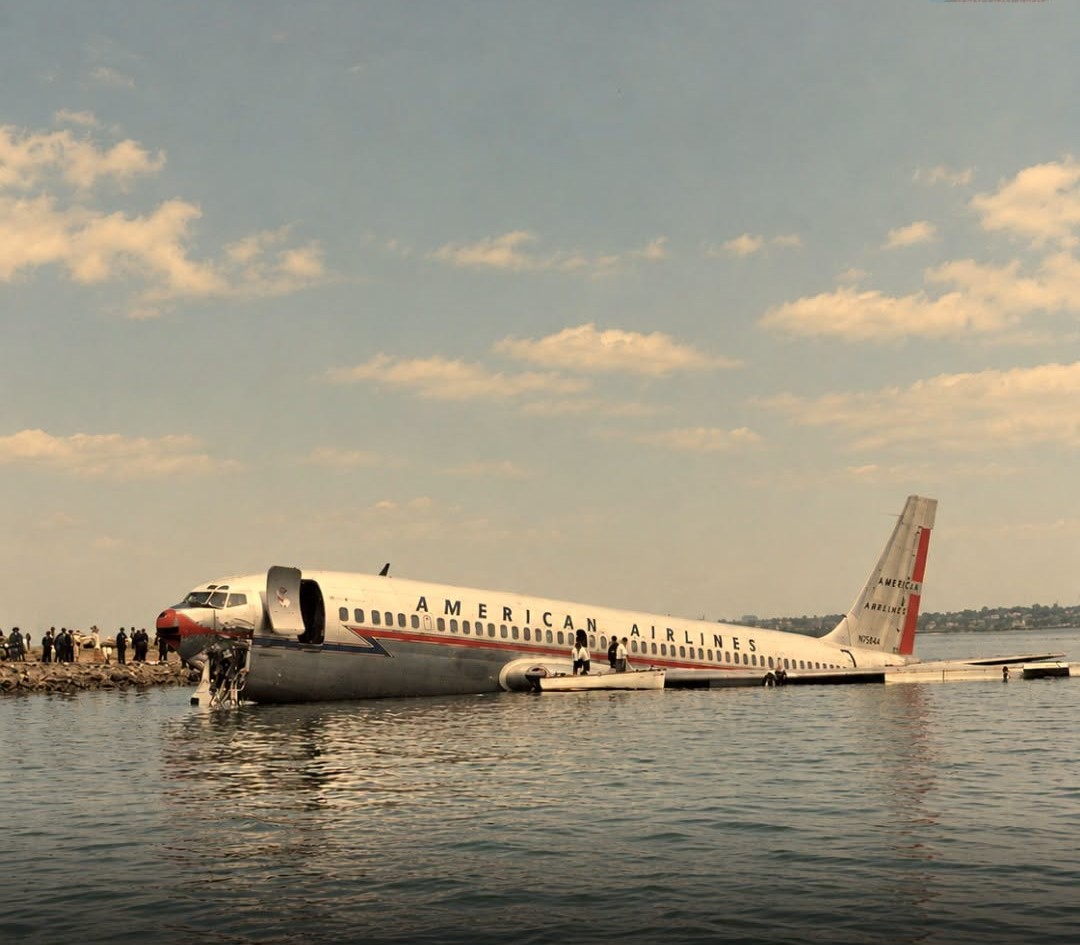
On September 24, 1961, American Airlines Flight 44, a Boeing 720-023B registered N7545A, was approaching Boston’s Logan International Airport after a stop in Chicago.
The jet carried 63 passengers and eight crew members. Weather was deteriorating, with fog and rapidly changing visibility.
The crew accepted a precision approach radar landing to Runway 4R. During the approach, the aircraft was about 200 feet above the prescribed glidepath at the outer marker and remained high during the final descent.
The controller issued repeated headings, altitude and descent instructions, but the crew had very limited visual references.
Visibility deteriorated sharply as fog moved across the airport. Runway visual range, previously reported at more than 6,000 feet, fluctuated and fell to about 2,200 feet during the final approach.
Investigators found that this deterioration was not passed to the crew by the approach controller, even though changing readings were available.
The pilots later said they could not see the runway approach end, lights or other useful visual references during most of the approach. Relying heavily on radar guidance, Flight 44 touched down about 3,165 feet beyond the normal PAR touchdown point, leaving only about 3,439 feet of runway.
The jet initially ran on its landing gear for about 100 feet, became airborne again, then touched down and skidded for roughly 614 feet before leaving the runway. The Boeing 720 entered Winthrop Bay and stopped about 420 feet beyond the physical end of Runway 4R.
The impact caused major damage. The No. 1 and No. 2 engines broke away, while the nose section, nose gear and lower forward fuselage suffered severe deformation.
Water entered the aircraft, but evacuation was completed in about 10 minutes. Passengers escaped through an emergency door and a window onto the wing, while boats helped take them ashore.
Remarkably, all 71 people survived, with no fatalities and no serious injuries reported. The aircraft sustained major damage. Investigators found no engine, aircraft-system or major mechanical failure responsible for the accident.
The flight recorder showed intermittent binding, but its usable parameters were insufficient for the investigation.
The investigation determined that the probable cause was the captain’s decision to land in variable weather conditions that prevented adequate visual orientation relative to the runway. A contributing factor was the failure to provide the flight crew with information concerning the deterioration of runway visual range.
Investigators also concluded that the aircraft was traveling at excessive speed during touchdown. The jet touched down at approximately 134 knots, leaving insufficient runway for an effective stop. The Board concluded that the aircraft’s stopping capability was not fully utilized.
Flight 44’s accident became a striking example of how rapidly changing fog, inadequate visual references, high approach speed and incomplete weather information can combine to turn a routine instrument approach into a runway overrun. Despite the violent impact and extensive structural damage, every person aboard survived.










