

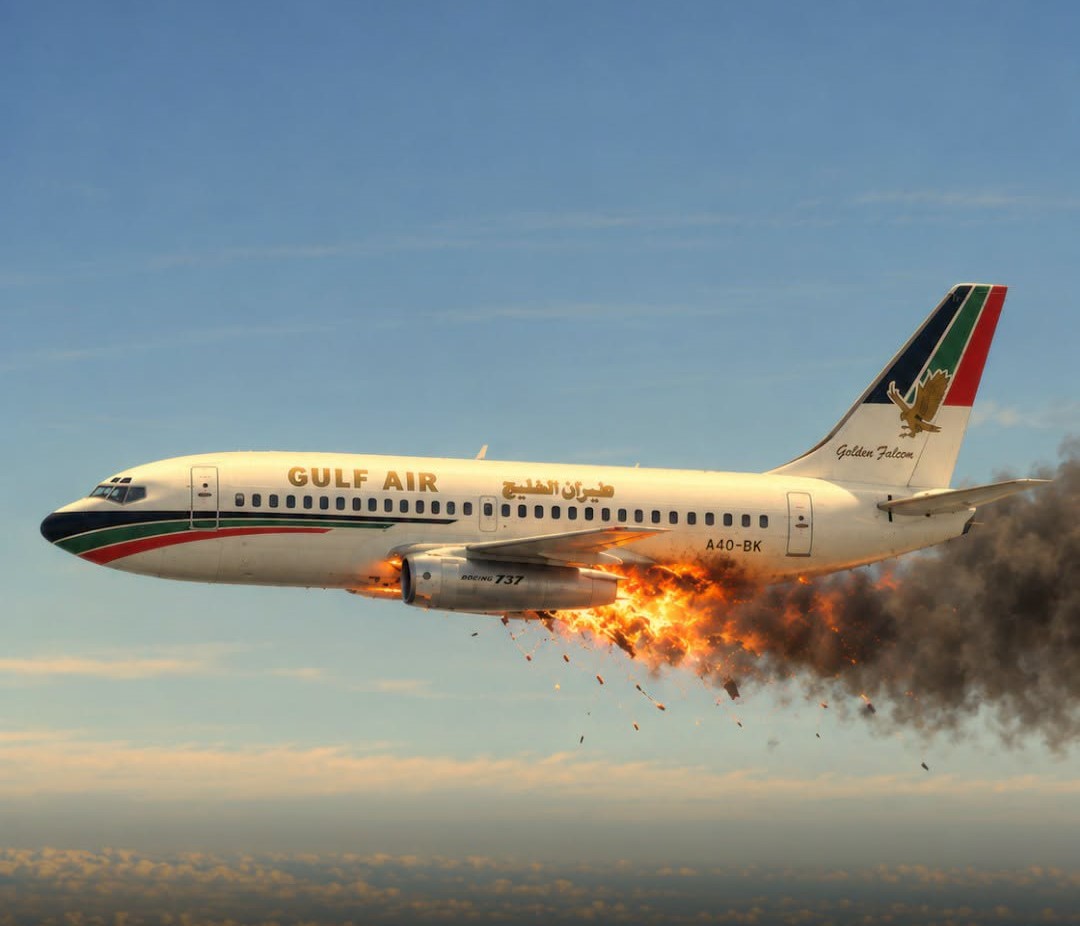
On September 23, 1983, Gulf Air Flight 771 was approaching Abu Dhabi International Airport when a sudden explosion transformed an otherwise routine flight into one of the deadliest aviation disasters in the United Arab Emirates.
The Boeing 737-2P6, registration A4O-BK, was operating from Karachi, Pakistan, with Abu Dhabi as its first stop before continuing toward Doha and Bahrain.
There were 112 people aboard the aircraft—105 passengers and seven crew members. Most of the passengers were Pakistani nationals returning to their jobs in the Gulf after spending the Eid al-Adha holiday with their families in Pakistan.
The crew included Omani Captain Saud al-Kindi and Bahraini First Officer Khazal al-Qadi, along with cabin crew from several countries.
As the aircraft descended toward Abu Dhabi, everything initially appeared normal. Cockpit voice recordings later revealed the pilots had been talking casually, with no indication of an impending emergency.
Then, without warning, an explosion occurred in the aircraft’s baggage compartment. The blast caused a fire and severely damaged the aircraft.
The Boeing 737 did not disintegrate immediately in the air, but the explosion and subsequent fire created catastrophic conditions inside the cabin. Investigators later concluded that many passengers likely died rapidly from the effects of the fire and smoke.
The crippled aircraft became uncontrollable and crashed into the desert near Jebel Ali, roughly 45 kilometres northeast of Abu Dhabi, between Abu Dhabi and Dubai.
There were no survivors. All 112 people aboard were killed, making the disaster one of the most devastating aviation tragedies in the UAE’s history.
The investigation eventually established that the aircraft had been destroyed by a bomb placed in the baggage compartment. Investigators examined the pattern of injuries, the sudden interruption of the previously normal flight, flight recorder data and an unusual passenger-baggage detail: one passenger had checked luggage at Karachi but did not board the aircraft.
These clues pointed investigators toward an explosive device rather than an accident caused by an aircraft system failure.
The full investigation findings became public in 1987, after pressure from relatives of victims, including the family of British flight attendant Lyn Farthing. Details from the cockpit recording revealed the terrifying final moments. After the sudden emergency, the pilots made a desperate attempt to regain control as the aircraft descended toward the ground.
The bombing was subsequently attributed to the Abu Nidal Organization, a Palestinian militant group based in Iraq at the time. Accounts of the aftermath stated that the bombing was intended to pressure the United Arab Emirates into paying protection money to prevent further attacks.
Gulf Air Flight 771 remains a grim reminder that an aircraft can be brought down without a conventional mechanical failure. On that September day, a concealed explosive device turned a normal passenger flight into a fatal attack, killing 112 people just minutes before their scheduled arrival in Abu Dhabi.










