

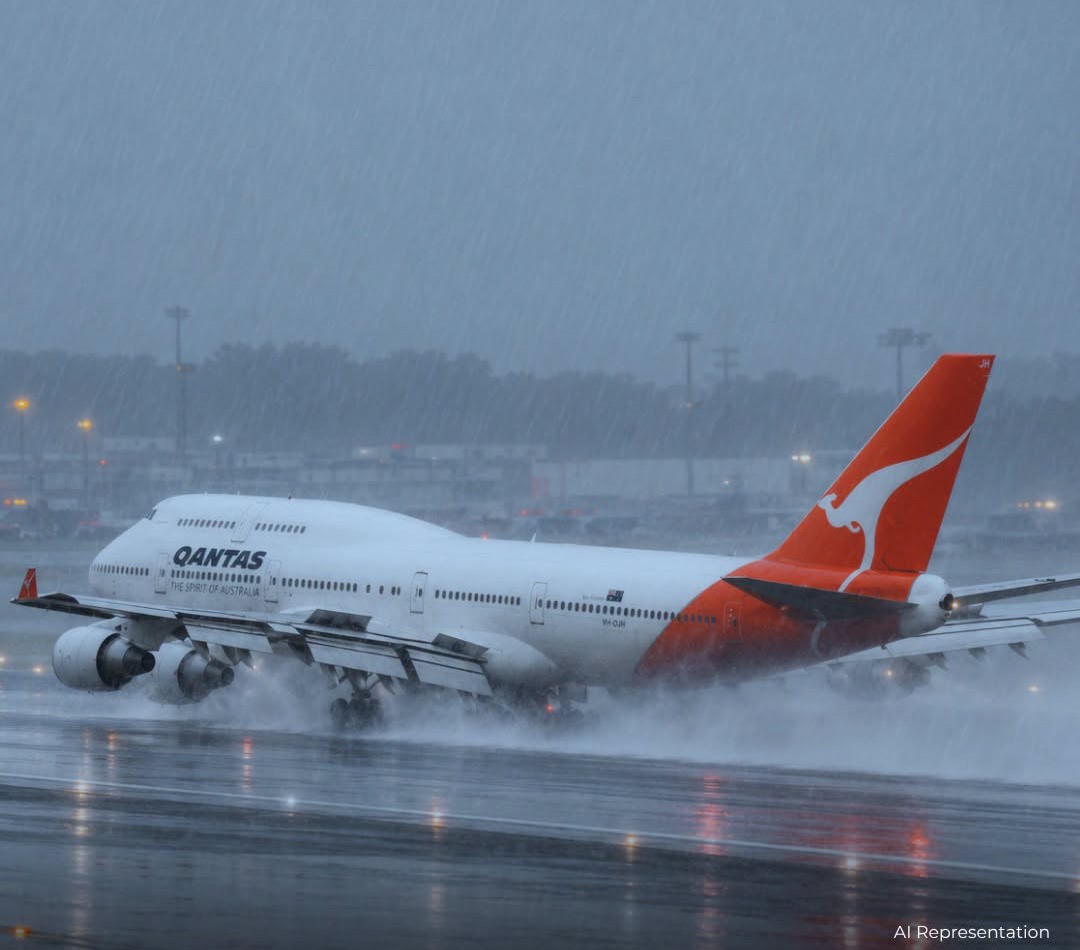
On 23 September 1999, Qantas Flight 1 was operating the long-standing Kangaroo Route from Sydney to London, with a scheduled stop at Don Mueang International Airport in Bangkok.
The aircraft, a Boeing 747-438 registered VH-OJH and named City of Darwin, carried 391 passengers and 19 crew.
After more than eight hours in flight, the 747 approached Bangkok late at night as the weather deteriorated rapidly. Visibility had fallen dramatically and heavy rain was affecting the airport.
Standing water covered parts of runway 21L, creating conditions in which hydroplaning could become a serious threat.
The first officer was flying the approach. The aircraft was high and fast, although initially within company limits. As the aircraft neared the runway, the crew struggled with deteriorating visibility and could see the runway lights only intermittently through the heavy rain.
Another Qantas 747 had gone around just minutes earlier because of the poor conditions, but the QF1 crew was unaware of that event.
The aircraft crossed the runway threshold and was already more than 3,000 feet beyond it when the captain ordered a go-around. The first officer advanced the thrust levers, but the takeoff/go-around system was not engaged.
Almost immediately, visibility improved and the aircraft touched down. The captain then cancelled the go-around by reducing thrust, without clearly communicating the action to the first officer.
The landing continued, but several critical stopping measures were not effectively used. The preselected autobrakes were cancelled, reverse thrust was not applied as required, and manual braking began only after the aircraft had travelled more than 5,200 feet along the runway.
With heavy water on the surface, the wheels began to aquaplane and the 747 lost effective braking performance.
The aircraft veered from the centreline and continued toward the runway end. It crossed the paved surface at substantial speed, travelled through soft ground and struck a ground radio antenna.
The impact damaged the landing gear, nose section and right-side engines before the aircraft finally stopped with its nose near the airport perimeter road.
Despite the severity of the overrun, there was no loss of life. All 410 occupants survived. Thirty-eight passengers sustained minor injuries, while the evacuation was ultimately completed in an orderly manner.
The 747 suffered extensive structural damage and was initially considered a possible write-off. Qantas instead undertook a major repair, eventually returning the aircraft to service.
The investigation by the Australian Transport Safety Bureau found that the accident was not caused by a single failure. A high and fast approach, long touchdown, ineffective crew coordination, cancellation of the go-around, lack of reverse thrust, loss of autobraking and water on the runway combined to produce the overrun.
Investigators also identified weaknesses in Qantas procedures and training for operations on water-affected runways and in assessing landing configurations in difficult conditions.
The accident became a major lesson in cockpit resource management, wet-runway operations and the importance of making timely decisions when a landing becomes unsafe.










