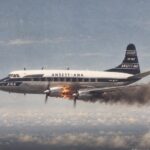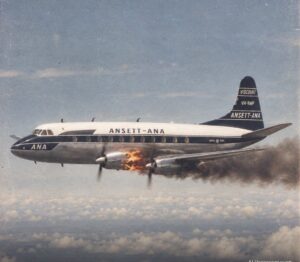

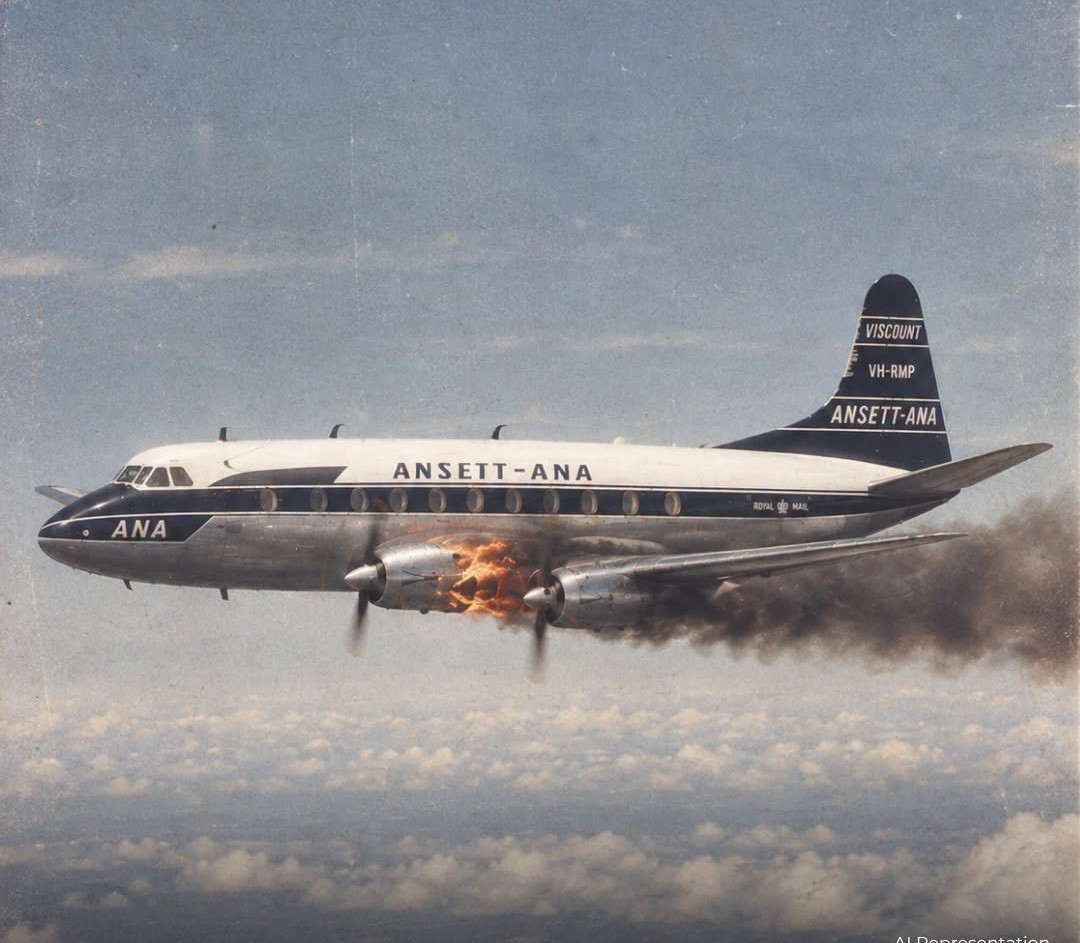
On 22 September 1966, Ansett-ANA Flight 149 was operating a scheduled service from Mount Isa to Brisbane via Longreach in Queensland, Australia.
The aircraft, a Vickers Viscount 832 registered VH-RMI, departed Mount Isa at 12:08 p.m. with 20 passengers and four crew members aboard. The flight initially proceeded normally, climbing to approximately 17,500 feet.
About 44 minutes after departure, the crew began an emergency descent. A fire warning had appeared for the No. 2 engine, and shortly afterward the pilots reported that they could see fire in the engine nacelle. They were also unable to feather the No. 2 propeller, increasing the urgency of the situation. The crew decided to divert to Winton, which was much closer than continuing toward Longreach, and began preparing for an emergency landing.
At approximately 1:03 p.m., while the aircraft was descending toward Winton and was only about 13.5 nautical miles from the airport, disaster struck. The left wing failed in flight at an altitude estimated between 3,500 and 4,000 feet. The outer section of the wing folded upward, causing the aircraft to roll violently. The No. 1 propeller struck and tore through the cabin roof, while the fuselage began breaking apart in the air.
Witnesses on the ground saw a large cloud of black smoke followed by burning sections falling toward the ground. The aircraft crashed on Nadjayamba Station and was destroyed.
The 24 people aboard—20 passengers and four crew members—were killed. Parts of the left wing and No. 1 engine were found hundreds of metres from the main wreckage, demonstrating the extent of the in-flight breakup.
The investigation became one of the longest and most detailed aircraft accident investigations conducted in Australia at the time. Investigators recovered and catalogued the wreckage before transporting it to Melbourne, where the aircraft was painstakingly reconstructed from thousands of pieces.
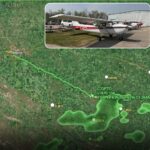
Importantly, VH-RMI carried an early flight data recorder, making this the first Australian accident investigation assisted by such a device. It was damaged by the crash and fire but still provided enough information to reconstruct the aircraft’s flight path. There was no cockpit voice recorder.
Investigators eventually discovered that the fire had not originated directly from the engine itself. A rotor inside the No. 2 engine’s cabin pressurisation blower had broken up, producing severe vibration.
The vibration caused the oil metering unit’s securing arrangement to fail, allowing lubricating oil to escape. A displaced rotor then created intense metal-to-metal contact, generating enough heat to ignite the oil.
The resulting fire damaged engine controls, preventing the propeller from being feathered. Burning oil spread through the wheel bay and into the leading edge of the left wing, eventually breaching a fuel tank.
The intense fire severely weakened the aluminium structure of the main wing spar. When the aircraft reached low altitude during its emergency descent, the weakened spar could no longer withstand the aerodynamic loads and the wing failed.
Investigators found that the oil metering unit was missing its securing nuts and locking wire. The blower had been overhauled only months earlier. Earlier Viscount blower fires in Canada and the British West Indies had involved similar problems, but those incidents had not resulted in the manufacturer being alerted to the underlying design or securing issue.
The Flight 149 investigation ultimately identified the failure of the blower securing system, followed by fire and structural weakening of the wing, as the probable cause. However, investigators could not determine exactly what caused the blower rotor to break up in the first place.
The accident exposed a hidden chain of mechanical failure, fire and structural damage that transformed an apparently manageable engine emergency into a catastrophic in-flight breakup.