
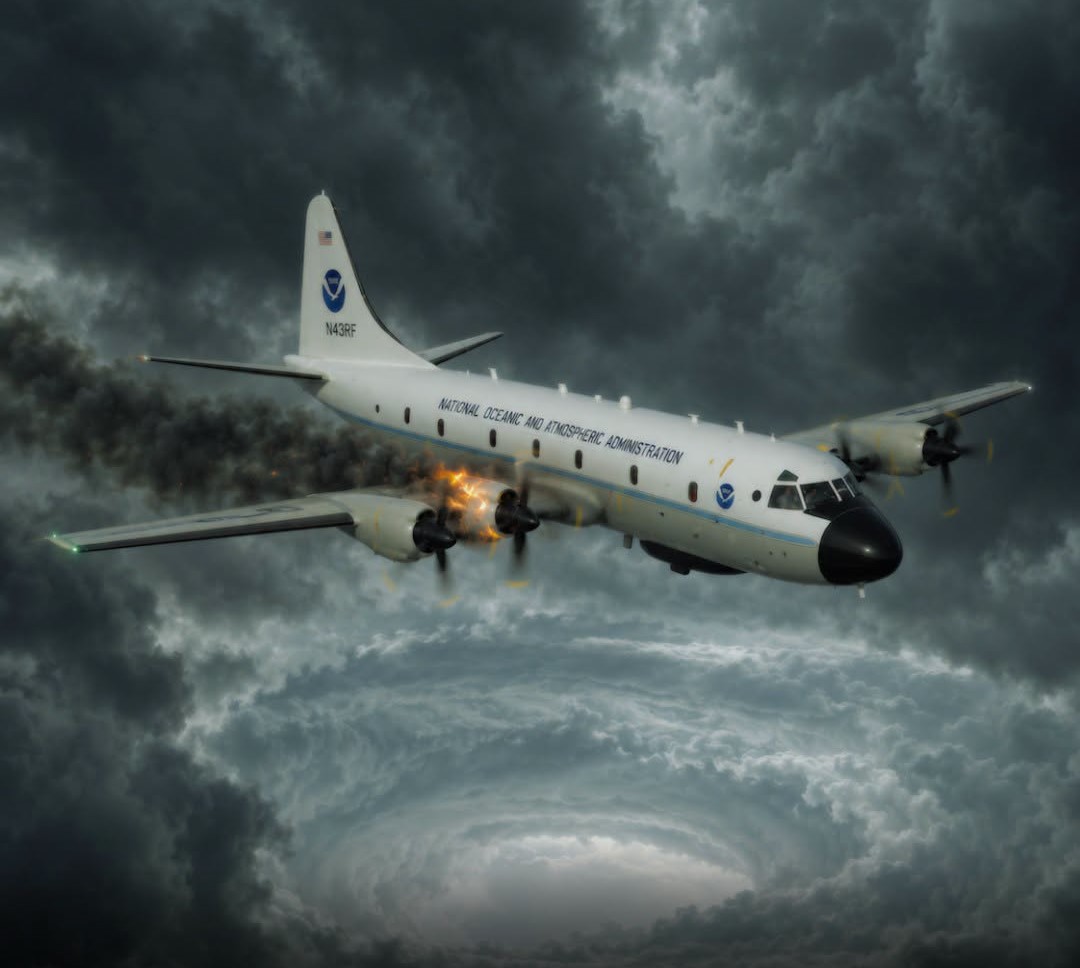
On September 15, 1989, NOAA’s Lockheed WP-3D Orion, N42RF “Kermit,” entered Hurricane Hugo near Barbados on a mission that almost ended in disaster.
All 16 people aboard survived, but the aircraft was severely damaged and the crew came within moments of losing control over the Atlantic.
Kermit had been deployed to Barbados for the Hurricane Energetics experiment, designed to collect valuable measurements inside hurricanes and improve forecasts.
Hugo was believed to be a Category 3 storm, so the crew planned to enter its eyewall at just 1,500 feet to study the low-level environment. Another aircraft would investigate the storm from 20,000 feet.
The mission initially appeared routine. After takeoff, however, Kermit’s belly-mounted radar failed. It was restored after about 20 minutes, leaving the crew only a few minutes to examine the radar picture before beginning their descent.
The available information suggested Hugo was still around Category 3 strength. As the aircraft approached the eyewall, surprisingly low winds made the storm appear weaker than expected, so the crew continued toward the eyewall at 1,500 feet.
They were badly wrong.
As Kermit entered the eyewall, conditions changed dramatically. Winds increased rapidly, eventually reaching an estimated Category 5 intensity with winds approaching 200 mph.
Severe updrafts and downdrafts threw the aircraft violently through the storm. Forces reached approximately +5.8 and -3.7 G, while unsecured equipment and two 200-pound life rafts were thrown around the cabin.
Then the situation became critical. The No. 3 engine began overheating and caught fire. The pilots struggled to keep the aircraft under control while shutting down the burning engine. Moments later, Kermit plunged toward the ocean but managed to stabilize at only about 880 feet above the water before reaching the relative calm of Hugo’s eye.
Inside the eye, the crew discovered additional damage, including a deteriorating deicing boot on the No. 4 engine. Losing that engine could have left the aircraft without power on one side. Kermit therefore circled inside the roughly nine-mile-wide eye while gradually climbing and dumping fuel to reduce weight.
A U.S. Air Force C-130, call sign Teal 57, arrived and searched for a safe escape route through the eyewall. NOAA 43 also joined the effort. After several reconnaissance passes, Teal 57 identified a comparatively safer route through the northeastern eyewall. Kermit climbed to about 7,000 feet and escaped the hurricane, eventually landing safely in Barbados. Remarkably, none of the 16 occupants was injured.
The subsequent NOAA investigation revealed that the engine fire was caused by a failed sensor in the No. 3 engine’s fuel-control system. The faulty sensor could not properly regulate fuel flow, allowing excessive fuel into the engine and causing the fire. Investigators also discovered that Hugo’s eyewall contained powerful mesovortices—small, tornado-like circulations that had not previously been observed in a hurricane.
The failed belly radar had prevented the crew from seeing how rapidly the storm’s structure was changing, while Kermit had entered the eyewall 3,500 feet below the altitude later considered appropriate for a hurricane of Hugo’s intensity. The turbulence itself did not cause the engine fire, but the combination of extreme weather, limited radar information, low altitude and mechanical failure created a nearly catastrophic situation.
The incident changed hurricane reconnaissance procedures. Future crews were required to penetrate hurricane eyewalls at no lower than 5,000 feet, and mission planning and conditions were to be reviewed more carefully before penetration. Kermit was grounded for the remainder of the 1989 hurricane season, but eventually returned to service and went on to investigate more than 30 hurricanes.
What began as a scientific mission into Hurricane Hugo became one of the most frightening survivals in Hurricane Hunter history—and produced data that helped scientists better understand hurricanes and improve future forecasts.