
On September 12, 1961, Air France Flight 2005 was operating a scheduled international service from Paris-Orly to Casablanca, with a planned stop at Rabat-Salé Airport in Morocco.
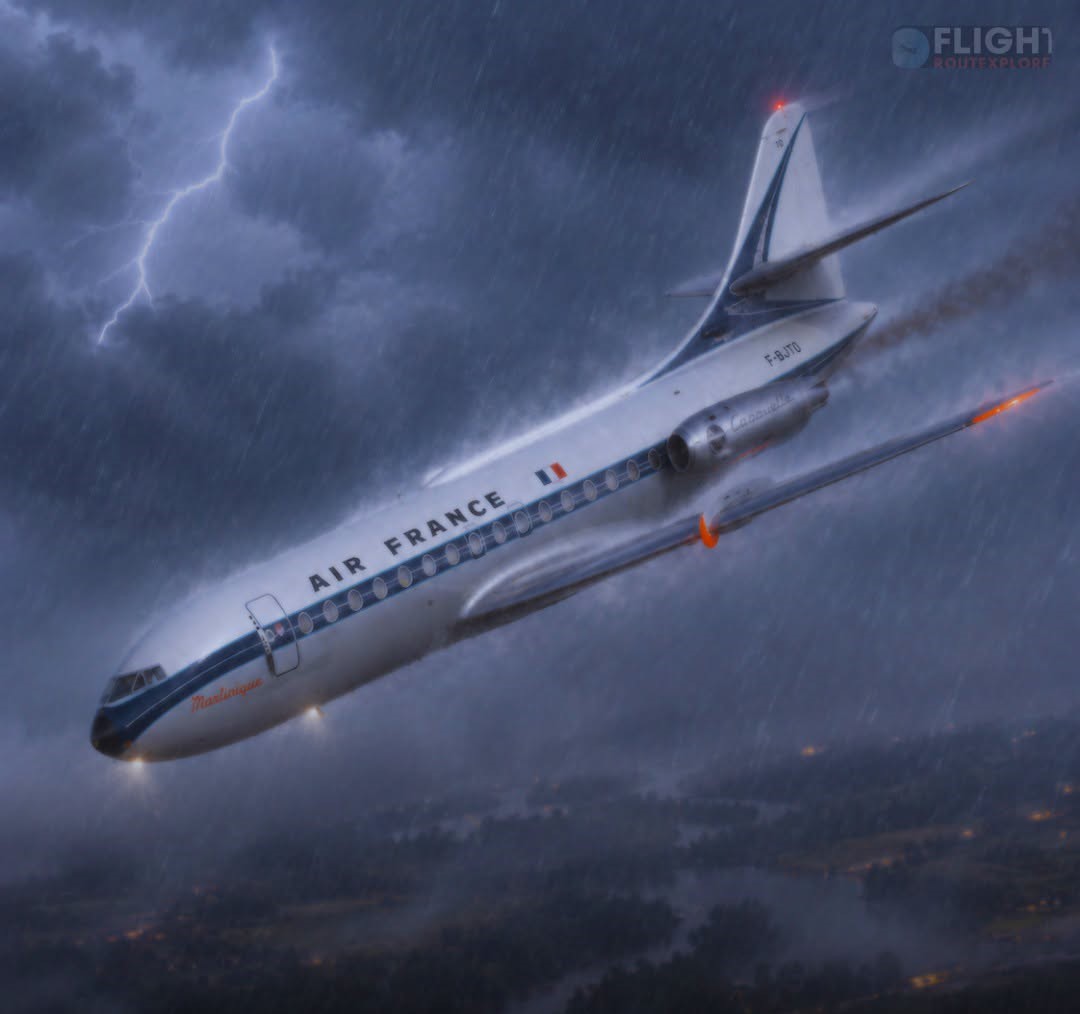
The aircraft was a Sud Aviation SE-210 Caravelle III, registration F-BJTB, named Antilles. There were 71 passengers and six crew members aboard.
The flight from Paris was initially routine. The Caravelle departed Orly at 18:26 GMT with its weight and fuel within normal limits and headed toward Rabat.
Trouble developed during the approach, when the weather around Rabat-Salé deteriorated rapidly. Thick, low fog severely reduced visibility and the cloud ceiling, creating extremely difficult conditions for a night landing.
The crew repeatedly discussed the weather with air traffic control. Because conditions were becoming increasingly unfavorable, the captain even considered bypassing Rabat and continuing directly to Casablanca. Instead, the crew decided to attempt the approach into Rabat using the airport’s non-directional beacon, or NDB.
That decision became critical. As the aircraft approached, the crew planned to use the NDB as an aid while descending toward the runway. Air traffic control warned the captain that the NDB was not aligned with the runway. The warning was not acknowledged by the crew.
At about 21:09 GMT, Flight 2005 struck the ground approximately 8.4 kilometers from the threshold of Runway 04 and about 1.4 kilometers left of the extended runway centerline. The Caravelle hit terrain before reaching the airport, was completely destroyed and caught fire. None of the 77 people aboard survived.
The aftermath revealed that there was no convincing evidence of an aircraft mechanical failure. Investigators also found no indication that air traffic control or the crew had suffered a physical incapacity. Instead, attention focused on the combination of deteriorating weather, a demanding approach and an apparent mistake in interpreting the aircraft’s flight instruments.
The official investigation ultimately identified an error in instrument reading as the probable cause. The investigation found that the rapidly changing weather created particularly unfavorable conditions, while the crew’s interpretation of their instruments resulted in the aircraft descending toward terrain while the pilots apparently believed they were at a safer altitude.
Later accounts highlighted the difficulty of accurately interpreting the type of altimeter installed in the Caravelle. Tests reportedly demonstrated that even trained crews could make a 1,000-foot reading error with the instrument, especially during the high workload of an instrument approach.
Flight 2005 was therefore not brought down by a dramatic engine failure or structural breakup. It became a tragic example of controlled flight into terrain, where an airworthy aircraft was flown into the ground because the crew’s perception of altitude did not match their actual position.
The disaster killed all 77 people aboard and became one of the major aviation tragedies associated with Air France during the early jet age.