
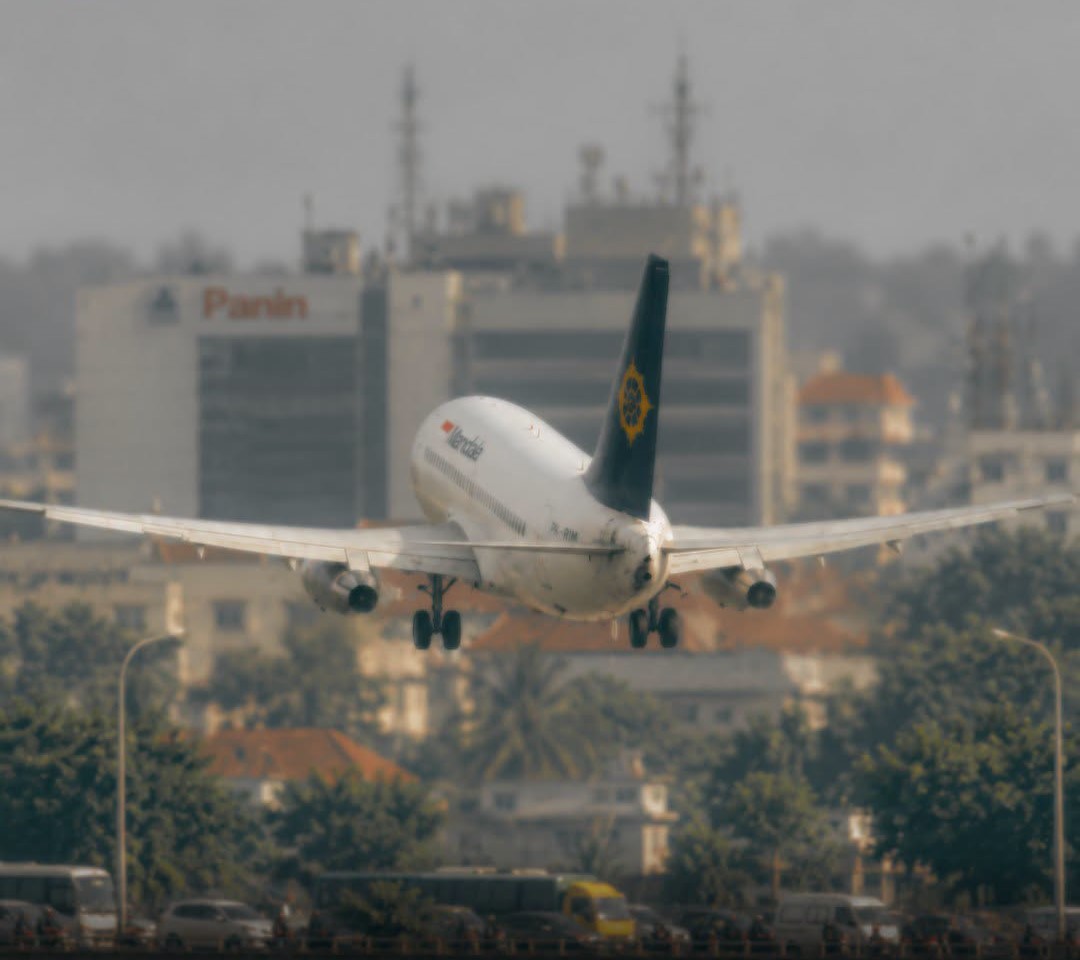
On September 5, 2005, Mandala Airlines Flight 091 was preparing to fly from Medan’s Polonia Airport to Jakarta, carrying 112 passengers and five crew members aboard a Boeing 737-230 Advanced registered PK-RIM.
The aircraft, then 24 years old, had already completed an earlier flight from Jakarta that morning with the same crew. At about 10:03 a.m. local time, the aircraft was cleared for takeoff from Runway 23.
The takeoff initially appeared normal, but witnesses noticed that the aircraft seemed to take an unusually long distance to become airborne. Although its nose was already raised, the Boeing struggled to climb. It briefly lifted off, veered from side to side and then stalled.
The aircraft’s tail struck the runway, leaving marks on the pavement, before it overran the runway and struck approach lights. It crossed a grassy area and a small river before reaching the busy Djamin Ginting road.
The impact turned into a catastrophe within seconds. The left wing struck a building and the aircraft broke apart while sliding into the populated area, hitting cars, motorcycles, shops, houses, power lines and streetlights.
Fuel ignited, producing a huge fire that spread through nearby buildings. The wreckage eventually came to rest on the road, while local residents rushed toward the scene to rescue survivors.
Of the 117 people aboard, 100 were killed and 17 survived. Another 49 people on the ground died, bringing the total death toll to 149. Among those killed were North Sumatra Governor Rizal Nurdin and his predecessor, Raja Inal Siregar.
The crash also left dozens injured on the ground and caused extensive destruction in the surrounding neighborhood.
The aftermath was complicated by serious emergency-response problems. Firefighters initially approached from the airport side but found that the crash had occurred outside the airport perimeter and could not be reached directly.
Local residents and private drivers began transporting victims themselves, while rescuers faced overwhelming crowds, poor coordination and difficulties reaching the wreckage. Investigators later concluded that these shortcomings may have contributed to additional deaths among people who initially survived the impact.
The investigation initially examined several possibilities, including excessive weight, engine failure and the aircraft’s flight-control configuration. Engine failure was ultimately ruled out: both engines were operating at high power at impact and investigators found no evidence that an engine failure caused the accident.
The aircraft was also within its permitted maximum takeoff weight, and investigators found no significant center-of-gravity problem.
The decisive discovery came from examination of the wreckage. Investigators found that the flaps and slats were still retracted when the aircraft attempted to take off. Without them extended, the Boeing 737 could not generate enough lift at the available takeoff speed and was unable to climb safely.
Examination did not reveal a mechanical failure that would explain the retracted configuration, pointing instead toward incorrect checklist execution by the flight crew.
The investigation was complicated by a malfunctioning cockpit-area microphone on the cockpit voice recorder. Although the recorders were recovered, the poor-quality CVR meant investigators could not establish precisely what happened inside the cockpit or whether the takeoff warning horn sounded. The aircraft’s warning system had been maintained, but investigators could not exclude the possibility that the warning was not functioning or was not heard.
Indonesia’s National Transportation Safety Committee ultimately concluded that Flight 091 took off with an improper configuration, that checklist procedures failed to identify the retracted flaps, and that the takeoff warning could not be confirmed from the cockpit recording. The accident became a stark reminder that a routine pre-takeoff checklist can be the final barrier between a minor oversight and a disaster.