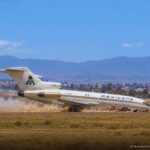


On September 4, 1971, Alaska Airlines Flight 1866 was approaching Juneau, Alaska, when a routine instrument approach turned into one of the deadliest aviation disasters in the state’s history.
The Boeing 727-193, registered N2969G, was carrying 104 passengers and seven crew members. None survived. The crash became the first fatal jet accident involving Alaska Airlines and remained the deadliest single-aircraft accident in the United States until 1975. It remains the worst air disaster in Alaska’s history.
Flight 1866, operating under the call sign “Alaska 66,” was a scheduled service from Anchorage to Seattle with stops at Cordova, Yakutat, Juneau and Sitka.
The aircraft departed Anchorage at 9:13 a.m. and completed its first two legs without major problems. After leaving Yakutat at 11:35 a.m., the aircraft headed toward Juneau with 111 people aboard.
At 11:46 a.m., the crew reported cruising at Flight Level 230, or about 23,000 feet, approximately 65 miles east of Yakutat. Air traffic control cleared the crew to descend and instructed them to cross the PLEASANT intersection at 10,000 feet.
A few minutes later, however, the controller ordered them to stop their descent at 12,000 feet because another aircraft was operating in the area near Juneau.
That other aircraft, a Piper PA-23 Apache, had departed Juneau and was heading toward Whitehorse. There was some uncertainty about its altitude and routing, and Flight 1866 was used as a communication relay between the controller and the smaller aircraft. The situation added workload and complexity to an already demanding approach.
At 11:58, Flight 1866 reported passing PLEASANT and entering a holding pattern. The crew told controllers they were at 12,000 feet and in clouds, flying entirely on instruments. At 12:01, they reported entering another holding pattern at HOWARD.
Six minutes later, the crew said they were turning onto the inbound course toward HOWARD. They were then cleared for a straight-in Localizer Directional Aid, or LDA, approach to Juneau’s Runway 8. The crew was instructed to cross HOWARD at or below 9,000 feet and began descending from 12,000 feet.
The approach was particularly demanding because the localizer provided horizontal guidance, while vertical positioning depended on published altitudes and intersections. The system did not provide distance-measuring information that could independently tell the pilots exactly where they were along the approach.
At about 12:08, the crew reported descending through 5,500 feet and then 4,500 feet. They were transferred to Juneau Tower and reported that they were over the BARLOW intersection. The tower controller was unable to clearly copy the intersection and asked them to report over BARLOW again.
That transmission was the final communication from Flight 1866.
Approximately seven minutes later, at about 12:15 p.m., the aircraft struck the eastern slope of a canyon in the Chilkat Mountain Range at an elevation of roughly 2,500 feet. The impact occurred about 18.5 miles west of Juneau. The Boeing 727 was destroyed and exploded on impact. Investigators later determined from the cockpit voice recorder and flight data recorder that there was no apparent last-second recognition by the crew that the aircraft was about to hit the mountain.
Search teams were dispatched after the aircraft stopped responding. The wreckage was located several hours later on the eastern slope of the Chilkat ridge. All 111 people aboard were dead. Witnesses in the area reported hearing a jet flying unusually low beneath or within the clouds shortly before hearing an explosion.
The investigation initially examined virtually every possible explanation. The aircraft itself was found to have been properly maintained and in good working order. The three flight crew members were experienced, current and qualified, and investigators found no evidence that their physical condition had affected their ability to operate the aircraft.
Attention therefore turned to the navigation equipment and the crew’s interpretation of their position.
The National Transportation Safety Board discovered that both navigation receivers aboard the aircraft were functioning properly after the crash, and the relevant ground navigation stations were also operating correctly. Yet evidence from the cockpit recordings indicated that the crew had received misleading information concerning their position along the localizer course. The captain’s navigation display apparently gave false indications at several points during the approach.
The most disturbing part was that investigators could not determine why.
The NTSB concluded that misleading navigational information caused the crew to believe the aircraft was farther along the approach than it actually was. That resulted in a premature descent below the altitude required to clear surrounding terrain. The aircraft consequently entered controlled flight into terrain while still under instrument conditions.
Investigators also found weaknesses in the crew’s navigation cross-checking. The pilots did not use all available navigation aids to independently verify their position, although the approach procedure did not specifically require them to do so. They also failed to perform the required audio identification of pertinent navigation facilities. The NTSB noted possible shortcomings in coordination between the pilots while tuning and monitoring their navigation radios.
One intriguing theory examined during the investigation was whether military radio jamming could have produced the false navigation indications. Investigators found no evidence that such interference had occurred and ultimately rejected it as a cause. The precise origin of the misleading navigation information therefore remained unexplained.
The NTSB released its final report in October 1972. Its conclusion was that the probable cause was the display of misleading navigational information about the aircraft’s progress along the localizer, leading to a premature descent below obstacle-clearance altitude. The investigation also highlighted inadequate use of available navigational cross-checks and failure to properly identify navigation facilities.
The crash exposed a dangerous vulnerability of early instrument approaches: pilots could be given apparently credible information about their position without having a reliable independent way to detect that the information was wrong. Flight 1866 became a landmark accident in the history of controlled flight into terrain, demonstrating how navigation errors, incomplete cross-checking and complex terrain could combine with catastrophic consequences.
On September 4, 1971, 111 people lost their lives on a mountain west of Juneau. The tragedy was not caused by an engine failure or structural breakup, but by an approach in which the aircraft descended based on information that investigators ultimately could not explain.