
On September 3, 2010, UPS Airlines Flight 6 departed Dubai International Airport at 6:53 p.m. local time, bound for Cologne, Germany.
The aircraft was a Boeing 747-44AF/SCD freighter registered N571UP, carrying only two people: Captain Douglas Lampe and First Officer Matthew Bell.
About 22 minutes after takeoff, while cruising at approximately 32,000 feet and roughly 120 nautical miles northwest of Dubai, the crew received a warning indicating a main-deck fire. They quickly declared an emergency and requested to return to Dubai.
The situation deteriorated with extraordinary speed. Thick smoke began pouring into the cockpit, severely restricting the pilots’ ability to see their instruments and radio controls.
Because the crew could no longer properly operate the radios, nearby aircraft relayed communications between Flight 6 and air traffic controllers.
Although Doha was offered as an alternative airport, Captain Lampe chose to return to Dubai. The decision was complicated by the fire spreading through the aircraft.
When Lampe disconnected the autopilot and attempted to control the 747 manually, he discovered that he had lost elevator control. The intense fire had burned through the protective liner of the main cargo deck and damaged primary flight-control systems.
Then another critical failure occurred: Lampe’s oxygen mask stopped functioning. He handed control to First Officer Bell and attempted to retrieve an emergency reserve oxygen system behind his seat.
But the smoke and lack of usable oxygen overcame him. Lampe lost consciousness on the cockpit floor and could not return to the controls.
Bell continued the flight alone, attempting to bring the crippled aircraft back to Dubai. The 747 approached runway 12L but was too high, and the landing gear did not extend.
After overflying the airport, Bell was directed toward another possible landing option, Sharjah International Airport. However, the aircraft turned in the wrong direction.
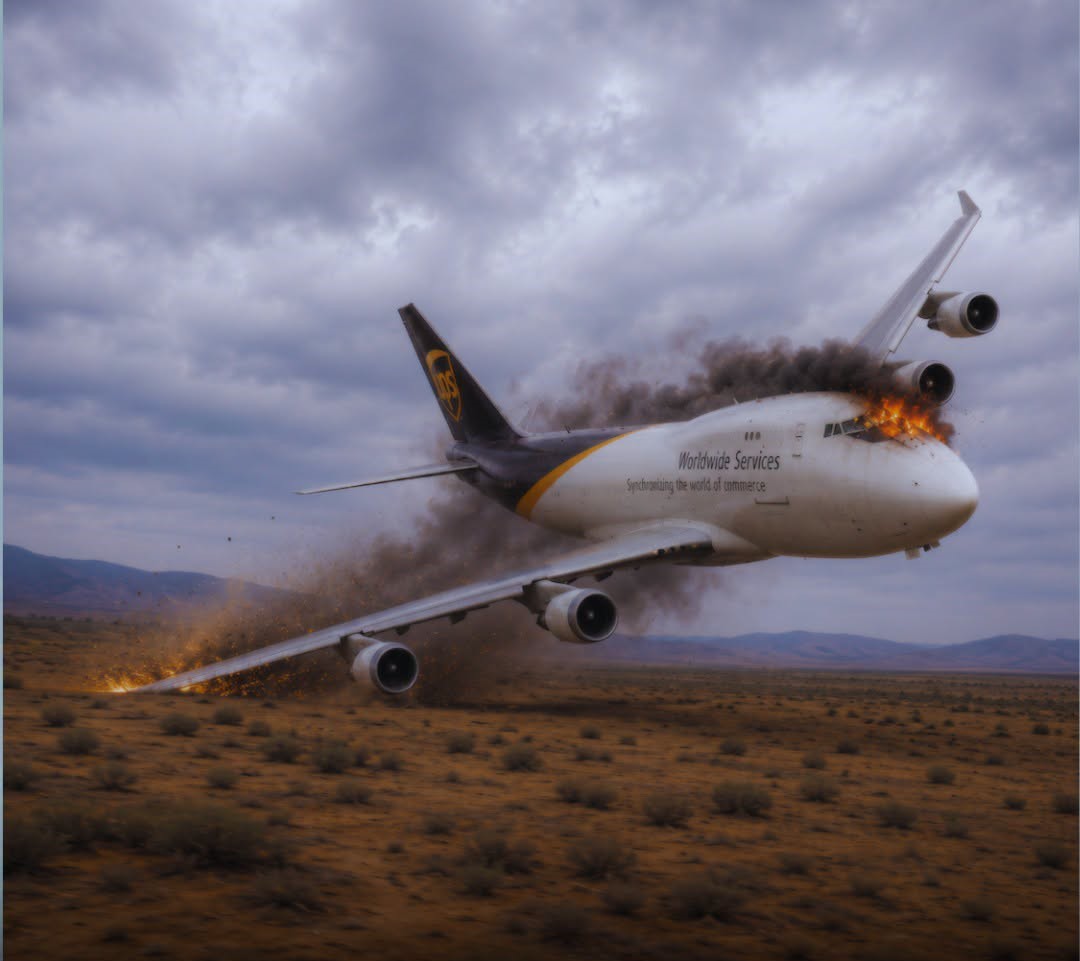
At about 7:42 p.m., radar contact was lost. Moments later, the burning 747 struck the ground at high speed in an unpopulated area near Dubai, between Emirates Road and the Al Ain Highway. The right wing hit first, and the aircraft skidded before erupting into a massive fireball. Both pilots were killed instantly. There were no fatalities on the ground.
The investigation by the UAE General Civil Aviation Authority, assisted by the U.S. National Transportation Safety Board, found that the fire originated in cargo containing more than 81,000 lithium batteries along with other combustible materials.
Investigators determined that the batteries underwent thermal runaway and autoignition, producing an intense fire that overwhelmed the aircraft’s defenses. The cargo fire also caused failures that allowed smoke to rapidly invade the cockpit.
The investigation highlighted another crucial problem: the main-deck cargo liner failed as the fire intensified, allowing the blaze to spread and damage critical aircraft systems. The time between the fire warning and major aircraft system failures was only about two and a half minutes.
The crash became a major turning point in aviation’s understanding of lithium-battery fire risks aboard aircraft. The FAA subsequently issued safety guidance concerning lithium batteries, while Boeing modified 747-400F emergency procedures to address smoke accumulation in the cockpit.
The accident also renewed calls for improved smoke protection and active fire-suppression systems on cargo aircraft.
UPS Flight 6 was the first fatal accident in UPS Airlines’ history. Its two-person crew had fought a rapidly escalating fire, failing flight controls, overwhelming smoke and deteriorating visibility until there was simply no longer a survivable way to bring the aircraft down safely.