
A Routine Helicopter Flight Vanished Into the Nallamala Forest During a Violent Storm.
On 2 September 2009, a routine official helicopter journey in Andhra Pradesh turned into one of India’s most closely watched aviation disasters.
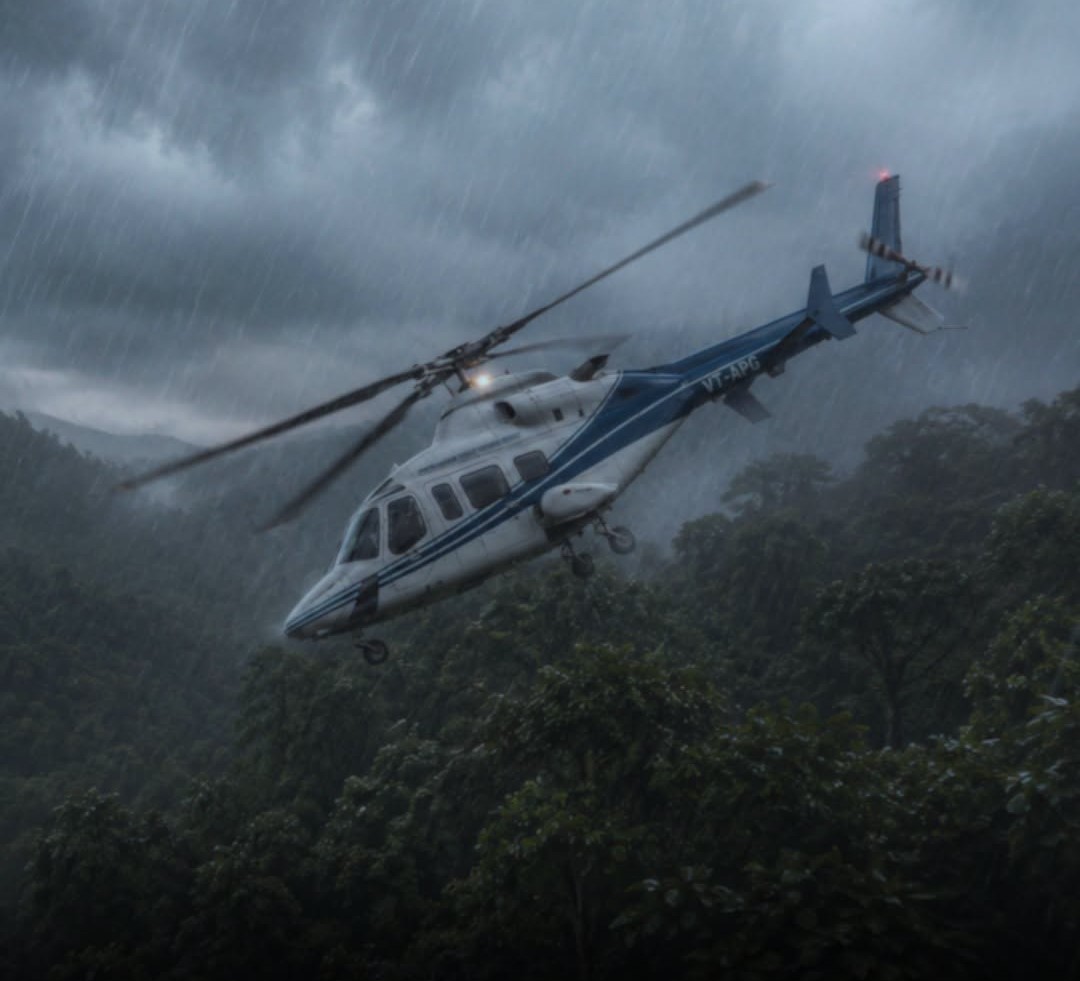
The Bell 430, registration VT-APG, operated by the Andhra Pradesh Government, was carrying Chief Minister Y. S. Rajasekhara Reddy, his principal secretary P. Subramanyam, chief security officer A. S. C. Wesley, and two pilots, Group Captain S. K. Bhatia and Captain M. S. Reddy. All five would die before the day was over.
The helicopter departed Begumpet Airport in Hyderabad at about 8:38 a.m., heading towards Chittoor district. Soon after takeoff, the crew encountered deteriorating weather.
The aircraft’s weather radar reportedly showed extremely severe weather, and the pilots altered their intended route to avoid the worst conditions. They planned to turn after crossing the Krishna River, but the helicopter continued into the increasingly difficult weather over the heavily forested Nallamala region.
At around 9:20 a.m., another problem suddenly complicated the flight: the crew detected an abnormal transmission oil-pressure indication. Instead of immediately abandoning the flight or turning back, the pilots became occupied with identifying the problem and searching for the appropriate emergency checklist procedure.
The investigation later found that they spent more than six minutes focused on the transmission-oil-pressure issue while the weather around them continued to deteriorate.
The situation became critical in the final moments. The helicopter was operating in instrument meteorological conditions even though its flight plan had been cleared for visual flight rules.
Investigators found no meaningful discussion among the crew about diverting, returning to base or terminating the flight because of the weather. In the last 14 seconds, the aircraft entered an extremely high rate of descent. The helicopter lost control in a downdraught and struck the terrain in a steep left bank near Rudrakonda Hill in Kurnool district. There were no survivors.
What followed was a massive search operation. Poor visibility, heavy rain and the dense forest made the search extremely difficult. Thousands of security personnel were deployed, while the Indian Air Force used aircraft including Sukhoi-30MKI fighters equipped with thermal-imaging capabilities.
Ground teams, police units, Greyhounds personnel and local tribal residents searched the forest. ISRO also provided satellite imagery, but dozens of high-resolution images initially failed to locate the wreckage.
The breakthrough came the following morning. At about 8:20 a.m. on 3 September, an Indian Air Force Mi-8 helicopter spotted the wreckage, less than 24 hours after the aircraft disappeared from contact. The crash site was in rugged, heavily forested terrain.
The bodies were badly burned and identification reportedly had to rely partly on clothing. The Prime Minister’s Office subsequently confirmed that Y. S. Rajasekhara Reddy and all four other occupants had died.
The investigation also dispelled early speculation that the helicopter might have been brought down by Maoist insurgents operating in the region. The Central Bureau of Investigation later ruled out conspiracy or sabotage and concluded that the accident could have been prevented if the pilots had terminated the flight or changed course in response to the adverse weather.
Investigators also uncovered serious concerns about the helicopter’s maintenance. A probe report said the aircraft had been poorly maintained and was not airworthy, while the Andhra Pradesh Aviation Corporation Limited had failed to maintain a proper snag register. The report also highlighted concerns over maintenance practices and the crew’s decision to continue despite the worsening conditions.
Ultimately, the tragedy was not attributed to one isolated failure. It was the result of a dangerous combination of worsening weather, flight into conditions beyond the approved visual-flight plan, crew fixation on a technical problem, loss of situational awareness and deficiencies in aircraft maintenance.
The crash remains a stark reminder of how rapidly multiple manageable risks can combine into an irreversible aviation disaster.