
On August 28, 1993, one of the deadliest aviation disasters in the history of Tajikistan unfolded at Khorog Airport, in the mountainous Gorno-Badakhshan region.
What makes the tragedy particularly shocking is that the aircraft was not simply overloaded by mistake: armed men reportedly forced the crew to accept far more passengers than the aircraft was designed to carry and then ordered the pilots to take off under threat of death.
The aircraft was a Yakovlev Yak-40 operated by Tajikistan Airlines, registration EY-87995. It was scheduled to fly from Khorog to Dushanbe. There were 86 people on board: five crew members and 81 passengers, including 14 children. Only four passengers survived. All five crew members and 77 passengers were killed, bringing the death toll to 82. T
he crash remains the deadliest accident involving a Yak-40 and the deadliest aviation accident recorded in Tajikistan.
The circumstances surrounding the flight were inseparable from the Tajik Civil War, which was raging across the country. Khorog and the surrounding area were under the influence of armed groups, and the airport was operating in an extremely difficult security environment.
According to accounts of the accident, Tajikistan Airlines management had already warned authorities in July 1993 that armed opposition groups were interfering with normal operations at Khorog Airport.
The Yak-40 involved in the disaster had been built in 1975 and was about 18 years old at the time. It was a three-engine regional jet, and the aircraft involved was configured with only 28 passenger seats. Other accounts state that the aircraft’s certified maximum passenger capacity was 32. Either way, the number of people eventually forced aboard was vastly beyond what the aircraft was intended to carry.
The flight was being used in connection with the chaotic conditions of the civil war. As passengers were boarding, armed fighters approached the aircraft and reportedly fired shots to stop the normal boarding process. They forced passengers who were already inside the aircraft to get off and then began deciding themselves who would board. The crew attempted to intervene, but the armed men prevented them from controlling the boarding process.
Eventually, 81 passengers were put aboard the Yak-40. Among them were women, children and soldiers. Fourteen of the passengers were children. The aircraft was now grossly overloaded.
The consequences of that decision were enormous. Investigators and accident records indicate that the aircraft’s maximum takeoff weight was exceeded by approximately 3,000 kilograms. In other words, the aircraft was carrying roughly three tonnes more than its permitted maximum takeoff weight. The problem was not merely that the cabin was crowded. The aircraft’s total mass was far beyond the limit at which its takeoff performance could safely be guaranteed.
The captain reportedly tried to explain to the armed men that the aircraft could not safely take off in that condition. The pilots initially refused to operate the flight. But the situation had moved beyond normal aviation decision-making. According to the detailed account published in German Wikipedia, the armed men pointed their weapons at the crew and fired a shot, effectively giving the pilots a choice between taking off and being killed. The crew ultimately complied.
The aircraft was therefore placed in the extraordinary position of attempting a takeoff that the crew knew was unsafe.
At approximately 10:46 a.m., the Yak-40 began its takeoff from Khorog Airport. The runway was the aircraft’s only chance of becoming airborne, but its excessive weight severely compromised its ability to accelerate and climb.
As the aircraft reached rotation speed, the pilots attempted to raise the nose. The nose gear lifted, but the aircraft itself failed to become airborne. It continued racing down the runway at high speed. The crew could no longer achieve the required performance to safely lift off.
Instead of climbing away, the Yak-40 ran beyond the end of the runway.
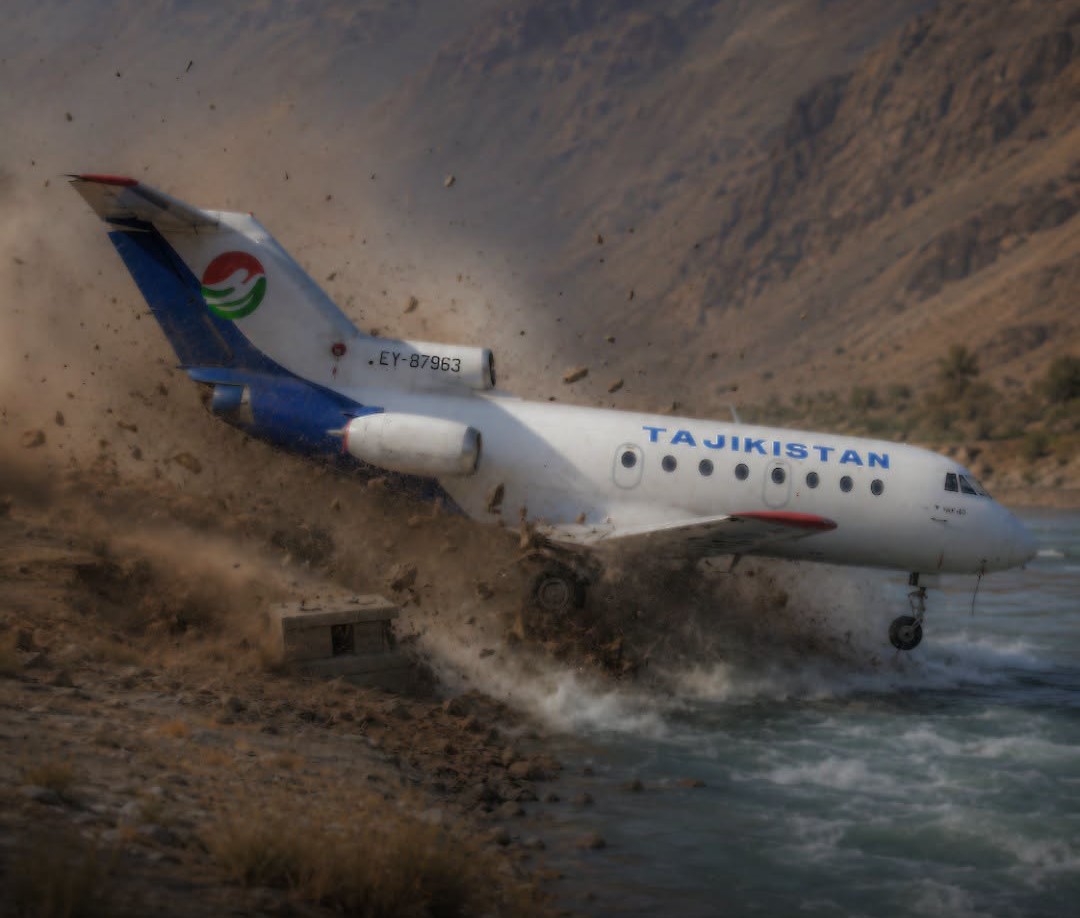
The first major obstacle came approximately 150 metres beyond the runway end. The aircraft’s left main landing gear struck a low earth embankment. It then struck a boulder approximately 60 centimetres high. About 60 metres farther on, the right main landing gear collided with a concrete pillbox or bunker.
The impacts severely damaged the aircraft and disrupted its trajectory. The Yak-40 ultimately plunged into the Panj River and broke apart. The aircraft was destroyed in the crash.
The aftermath was devastating. Emergency crews and ambulances reached the crash site, but the wreckage was burning, making it difficult for rescuers and doctors to immediately search for survivors. Several people were initially found alive and transported for medical treatment. Six people, including flight engineer Nisomiddin Burijew and another crew member, were reportedly taken to hospitals. The two surviving crew members later died from their injuries, leaving only four surviving passengers.
The final toll was therefore 82 dead and four survivors. All four survivors were passengers. The five crew members were among those killed.
The disaster was particularly tragic because the immediate technical failure was not a mysterious mechanical malfunction. The aircraft had failed to take off because it had been placed in an impossible operating condition.
The investigation and subsequent accident records identified the central cause as unlawful interference with aviation operations during the civil war. Armed men had forced the crew to accept an extraordinary number of passengers, taking the aircraft far beyond its certified capacity and approximately 3,000 kilograms above its maximum takeoff weight. With that excessive weight, the Yak-40 could not generate the performance needed to leave the runway safely.
This distinction is important. The pilots were not simply confronted with a routine case of poor judgment or an ordinary operational error. The available accounts indicate that the crew recognized the danger and initially refused to fly. They were then compelled to proceed by armed men. The accident was therefore a direct consequence of the collapse of normal aviation safety controls in a war zone.
There was also a disturbing warning sign before the accident. Tajikistan Airlines’ management had reportedly informed authorities in July that armed opposition groups were disrupting operations at Khorog Airport. Despite those concerns, the airport remained exposed to the armed interference that ultimately contributed to the disaster.
The accident records therefore point to a chain of events rather than a single isolated mistake: an airport operating amid civil war, armed groups taking control of passenger boarding, the crew being forced to accept 81 passengers, an approximately three-tonne excess over maximum takeoff weight, a takeoff performed under threat, failure to become airborne, a high-speed runway overrun, collisions with obstacles beyond the runway and finally the aircraft’s destruction in the Panj River.
The consequences extended beyond the loss of 82 lives. Following the crash, air traffic at Khorog was reportedly suspended for the remainder of the civil war, highlighting how seriously the security situation had compromised aviation operations in the region.
The August 28, 1993 crash remains an extraordinary example of how aviation disasters can result from circumstances far beyond the aircraft itself. The Yak-40 was capable of carrying out the short domestic flight from Khorog to Dushanbe, but the aircraft was never given a realistic opportunity to do so safely. The combination of armed coercion, extreme overloading and an unsafe takeoff created a situation from which the crew had virtually no way to recover.
In the end, the most chilling revelation was that the pilots reportedly knew the aircraft was dangerously overloaded before the takeoff began. They objected, but their professional judgment was overridden at gunpoint. The Yak-40 then entered the runway carrying nearly three times the number of passengers for which its 28-seat configuration had been arranged. Moments later, it failed to lift off and disappeared into the Panj River.
The tragedy is remembered not simply as a runway overrun, but as a disaster born from the intersection of aviation and civil war. It remains the deadliest Yak-40 accident ever recorded and the deadliest aviation disaster in Tajikistan.