
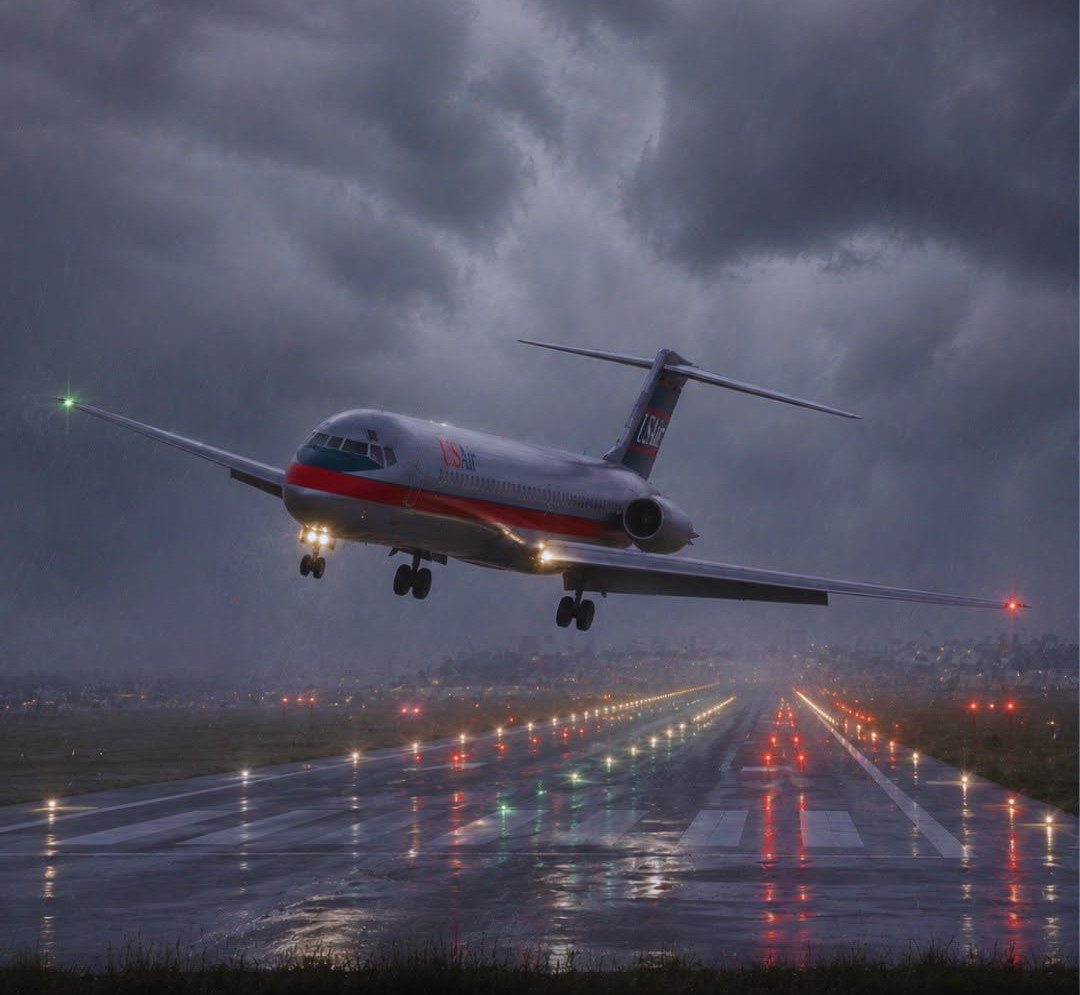
On July 2, 1994, what began as a routine 35-minute domestic flight turned into one of the deadliest weather-related aviation disasters in U.S. history. USAir Flight 1016, a McDonnell Douglas DC-9-31, was operating a short scheduled service from Columbia, South Carolina, to Charlotte, North Carolina.
The flight lasted barely half an hour, but in its final moments, an invisible and violent weather phenomenon known as a microburst overwhelmed the aircraft just seconds before landing, sending it crashing into trees and a residential neighborhood near Charlotte/Douglas International Airport.
The disaster claimed 37 lives and became a landmark case that reshaped windshear awareness and airport weather-warning procedures.
The aircraft departed Columbia Metropolitan Airport at approximately 6:15 p.m. with 52 passengers and five crew members on board. The flight itself was uneventful during cruise, and nothing suggested the crew would soon face one of aviation’s most dangerous weather hazards.
As the DC-9 approached Charlotte, thunderstorms were rapidly developing around the airport. Heavy rain, gusty winds, and lightning surrounded the final approach path, creating conditions favorable for powerful microbursts.
Despite the deteriorating weather, several aircraft had landed successfully ahead of Flight 1016, although pilots had reported increasingly unstable conditions. The crew of Flight 1016 continued the instrument approach to Runway 18R while monitoring the worsening weather.
Unknown to them, a rapidly intensifying thunderstorm had generated a powerful microburst directly along the aircraft’s landing path. Air traffic controllers had weather information available, but critical real-time windshear hazard information was not relayed effectively to the crew before the encounter.
As the aircraft descended through approximately 500 feet above the ground, it first encountered a strong headwind. Initially, this actually increased lift and airspeed, giving the illusion that the approach was stable. Seconds later, the aircraft flew into the core of the microburst, where the headwind abruptly transformed into a powerful downdraft followed by a severe tailwind.
Within moments, the aircraft experienced a dramatic loss of lift and airspeed. The rapid wind shift robbed the DC-9 of the performance needed to continue flying safely at such a low altitude.
Recognizing the deteriorating situation, the pilots initiated a missed approach and attempted to climb away. The first officer initially pitched the aircraft nose-up correctly, but engine thrust was not advanced to the required go-around power immediately. During the escape attempt, the aircraft’s nose attitude was lowered instead of maintaining the aggressive climb needed to escape the windshear. At the same time, the flaps were transitioning, reducing available lift during the most critical phase of flight. Compounding the emergency, the aircraft’s onboard windshear warning system failed to provide a timely alert due to a software-related issue, depriving the crew of several precious seconds that might have prompted an earlier escape maneuver.
The aircraft rapidly descended despite the crew’s efforts. At approximately 6:43 p.m., the DC-9 struck trees roughly half a mile short of the runway before slamming into a residential area. The aircraft collided with a private home, broke into several major sections, and burst into flames. The cockpit separated from the fuselage while the cabin was torn apart by the tremendous impact forces. The intense fire and structural breakup made survival impossible for many occupants.
Of the 57 people on board, 37 lost their lives while 20 survived, many with serious injuries. Miraculously, the occupants of the house struck by the aircraft survived despite the extensive destruction. Emergency responders rushed to the scene within minutes, battling both the wreckage fire and heavy rain. Survivors were pulled from the broken fuselage as firefighters extinguished flames and paramedics transported the injured to nearby hospitals. The crash deeply affected the Charlotte community, becoming one of the city’s darkest aviation tragedies.
The National Transportation Safety Board immediately launched an extensive investigation. Investigators recovered both the cockpit voice recorder and flight data recorder, allowing them to reconstruct the aircraft’s final moments in remarkable detail. Weather radar data, air traffic control recordings, and meteorological studies confirmed that the aircraft had encountered a powerful microburst generated by a rapidly developing thunderstorm positioned directly over the approach path.
The investigation concluded that the crash resulted from a combination of severe weather and human factors rather than a mechanical failure. The NTSB determined that the primary cause was the flight crew’s decision to continue the approach into an area where severe convective activity made a microburst likely. Investigators also found that the crew failed to recognize the developing windshear quickly enough and did not establish or maintain the proper pitch attitude and engine thrust necessary to escape once the windshear was encountered. Additionally, the aircraft’s windshear alerting system failed to provide a timely warning because of a software deficiency, and air traffic control did not provide the crew with the most current adverse weather information available.
One of the most revealing findings was just how quickly the wind changed. Data showed the aircraft transitioned from a significant headwind to a powerful tailwind within only about 14 seconds, producing a total wind change of approximately 61 knots. Such an extreme and sudden reversal dramatically reduced lift, leaving the aircraft with insufficient altitude and energy to recover despite the pilots’ efforts.
The tragedy led to significant improvements in aviation safety. Airlines reinforced pilot training on microburst recognition and escape procedures, weather surveillance systems at airports continued to improve, and refinements were made to airborne windshear detection and alerting technology. Air traffic control procedures were also strengthened to ensure that critical weather information reaches flight crews more rapidly during rapidly changing thunderstorm conditions. The lessons learned from Flight 1016 have since helped pilots better recognize and respond to one of aviation’s most dangerous weather phenomena.
More than three decades later, USAir Flight 1016 remains a powerful reminder that even a short routine flight can become catastrophic when severe weather, incomplete situational awareness, and seconds of delayed response converge. The accident continues to be studied worldwide by pilots, investigators, and aviation safety experts as one of the defining cases in understanding microburst-induced windshear and its devastating consequences.