
On the night of June 20, 2011, RusAir Flight 9605 was operating a domestic passenger service from Moscow’s Domodedovo Airport to Petrozavodsk in Russia’s Republic of Karelia.
The aircraft involved was a Tupolev Tu-134A, a Soviet-era twin-engine airliner carrying 52 people, including passengers and crew. What should have been a routine late-night flight ended in one of Russia’s deadliest aviation accidents of the decade when the aircraft crashed just short of the runway during its final approach.
The flight departed Moscow at approximately 10:24 p.m. local time and proceeded normally toward Petrozavodsk. As the aircraft neared its destination shortly before midnight, weather conditions around the airport began deteriorating rapidly.
Dense fog reduced visibility far below normal landing conditions, making the approach increasingly challenging for the crew. Air traffic controllers advised the pilots about the worsening weather, and visibility had dropped below the airport’s prescribed landing minimums.
Despite the poor conditions, the crew decided to continue the approach instead of diverting to an alternate airport or initiating a go-around.
During the approach, the crew faced another critical problem. Petrozavodsk Airport lacked modern precision approach systems, forcing crews to rely heavily on radio navigation aids. Instead of primarily using the approved radio-beacon guidance system, the flight navigator chose to rely on the aircraft’s KLN-90B GPS unit. Although the GPS could be used as a supplemental navigation aid, regulations specifically prohibited using it as the primary reference during final approach.
Investigators later discovered that the navigator had entered airport coordinates that were based on an older Soviet mapping system directly into a GPS that operated on the WGS-84 global coordinate system. Because the necessary conversion was not performed, the GPS guided the aircraft toward a point approximately 130 meters to the right of the actual runway centerline and beyond the runway threshold. As a result, the aircraft gradually drifted off the proper approach path without the crew fully realizing the extent of the deviation.
As the Tupolev descended through the fog, the crew lost situational awareness. Instruments that could have revealed the deviation were either not properly monitored or their indications were not given sufficient attention. Investigators found that crew coordination had broken down. The navigator became unusually influential in decision-making, while the captain followed his guidance. The first officer played almost no meaningful role during the final moments of the flight, creating a dangerous cockpit environment where critical checks and balances were absent.
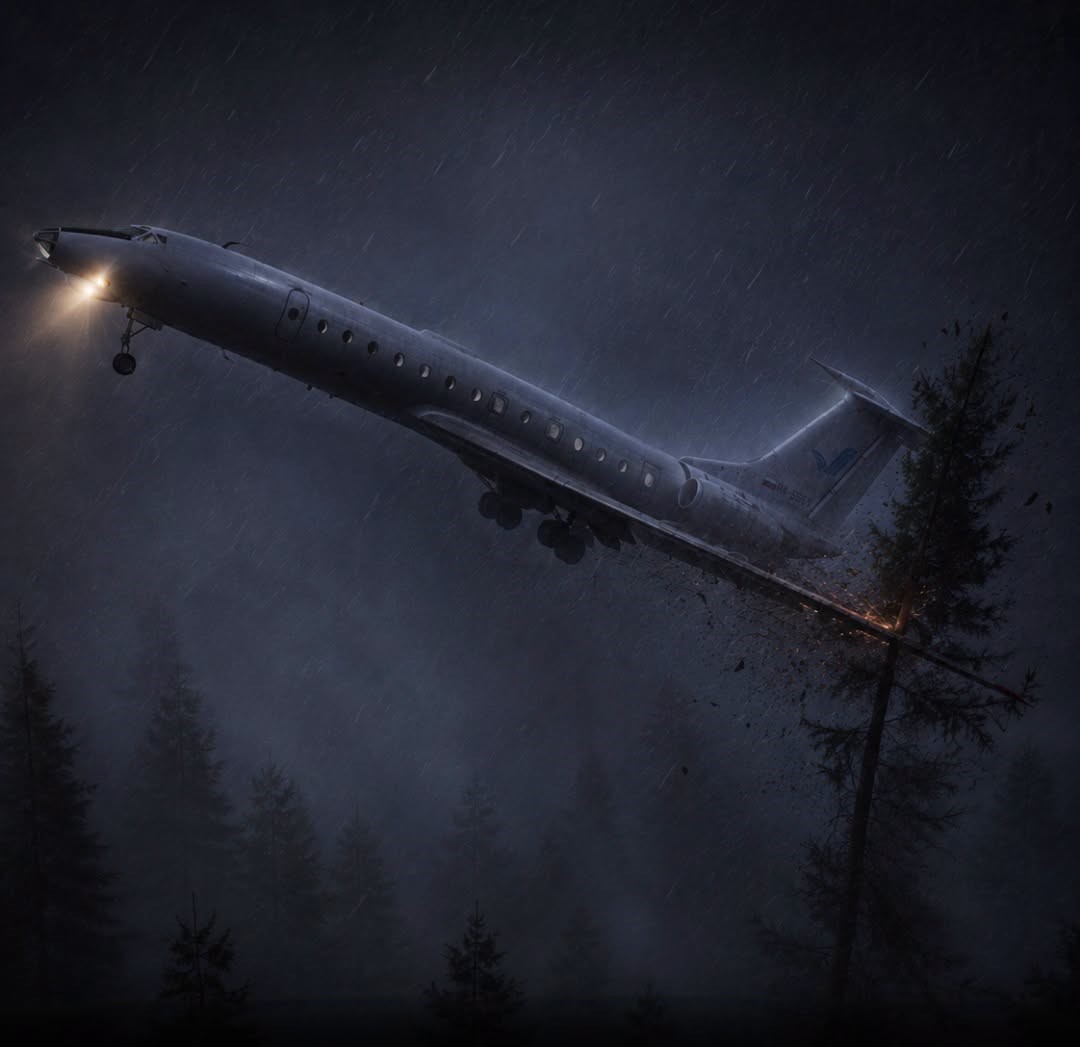
The aircraft continued descending below the minimum safe altitude even though the crew had not established the required visual contact with the runway environment. Still enveloped by fog and offset from the runway, the Tu-134 flew dangerously low over terrain. At approximately 11:40 p.m. local time, the aircraft’s left side clipped trees near the airport. Seconds later, it struck additional obstacles, crashed onto a nearby highway, broke apart, and burst into flames. The wreckage came to rest roughly 1.2 kilometers short of the runway.
The impact and post-crash fire were devastating. Forty-seven of the fifty-two people on board lost their lives. Only five survived, many with severe injuries. Rescue crews rushed to the scene and worked through the night amid difficult conditions. The accident shocked Russia and reignited concerns about aging aircraft, airport infrastructure, and flight safety practices throughout the country.
Investigators from the Interstate Aviation Committee (MAK) recovered the flight data recorder and cockpit voice recorder, both of which had survived the crash and contained usable data. Analysis of the recordings allowed investigators to reconstruct the final minutes of the flight in detail.
The final investigation report, published in September 2011, concluded that the immediate cause of the accident was the crew’s decision to continue the approach in weather conditions below the minimums established for the airport, aircraft, and captain. The crew failed to execute a go-around and descended below the minimum safe altitude without visual contact with the runway or approach lights, resulting in a controlled flight into terrain.
One of the most startling revelations was that the navigator was found to have been under the influence of alcohol. Toxicology results indicated a low but measurable level of alcohol intoxication. Investigators concluded that his condition likely affected judgment and contributed to poor decision-making during the approach. The report also highlighted serious crew resource management failures, noting that the captain allowed the navigator to dominate operational decisions while the first officer was effectively excluded from the control loop.
The investigation also identified several additional contributing factors. Weather forecasts did not accurately reflect the severity of the fog that developed around the airport. The airport’s navigation and lighting infrastructure was limited, and some lighting issues reduced the visibility of runway references. Investigators further criticized the crew’s failure to cross-check GPS information against approved radio-navigation instruments that could have revealed the aircraft’s dangerous deviation from the correct approach path.
In the aftermath, the crash became a textbook example of how multiple small failures can combine into a catastrophe. Poor weather, inadequate navigation procedures, improper GPS use, alcohol impairment, ineffective cockpit teamwork, and the decision to continue an unstable approach all contributed to the tragedy. Aviation safety experts often cite RusAir Flight 9605 as a powerful reminder that technology can never replace disciplined adherence to procedures and that effective crew coordination remains one of the most important defenses against disaster.