
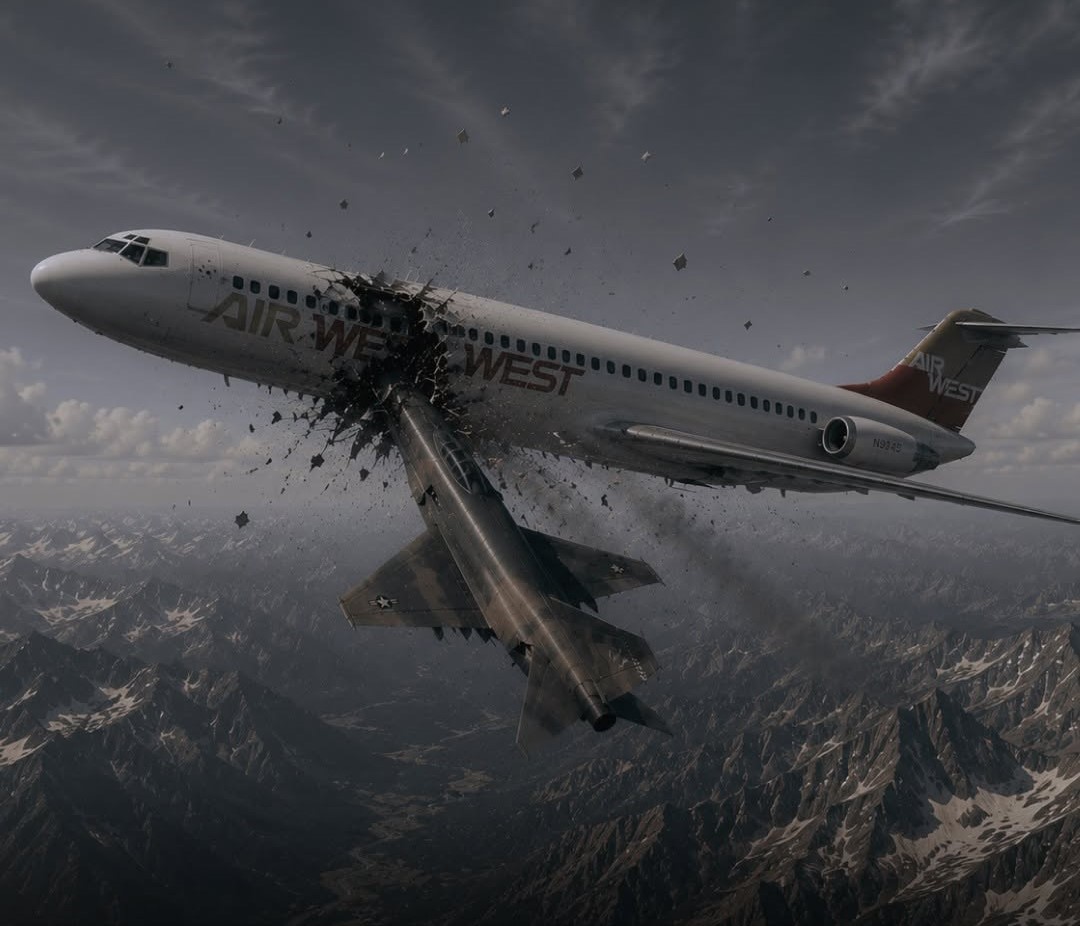
On June 6, 1971, one of the deadliest mid-air collisions in American aviation history unfolded over the rugged San Gabriel Mountains of Southern California. Hughes Airwest Flight 706, a McDonnell Douglas DC-9 carrying 44 passengers and five crew members, had departed Los Angeles International Airport on a scheduled multi-stop journey to Seattle. At nearly the same time, a United States Marine Corps F-4B Phantom II fighter jet was returning toward Marine Corps Air Station El Toro after a flight from Nevada. What happened next would claim 50 lives and trigger major changes in the way military and civilian aircraft shared American airspace.
Flight 706 departed Los Angeles shortly after 6:00 p.m. and began climbing under instrument flight rules (IFR) while under radar control from Los Angeles Air Route Traffic Control Center. Meanwhile, the Marine F-4B Phantom II was operating under visual flight rules (VFR) at approximately 15,500 feet. Unlike the airliner, the fighter was relying primarily on the pilots’ ability to visually detect and avoid other aircraft. The two aircraft were converging rapidly in the same airspace over the San Gabriel Mountains near Duarte, California.
Investigators later determined that the fighter crew had performed a 360-degree aileron roll during the flight. Contrary to some early media reports that described it as “stunting,” the maneuver was intended to help the crew visually check for traffic above and below the aircraft. Unfortunately, the maneuver did not prevent the impending collision.
At approximately 6:11 p.m., the two aircraft met at an altitude of about 15,150 feet. Investigators found that the fighter pilot attempted an evasive maneuver moments before impact, but there was simply not enough time. The closing speed between the aircraft was enormous; later NTSB calculations compared it to the muzzle velocity of a .45-caliber bullet. The F-4’s right wing struck the forward passenger cabin of the DC-9, while its vertical stabilizer sliced through the airliner’s cockpit area. The impact was catastrophic.
The DC-9 immediately broke apart. Witnesses on the ground reported hearing a loud explosion and seeing flaming debris falling from the sky. The airliner cartwheeled uncontrollably before crashing into Mount Bliss in the San Gabriel Mountains. Everyone aboard the DC-9 was killed instantly. The fighter jet also suffered fatal damage. Its tail section was torn away, sending the aircraft into a violent tumble. Radar Intercept Officer Christopher Schiess successfully ejected and parachuted to safety, becoming the sole survivor of the disaster. Pilot Lieutenant James Phillips was unable to escape and died in the crash.
The collision scattered wreckage across more than a mile of steep, inaccessible mountain terrain. Burning debris ignited several brush fires, complicating rescue and recovery efforts. Helicopters and ground crews struggled with difficult terrain and poor visibility as they searched for victims and wreckage. Investigators recovered both the flight data recorder and cockpit voice recorder from the DC-9, providing valuable evidence about the final moments before the collision.
The National Transportation Safety Board conducted a lengthy investigation involving the FAA, the Marine Corps, Hughes Airwest, and pilot organizations. Early findings showed that the fighter crew attempted to avoid the collision at the last moment and that only a few additional feet of separation might have prevented impact. However, investigators concluded that neither crew had adequate time to detect, assess, and avoid the other aircraft once visual contact was established.
One of the most significant revelations involved the limitations of the “see and avoid” system that governed many flights operating under visual flight rules. The NTSB concluded that the combination of high-speed military aircraft and civilian airliners in congested airspace created a dangerous situation. The investigation also found that the fighter jet’s transponder was not operating and that the crew had not requested radar advisory services, reducing the effectiveness of air traffic monitoring. The board determined that the mixing of IFR and VFR traffic in the same area, combined with the extremely high closing speed, played a major role in the accident.
Investigators uncovered another startling issue. The F-4B Phantom’s ejection-seat and canopy design contained a flaw that could prevent the pilot from ejecting if the rear-seat officer ejected first. The aircraft involved in the crash still carried the older canopy system and had not yet received planned modifications. The NTSB concluded that both fighter crew members might have survived the collision had the ejection system functioned differently. This finding led to additional scrutiny and improvements in military aircraft escape systems.
The NTSB’s final report, released in 1972, identified the probable cause as the failure of both aircraft crews to see and avoid each other, while acknowledging that both crews had only a marginal opportunity to do so. The board emphasized the limitations of visual separation at modern jet speeds and highlighted weaknesses in the air traffic control system’s ability to separate VFR and IFR traffic effectively.
The aftermath of Flight 706 extended far beyond the mountains where the wreckage fell. Public outrage and political pressure prompted calls for stricter regulation of military flights near civilian air corridors. The FAA and the U.S. military eventually agreed to reduce military VFR operations in busy civilian airspace and increase the use of instrument flight rules. Aviation organizations also pushed for wider use of transponders, radar advisory services, collision-avoidance measures, and improved air traffic surveillance. Many of the lessons learned from Flight 706 contributed to the gradual development of the safer, more integrated airspace system used today.
Fifty people lost their lives that evening over the San Gabriel Mountains. Yet the tragedy of Hughes Airwest Flight 706 became a turning point in aviation safety, exposing the dangers of relying solely on visual separation in the jet age and helping shape reforms that continue to protect passengers and pilots more than five decades later.