
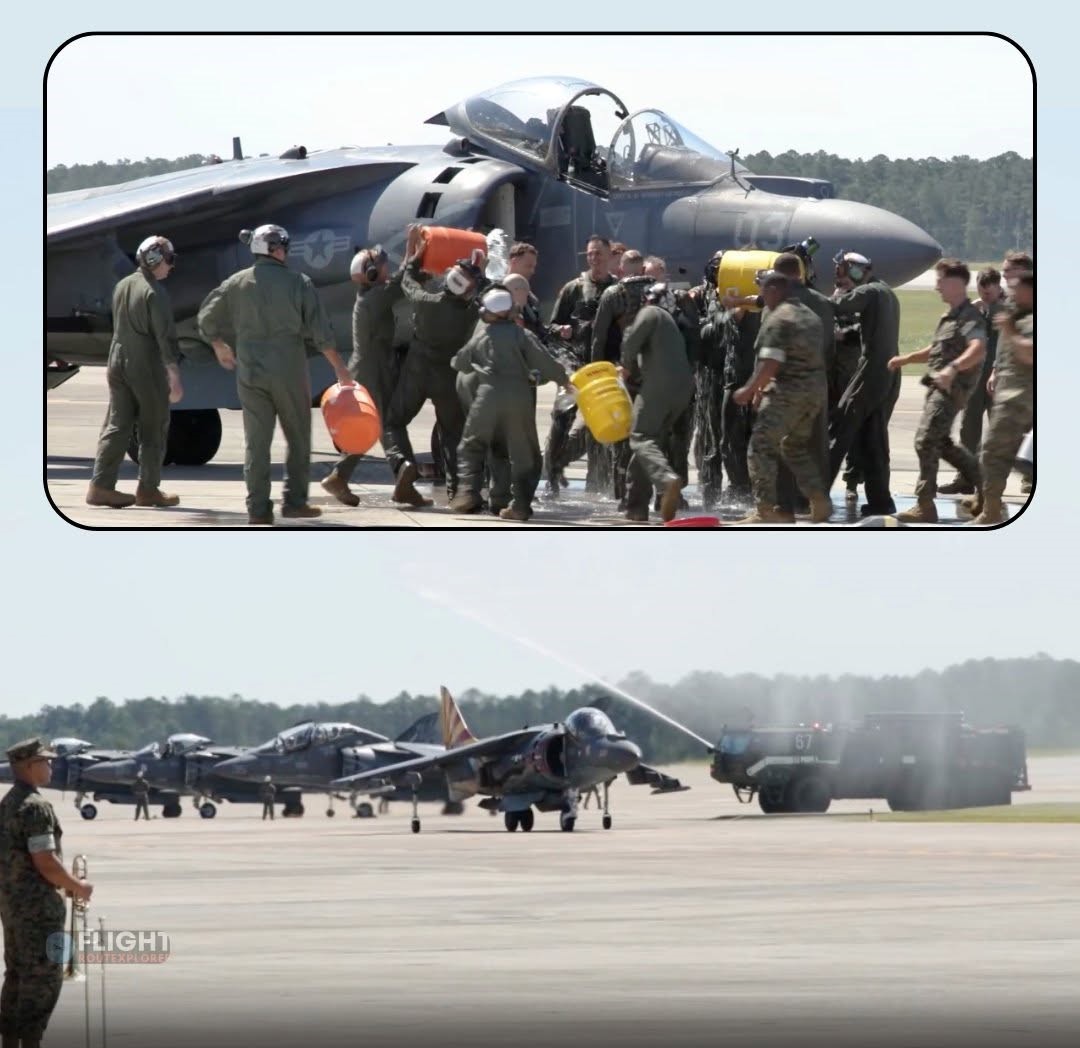
June 3, 2026, marked a historic moment in military aviation as the United States Marine Corps officially bid farewell to the iconic AV-8B Harrier II during a special “Sundown Ceremony” at Marine Corps Air Station Cherry Point, North Carolina. After more than four decades of service, the legendary aircraft completed its final official Marine Corps flight, closing one of the most remarkable chapters in aviation history.
Known worldwide as the “Jump Jet,” the Harrier revolutionized military aviation with its unique Vertical/Short Takeoff and Landing (V/STOL) capability. Unlike conventional fighter aircraft, the Harrier could take off from short runways, rough forward operating bases, and amphibious assault ships, giving Marines unprecedented flexibility in combat zones. The aircraft first entered Marine Corps service in the 1970s, while the improved AV-8B Harrier II variant joined the fleet in 1985.
The farewell ceremony featured five Harriers flying in formation before landing in front of service members, veterans, and aviation enthusiasts who gathered to witness aviation history. The final operational Harriers belonged to Marine Attack Squadron 223 (VMA-223), the last active Harrier squadron in the Marine Corps.
Throughout its service life, the Harrier supported Marine operations around the globe, earning a reputation for reliability, versatility, and its unmistakable hovering capability. Even in its final weeks, the aircraft remained operational, concluding deployments before its retirement.
As the Harrier leaves active service, the Marine Corps is transitioning to the F-35B Lightning II, a fifth-generation stealth fighter that also possesses short takeoff and vertical landing capabilities. While the F-35B represents the future, many aviation enthusiasts agree that the Harrier’s unique legacy will never be forgotten.
Farewell, Harrier. For generations of Marines and aviation fans, the sound of those vectored-thrust engines and the sight of a fighter jet hovering above the runway will remain unforgettable.