
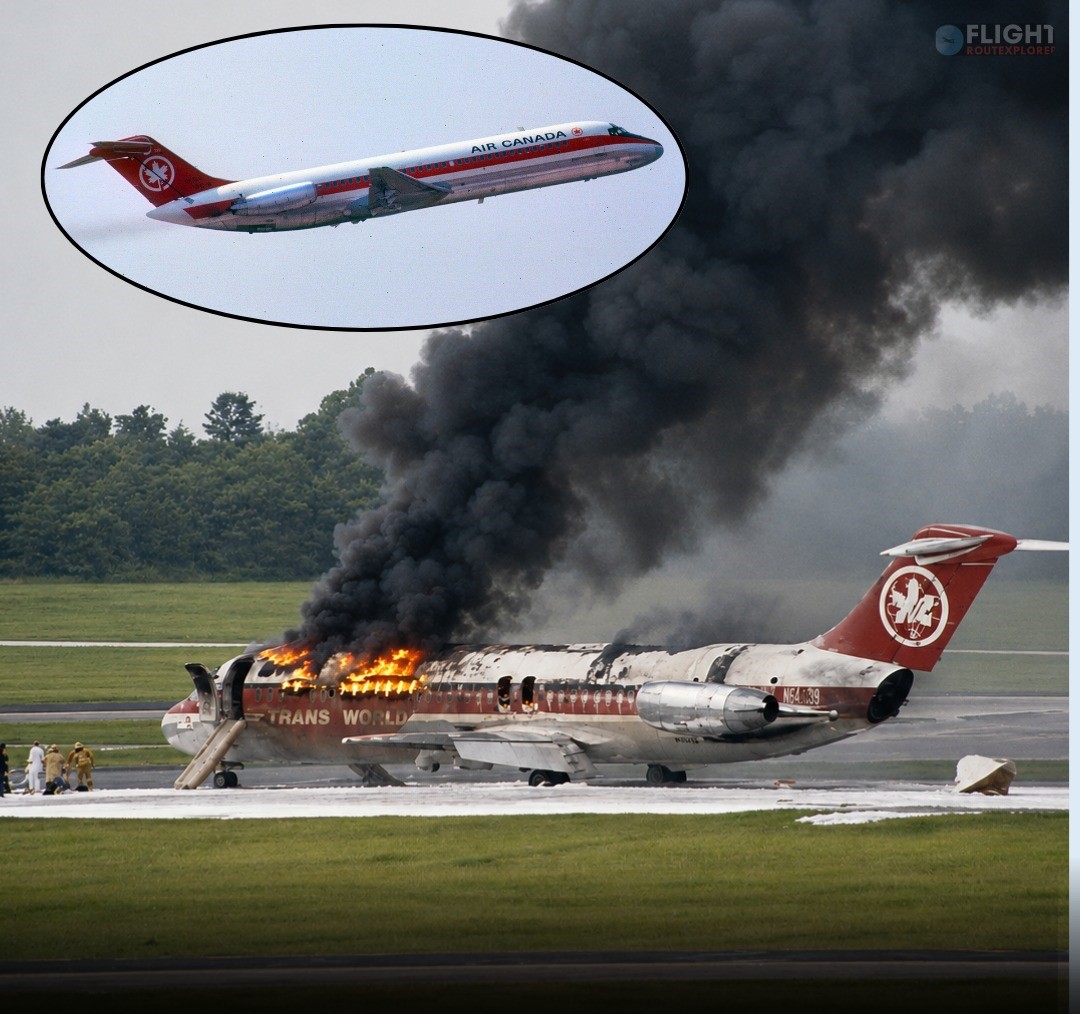
On June 2, 1983, Air Canada Flight 797 became the center of one of aviation’s most important safety disasters. In a tragic twist, the pilots successfully landed the aircraft after an in-flight fire, but a deadly flash fire erupted just moments after touchdown, killing 23 people who had survived the emergency landing. The accident would ultimately transform aircraft fire safety standards around the world.
Air Canada Flight 797 was a regularly scheduled international service from Dallas, Texas, to Montreal, Canada, with an intermediate stop in Toronto. The aircraft was a McDonnell Douglas DC-9-32 carrying 41 passengers and 5 crew members. The flight departed Dallas normally and climbed to its cruising altitude of approximately 33,000 feet.
The first signs of trouble appeared during the evening cruise portion of the flight when passengers and flight attendants noticed an unusual odor coming from the rear of the aircraft. Initially, the smell did not immediately indicate a major emergency because smoking was still common aboard commercial airliners in 1983. Within minutes, however, smoke began seeping from the left rear lavatory. Flight attendants investigated and discovered that a hidden fire was burning somewhere behind the lavatory walls rather than inside the compartment itself.
Crew members attempted to locate and extinguish the fire, but they faced a critical problem. The flames were concealed behind interior panels, making them inaccessible to handheld fire extinguishers. As smoke spread through the cabin, the flight crew was informed of the worsening situation. The captain initially received reports suggesting that the fire might be under control, but the true severity of the blaze remained unknown. This misunderstanding would later become an important factor in the investigation.
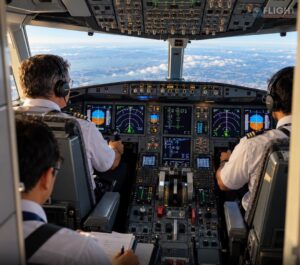
Realizing the aircraft was in danger, the pilots declared an emergency and began a rapid descent toward the nearest suitable airport, Cincinnati/Northern Kentucky International Airport in Kentucky. As the fire spread behind the cabin walls, it burned through electrical wiring and disabled numerous cockpit instruments and systems. Smoke also began entering the cockpit, making communication and aircraft control increasingly difficult. Despite the deteriorating conditions, the crew managed to navigate the aircraft toward Cincinnati.
At approximately 7:20 p.m. local time, the DC-9 landed safely on the runway. Airport firefighters were already in position, prepared to respond. To many on board, the worst seemed to be over. The aircraft came to a stop and evacuation immediately began through several exits. Passengers and crew rushed toward the doors while firefighters moved in to attack the fire from outside.
Then disaster struck.
Roughly 60 to 90 seconds after the doors were opened, fresh oxygen rushed into the smoke-filled cabin. The intense heat that had built up inside the aircraft combined with the incoming air and triggered a flash fire, often described as a backdraft-like event. In an instant, the entire interior became engulfed in flames and toxic gases. Passengers who had not yet escaped were trapped. Twenty-three people died, most from smoke inhalation and toxic fumes, while 23 others survived. Among the victims was renowned Canadian folk singer Stan Rogers.
Investigators faced a difficult challenge when examining the wreckage. The fire had destroyed much of the evidence. They determined that the fire originated in or near the rear lavatory area and spread through hidden spaces between the aircraft’s outer skin and interior panels. However, despite extensive investigation, the exact ignition source could never be conclusively identified. The National Transportation Safety Board ultimately classified the origin as undetermined.
The investigation revealed several critical findings. The severity of the fire had been underestimated during the early stages of the emergency, and information passed to the captain suggested conditions were less serious than they actually were. Investigators also concluded that the time spent assessing the fire before beginning the emergency descent allowed the blaze to spread further. Meanwhile, toxic smoke and gases accumulated rapidly inside the cabin, creating a deadly environment long before flames became visible.
Another alarming discovery was how quickly fire could spread through cabin materials. Interior furnishings, wall panels, insulation, wiring, and other components produced large amounts of toxic smoke when exposed to fire. The accident demonstrated that passengers could be incapacitated by smoke and gases even before flames reached them.
The aftermath of Flight 797 led to sweeping aviation safety reforms worldwide. Smoke detectors became mandatory in aircraft lavatories. Automatic fire extinguishing systems were added to lavatory waste bins. Emergency floor-path lighting was introduced to help passengers find exits in smoke-filled cabins. Fire-resistant cabin materials were developed and required on new aircraft. Crew training for in-flight fire emergencies was significantly enhanced, and evacuation certification standards were strengthened. Aircraft manufacturers were also required to demonstrate that passengers could evacuate within 90 seconds under emergency conditions.
Today, Air Canada Flight 797 is remembered not only for the tragedy that claimed 23 lives, but also for the profound lessons it taught the aviation industry. The accident showed that an in-flight fire can be one of the most dangerous emergencies an aircraft can face, and many of the fire-safety features passengers take for granted today exist because of the hard lessons learned from that summer evening in 1983.