
Today in 1999, a passenger jet carrying 145 people raced a powerful thunderstorm toward Little Rock, Arkansas, in a desperate attempt to land before the weather completely closed in. Just minutes later, the aircraft would slide off the runway at highway speeds, tear through airport structures, break apart in the darkness, and become one of the most studied weather-related airline disasters in modern American aviation history.
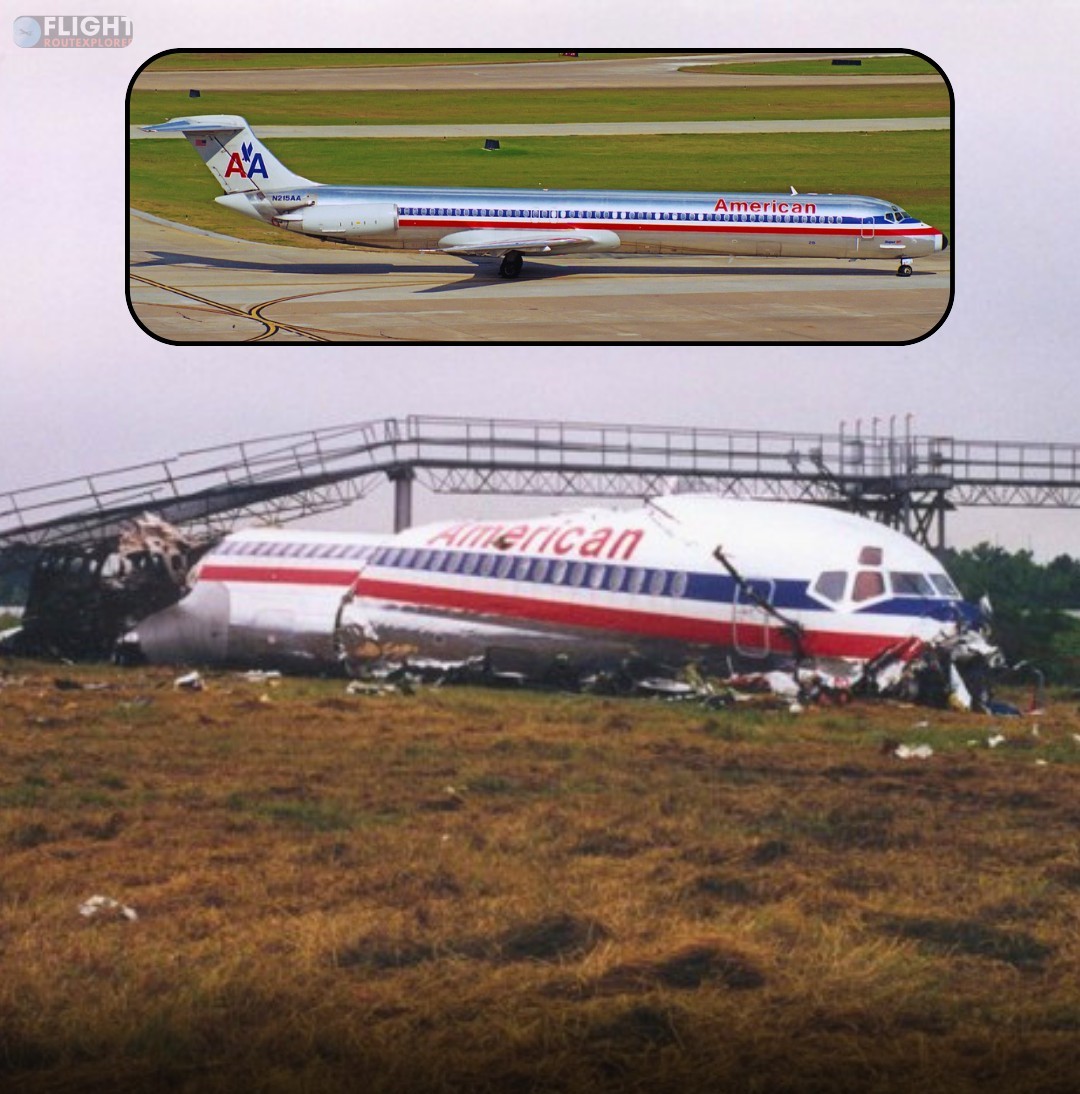
On the night of June 1, 1999, American Airlines Flight 1420, a McDonnell Douglas MD-82, was operating a scheduled flight from Dallas/Fort Worth, Texas, to Little Rock, Arkansas. The crew had already completed multiple flight segments during the day and were approaching the end of a long duty period. Weather across the region had been deteriorating for hours, with severe thunderstorms moving toward Little Rock.
Before departure and during the flight, the crew received numerous weather advisories warning of intense storms, heavy rain, lightning, strong winds, and hazardous conditions near the airport. Despite these warnings, the flight continued toward Little Rock. Investigators later found that the crew never seriously discussed diverting to another airport or delaying the arrival, even as the storm intensified.
As Flight 1420 approached Little Rock shortly before midnight, the airport was being battered by thunderstorms. Lightning flashed around the airport, heavy rain reduced visibility, and wind conditions were changing rapidly. Air traffic controllers informed the crew about the worsening weather and runway conditions. The pilots requested an expedited approach, hoping to land before the strongest part of the storm reached the airport.
The approach quickly became complicated. The storm was moving directly across the airport, creating an extremely demanding environment for the crew. As the aircraft descended, the pilots were forced to manage changing winds, rain, darkness, and the pressure of completing the flight before their duty limits expired. Investigators later concluded that the crew was experiencing significant workload and stress during these final minutes.
At approximately 11:50 p.m. local time, Flight 1420 touched down on Runway 4R. However, several critical problems emerged almost immediately. The aircraft landed long on the runway, reducing the available stopping distance. More importantly, investigators determined that the automatic spoiler system had not been armed before landing. Spoilers are panels on the wings that help destroy lift after touchdown and transfer the aircraft’s weight onto the wheels, allowing brakes to work effectively. Because the spoilers did not deploy as intended, the aircraft’s braking performance was severely reduced on the rain-soaked runway.
The pilots attempted to slow the aircraft using brakes and reverse thrust, but the MD-82 continued sliding down the runway. The heavy rain further reduced tire grip, and the aircraft was unable to stop before reaching the end of the pavement. At high speed, the jet overran the runway and smashed through structures beyond the airport boundary.
After leaving the runway, the aircraft struck the instrument landing system localizer structure, crashed through a security fence, plunged down an embankment, and collided with the support structure for the runway approach lights. The violent impact ripped the aircraft apart. Sections of the fuselage separated, and a post-crash fire erupted amid heavy rain and darkness.
The crash scene was chaotic. Passengers who survived the initial impact struggled to escape through broken sections of the fuselage while rain, smoke, and fire surrounded the wreckage. Emergency responders faced difficult conditions due to the storm and the aircraft’s location beyond the runway. Many survivors later recalled crawling through wreckage and floodwater to reach safety.
The accident killed Captain Richard Buschmann and ten passengers. More than 100 other occupants suffered injuries ranging from minor to severe. Although the aircraft was destroyed, the survival of many passengers was credited to the actions of cabin crew members and rescuers who worked in dangerous conditions throughout the stormy night.
The National Transportation Safety Board launched a detailed investigation that examined every aspect of the flight. Investigators reviewed cockpit voice recordings, flight data, weather reports, crew schedules, airport design, and aircraft systems. One of the most important findings involved the spoiler system. Testing showed there was no evidence that the spoilers had been properly armed before landing, a mistake that dramatically reduced the aircraft’s ability to stop on the wet runway. Following the accident, American Airlines revised procedures to require additional spoiler verification during landing operations.
Investigators also focused heavily on the crew’s decision-making. Evidence suggested that the pilots felt pressure to complete the flight despite worsening weather. The crew had already experienced delays earlier in the day, and researchers studying the accident pointed to a phenomenon known as “get-there-itis” or task completion bias, where pilots become increasingly determined to finish a flight despite mounting risks.
Fatigue emerged as another major factor. The captain had reportedly been awake for roughly 16 hours by the time of the accident. The first officer also reported feeling tired. Investigators concluded that fatigue likely impaired judgment, decision-making, and the crew’s ability to manage the rapidly changing situation during the approach and landing.
The final NTSB report concluded that the probable cause of the crash was the flight crew’s failure to discontinue the approach when severe thunderstorms and associated hazards threatened the airport, combined with failures in landing execution and spoiler deployment. Contributing factors included pilot fatigue, poor decision-making under pressure, adverse weather conditions, and airport infrastructure that increased the severity of the crash once the aircraft left the runway.
The disaster led to significant safety changes throughout the aviation industry. Airlines strengthened procedures regarding spoiler deployment verification, pilot fatigue awareness, and thunderstorm operations. Regulators also reviewed airport safety areas and the design of structures located beyond runways to reduce the likelihood of catastrophic damage during overruns. The lessons learned from Flight 1420 continue to influence pilot training and aviation safety policies decades later.
More than twenty-five years later, American Airlines Flight 1420 remains a powerful reminder that modern airliners can be defeated not by a single mechanical failure, but by a chain of small decisions, human limitations, severe weather, and timing. On that stormy night in Arkansas, a race against the thunderstorm ended in tragedy, leaving behind lessons that continue to shape aviation safety around the world.