
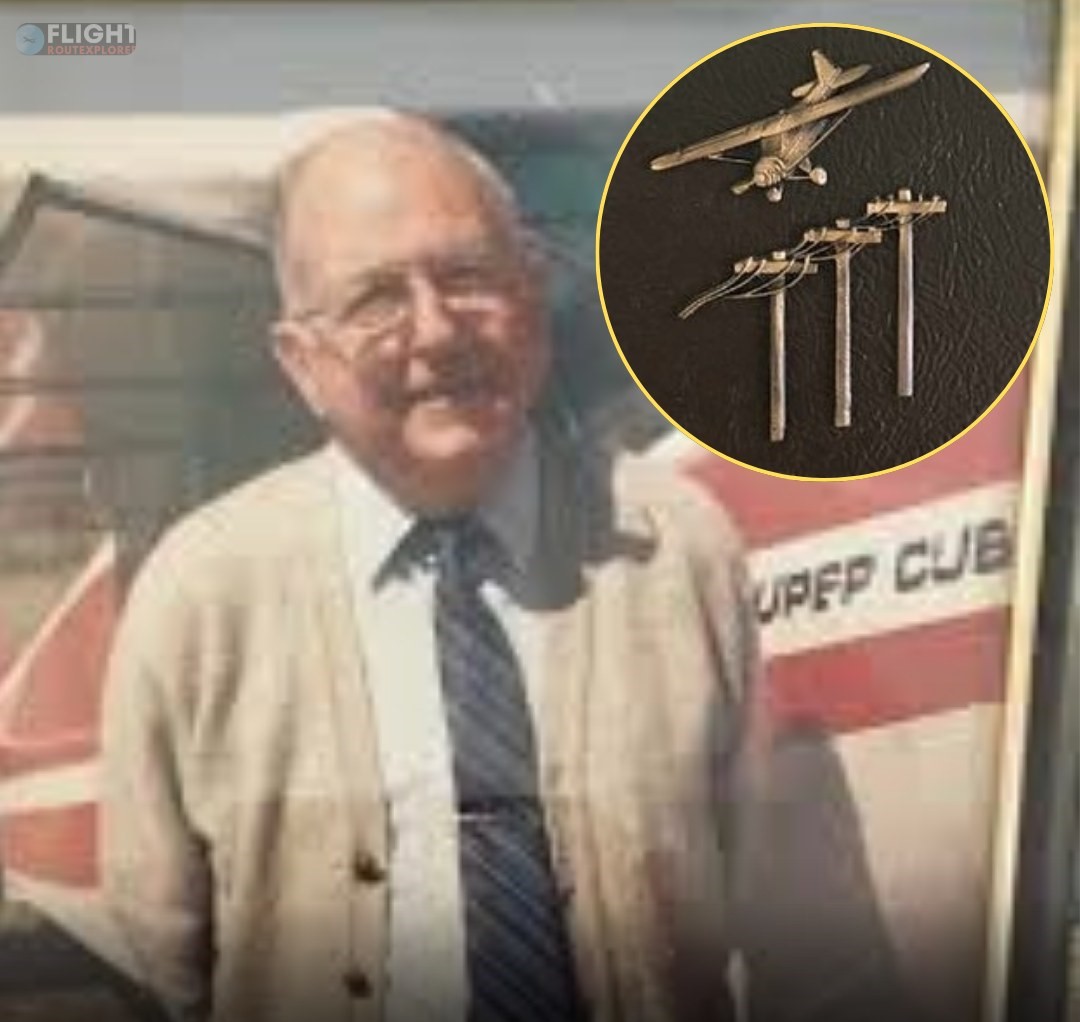
There are pilots who fly for glory. There are pilots who fly for war. And then there are pilots like John Edward Long Jr. — a man who quietly spent so much time in the sky that he practically became part of it.
Hidden among the names etched into the Wall of Honor at the National Air and Space Museum is the story of a pilot whose career was built not on headlines or speed records, but on relentless dedication, precision, and endurance. Yet by the time he passed away in 1999, John Edward Long Jr. had logged more pilot-in-command flight hours than any person in history: an astonishing 64,397 hours. That is the equivalent of more than seven continuous years in the air.
Born in 1915 in Montgomery, Ed Long grew up during aviation’s golden age. The exploits of legendary aviators like Charles Lindbergh and Wiley Post fascinated him as a boy. But unlike many dreamers of the era, Long did not chase fame. He chased flight itself.
At just fifteen years old, armed with fifty cents from his grandmother, he climbed aboard a Ford Tri-Motor for his first airplane ride. That single experience changed the course of his life forever.
The Great Depression made flying lessons painfully expensive, so Long found another route into aviation. He washed airplanes at a local flight school in exchange for thirty minutes of flying time per week. Progress was painfully slow. It took him three years to solo, accumulating barely an hour and forty minutes of airtime during that entire period. But he refused to quit. In 1939, after logging just 63 total hours, he officially earned his pilot certificate.
When World War II erupted, Long hoped to become an Army Air Corps pilot. Instead, the military rejected him for being underweight. At only 115 pounds, he failed to meet the Army’s minimum standards. Rather than abandon aviation, he served as an aircraft mechanic, inspector, and B-24 crew chief, eventually rising to master sergeant.
After the war, Long returned home to Alabama and resumed flying. What followed would become one of the most extraordinary aviation careers ever recorded.
In 1953, through a contract with Alabama Power Company, Long began flying low-level patrol missions inspecting power transmission lines across the southeastern United States. It sounds routine — until you realize how he did it.
He flew day after day at altitudes often below 200 feet, hand-flying small aircraft for hours at a time while searching for damaged insulators, broken poles, woodpecker holes, and encroaching vegetation. Most of those missions were flown solo in a Piper PA-18 Super Cub, the aircraft he adored above all others.
For the next 46 years, Ed Long lived in the cockpit.
Five days a week. Eight hours a day. Sometimes more.
No autopilot. No modern glass cockpit. Just stick-and-rudder flying at dangerously low altitudes over forests, hills, rivers, and power corridors. More than 50,000 of his record-setting hours were spent hand-flying the Super Cub alone.
And somehow, despite flying one of the riskiest profiles imaginable for decades, his safety record bordered on unbelievable.
Long survived near collisions with an F-4 Phantom jet and even a turkey. He successfully dead-sticked a Beechcraft Bonanza onto a two-lane road after an engine seizure. He once damaged an aircraft landing in a field to rescue another downed airplane. Yet throughout his immense career, accidents remained remarkably rare.
His philosophy toward flying was simple and handwritten inside his earliest logbooks:
“It is better to be an old pilot than to be a bold pilot. Fly safe.”
That mindset defined him.
Long was not instrument-rated because nearly all of his flying happened at extremely low altitude where IFR procedures offered little value. Instead, survival depended on instinct, terrain knowledge, and experience. Once, while trapped beneath lowering clouds during a patrol flight, he climbed through an opening, found a gap in the weather, spiraled back down, and navigated home by following a highway at low altitude. That terrifying moment became one of the defining lessons of his career.
Despite holding a world record that few pilots could ever dream of approaching, Ed Long remained deeply humble. Friends described him as quietly dignified and intensely devoted to aviation. He served in multiple aviation organizations, became president of local air safety groups, and was inducted into the Alabama Aviation Hall of Fame.
His final logbook entry came on June 21, 1999, during yet another routine power-line patrol flight.
Less than a month later, on July 17, 1999, John Edward Long Jr. passed away in a hospital in Montgomery, Alabama. He was 83 years old.
Today, while famous aviators are remembered for crossing oceans, breaking sound barriers, or walking on the Moon, Ed Long’s legacy stands apart. He proved that greatness in aviation is not always measured by fame or spectacle.
Sometimes, greatness is measured one careful flight hour at a time.