
For more than seven decades, the final resting place of one of Pan American World Airways’ most tragic accidents remained hidden beneath the Atlantic Ocean. Now, 74 years after the disaster, explorers have finally located the wreckage of the legendary Pan Am “Clipper Endeavor” off the northern coast of Puerto Rico—bringing long-awaited answers to families and uncovering a powerful piece of aviation history.
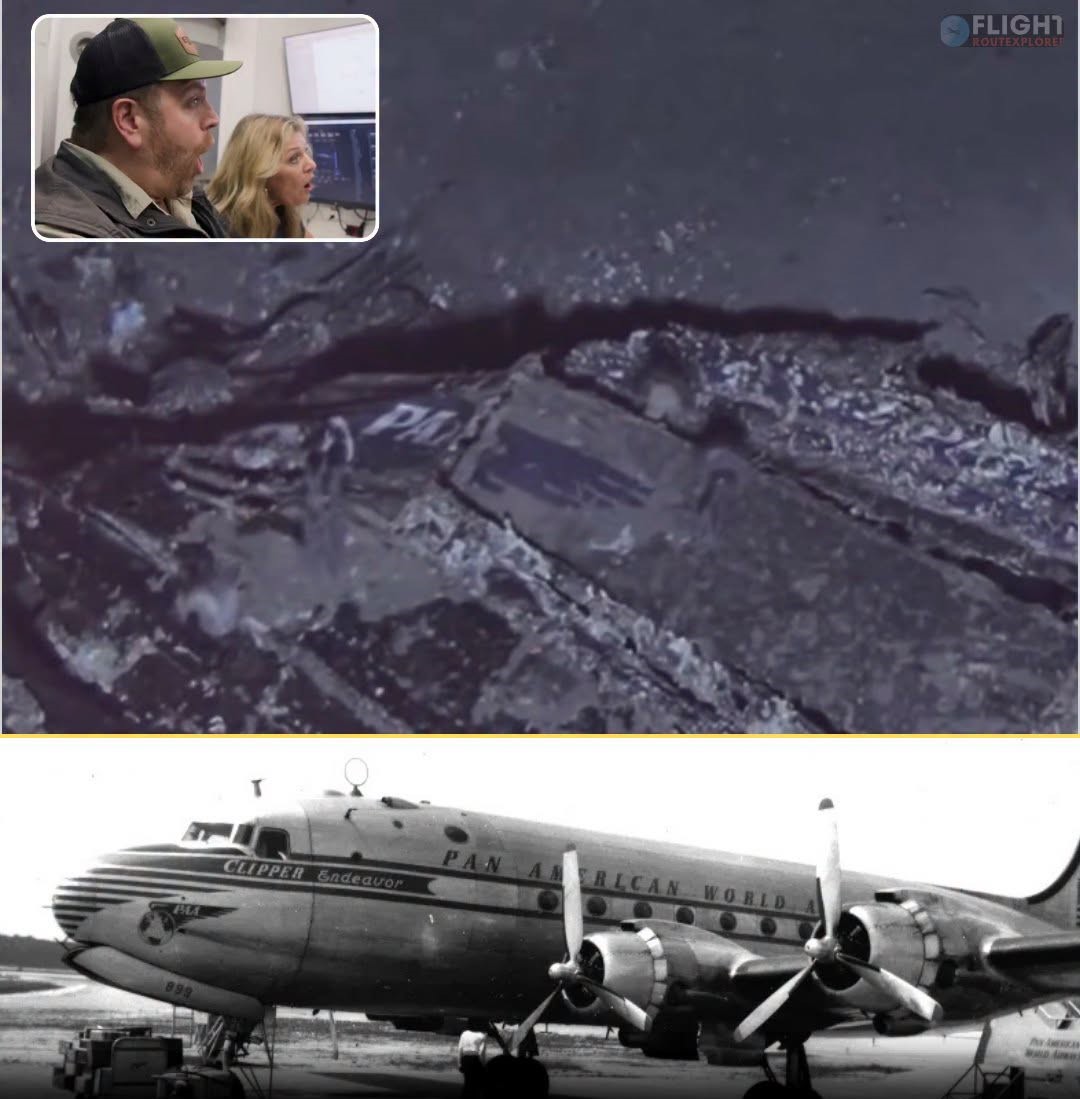
On June 2, an expedition led by the Air/Sea Heritage Foundation, together with Deep Sea Vision and Discovery Channel’s Expedition Unknown, used an autonomous underwater vehicle equipped with high-resolution sonar to scan the seabed nearly 2,000 feet below the surface. What they found was extraordinary.
The Douglas DC-4 lay broken into two major sections. Even after spending more than seven decades underwater, photographs revealed the iconic Pan American winged logo and the aircraft’s name, “Clipper Endeavor,” still clearly visible—an astonishing sight that immediately confirmed the aircraft’s identity.
The discovery finally solves one of aviation’s longest-standing mysteries: exactly where the aircraft came to rest after disappearing beneath the waves on April 11, 1952.
The flight had departed San Juan, Puerto Rico, for New York when disaster struck just minutes after takeoff. Both engines on the aircraft’s right wing suddenly failed, leaving the crew with little choice but to attempt an emergency ditching in the Atlantic.
The pilots managed an incredible feat—every passenger survived the violent impact with the water.
But what happened next turned a survivable accident into one of the deadliest ditching disasters in aviation history.
Although the aircraft carried life rafts and life jackets for everyone onboard, there had been no passenger safety briefing before departure. Many passengers didn’t know where the emergency equipment was located or how to use it. Language barriers created confusion, and there was no coordinated evacuation procedure. Within less than three minutes, the aircraft disappeared beneath the ocean.
Rescue aircraft and Coast Guard crews rushed to the scene, but time was against them.
Only 17 people—12 passengers and five crew members—were rescued.
Fifty-two lives were lost.
The tragedy shocked the aviation industry and prompted a sweeping investigation by the Civil Aeronautics Board, the predecessor of today’s Federal Aviation Administration (FAA).
The investigation concluded that the lack of standardized passenger safety briefings significantly contributed to the high death toll. In response, regulators introduced mandatory preflight safety demonstrations explaining how to locate and wear life vests, where emergency exits are located, and how evacuation procedures work.
Those familiar instructions that millions of airline passengers hear before every flight today—often ignored or taken for granted—exist in large part because of lessons learned from the Clipper Endeavor disaster.
As Doug Miller of the Pan Am Historical Foundation explained, establishing the cabin crew’s authority before departure helps ensure passengers understand and follow instructions during emergencies. Witnesses from the 1952 accident reported that many passengers failed to recognize the seriousness of the situation despite repeated directions from the crew.
Josh Gates, host of Discovery Channel’s Expedition Unknown, summarized the importance of the discovery perfectly:
“Every time you step onboard an airplane today, you are safer because of what happened to Clipper Endeavor and her passengers.”
The newly discovered wreckage is now being considered for additional protection by the Puerto Rican government. The Air/Sea Heritage Foundation is also advocating for a permanent memorial honoring those who lost their lives, while the expedition team has reached out to surviving family members and the accident’s only two known living survivors.
Sometimes history isn’t just about finding an airplane.
Sometimes it’s about rediscovering the moment that forever changed aviation safety.
The Clipper Endeavor may have rested silently beneath the Atlantic for 74 years—but its legacy has protected countless millions of airline passengers ever since.