Busy radio frequencies are a daily challenge for pilots and air traffic controllers.
The FAA’s Data Comm system is helping make communication clearer, faster and more efficient by allowing clearances and instructions to be exchanged through digital text messages.
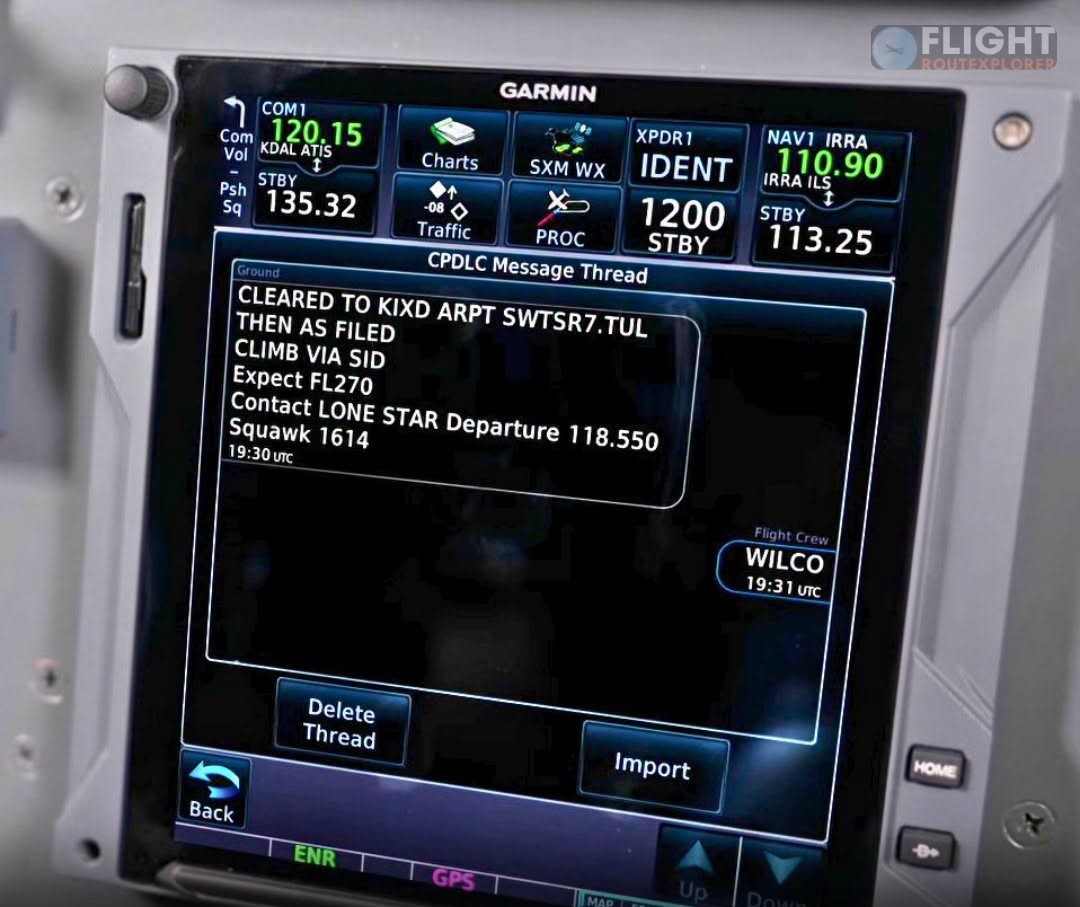
Instead of relying entirely on voice transmissions, pilots and controllers can use Controller-Pilot Data Link Communications (CPDLC) to exchange departure clearances, route changes and other flight-related information through compatible cockpit systems.
Pilots can receive and review ATC clearances digitally, reducing dependence on busy radio frequencies. Written instructions help minimize misunderstandings during voice transmissions and readbacks, while routine messages sent through datalink leave radio frequencies available for other important communications.
On suitably equipped aircraft, departure clearance routes can also be loaded directly into the navigation system, helping streamline flight operations.
The FAA provides Data Comm services at more than 60 U.S. airports and across much of its en-route airspace.
Access requires compatible avionics and the necessary FAA Data Comm enablement. Supported equipment includes select Garmin integrated flight decks and GTN Xi navigators equipped with a GDR 66 datalink. Garmin lists an annual subscription fee of $499 for the service.
Digital messaging does not completely replace traditional radio communication. Instead, it complements voice transmissions, helping pilots and controllers manage increasingly busy airspace with greater clarity and efficiency.
As aviation becomes increasingly digital, could datalink communication become the future standard for routine pilot–controller exchanges?