
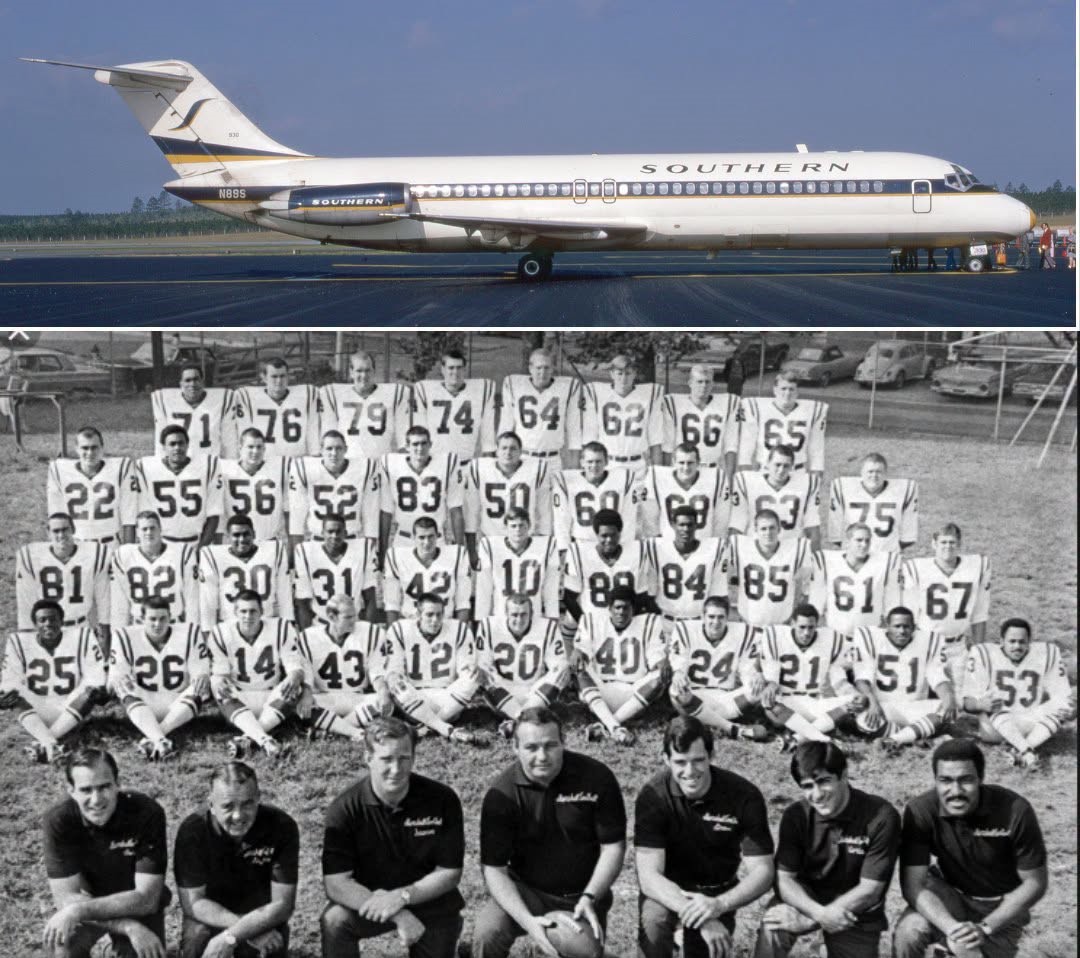
On November 14, 1970, one of the darkest tragedies in American college sports history unfolded near Huntington, West Virginia, when Southern Airways Flight 932 crashed during its final approach to Tri-State Airport.
The chartered McDonnell Douglas DC-9-31, registration N97S, was carrying 71 passengers and four crew members, including Marshall University’s football team, coaching staff, university officials and supporters.
The team was returning home after playing East Carolina University in Greenville, North Carolina, where Marshall had lost 17–14.
The flight had been largely uneventful until it approached Huntington at approximately 7:23 p.m. local time.
Conditions around the airport were extremely challenging, with darkness, light rain, fog, smoke and low, broken clouds restricting visibility.
Air traffic control advised the pilots about the deteriorating weather. The crew prepared for an instrument approach to Runway 11, using the localizer system to align the aircraft with the runway.
At approximately 7:34 p.m., the aircraft passed the outer marker and continued its descent. However, something went terribly wrong. Instead of maintaining the required Minimum Descent Altitude of 1,240 feet, the DC-9 continued descending.
The pilots never established visual contact with the runway environment. At approximately 7:36 p.m., the aircraft struck trees on a hillside about one mile short of the runway. It tore through the trees, broke apart and crashed into the ground, where a massive fire engulfed the wreckage.
All 75 people aboard perished. Among the victims were 36 Marshall football players and five coaches. There were no survivors.
The tragedy devastated Marshall University and the entire Huntington community. The university lost much of its football team, coaching staff and athletic leadership in a single evening. The disaster later became the subject of the 2006 film “We Are Marshall.” A memorial was established to honour the victims, and their legacy remains central to the university’s identity.
The National Transportation Safety Board investigated the disaster and released its final report in April 1972. Investigators determined that the aircraft descended below the prescribed minimum altitude during a non-precision instrument approach without visual contact with the runway.
However, the precise reason for the descent could never be established. Investigators identified two leading possibilities: improper use of cockpit instrumentation or an error in the aircraft’s altimetry system. They also highlighted the absence of electronic vertical guidance as an important safety consideration.
The investigation recommended improvements in crew coordination, instrument approach procedures and ground proximity warning technology.
The Marshall University crash remains one of the deadliest disasters involving an American collegiate sports team and a heartbreaking reminder of how a seemingly routine landing can turn into an unimaginable tragedy.