
On October 28, 2016, American Airlines Flight 383, a Boeing 767-323ER registered N345AN, was preparing to fly from Chicago O’Hare International Airport to Miami, Florida, with 161 passengers and nine crew members aboard.
What began as a routine departure suddenly turned into a terrifying emergency during the takeoff roll.
At approximately 2:32 p.m. local time, the aircraft accelerated along Runway 28R with its engines operating at takeoff power. As the Boeing 767 approached 128 knots, its right engine suffered a catastrophic, uncontained failure.
A high-pressure turbine disk inside the General Electric CF6 engine ruptured, sending heavy metal fragments flying through the engine casing.
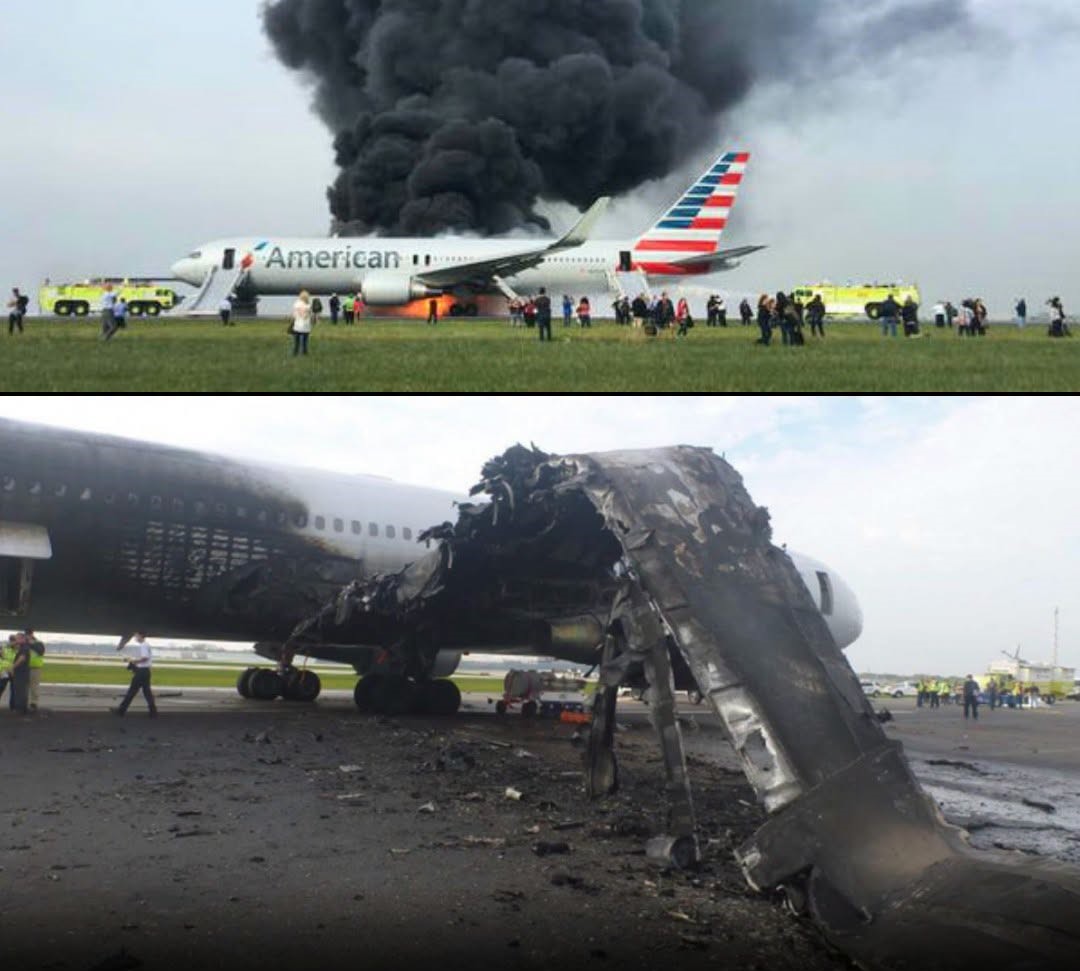
One fragment tore through the right wing, severing the engine’s fuel feed line and puncturing the wing fuel tank. Fuel spilled out and ignited, producing a large fire beneath the aircraft’s right wing.
Astonishingly, another piece of the turbine disk travelled approximately 2,935 feet (895 metres) before crashing through the roof of a nearby United Parcel Service warehouse. Nobody inside the warehouse was injured.
Recognising the emergency, the pilots rejected the takeoff and brought the aircraft to a stop on the runway. Air traffic control confirmed the fire and dispatched airport rescue and firefighting crews.
Meanwhile, flight attendants initiated an emergency evacuation using the aircraft’s inflatable escape slides.
However, the evacuation itself introduced additional danger. Passengers exited through the left overwing emergency exit while the left engine was still running.
The powerful engine airflow affected an evacuation slide at another exit, making it temporarily unusable until it was repositioned. All 170 occupants escaped, but 21 people were injured: one passenger suffered serious injuries, while 19 passengers and one flight attendant sustained minor injuries. There were no fatalities.
The aircraft sustained extensive fire damage and was ultimately written off, becoming a hull loss.
The US National Transportation Safety Board (NTSB) investigation uncovered a critical manufacturing defect. Investigators determined that microscopic material irregularities inside the turbine disk had allowed low-cycle fatigue cracks to develop.
These cracks progressively weakened the component until it fractured under the extreme stresses of takeoff. The underlying manufacturing anomaly was most likely undetectable using the production and in-service inspection procedures then in place.
Investigators also identified shortcomings in emergency procedures. The Boeing 767 lacked a dedicated checklist specifically addressing an engine fire on the ground, and communication between the flight deck and cabin crew contributed to the delay in shutting down the unaffected engine.
Following the investigation, the NTSB issued safety recommendations addressing turbine-disk inspections, engine-fire procedures and evacuation risks. The accident demonstrated how a defect hidden deep inside an engine could trigger a catastrophic failure within seconds—and how improvements in manufacturing inspections and emergency coordination could help prevent similar events.