

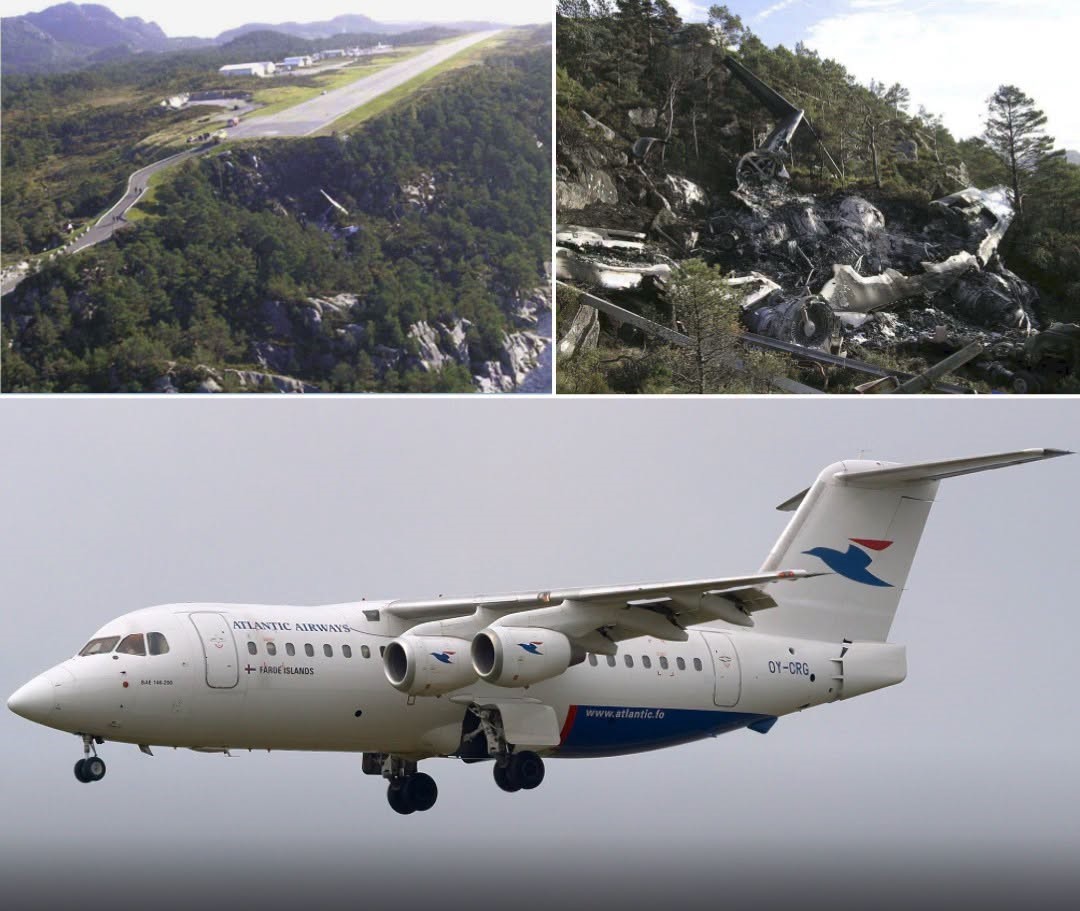
On October 10, 2006, Atlantic Airways Flight 670, a British Aerospace BAe 146-200A registered OY-CRG, crashed while landing at Stord Airport, Sørstokken, in Norway.
The accident killed four of the 16 people aboard, including three passengers and one crew member, while 12 others survived.
The aircraft was operating a charter flight for employees of engineering company Aker Kværner, travelling from Stavanger Airport to Stord before continuing to Molde.
The flight departed Stavanger that morning with 12 passengers and four crew members on board. Weather conditions included a damp runway, and the airport’s relatively short runway left little margin for error during landing.
At approximately 7:32 a.m. local time, the aircraft touched down on Runway 33. Almost immediately, the pilots noticed that the lift spoilers had failed to deploy.
These panels on the wings normally rise after touchdown to reduce lift, increase drag and transfer more weight onto the wheels, allowing the brakes to slow the aircraft effectively.
The first officer called attention to the missing spoilers, and the crew checked the system while attempting to slow the aircraft. However, the expected deceleration did not occur.
The captain increased the braking effort and eventually selected emergency braking, unaware that this action disconnected the anti-lock braking system.
With the wheels locked, the tyres generated intense heat on the damp runway. Investigators later determined that this caused reverted-rubber hydroplaning, in which water beneath the tyres turns to steam, creating a layer that drastically reduces friction. The aircraft continued rolling despite the crew’s efforts to stop it.
About 23 seconds after touchdown, Flight 670 overran the runway. It slid down a steep embankment, struck obstacles and came to rest after sustaining severe damage.
A fire erupted, and burning fuel spread through the aircraft. Four occupants died, while the surviving passengers and crew escaped with varying injuries.
Norway’s Accident Investigation Board conducted a detailed investigation using flight recorder data, wreckage examinations and runway evidence. Its final report, published in 2012, could not establish the precise underlying reason why the spoilers failed.
Investigators identified the spoiler malfunction, the use of emergency braking without anti-lock protection, and the resulting hydroplaning as critical factors in the accident.
The investigation also highlighted shortcomings in airport safety provisions. The runway lacked surface grooves that could have improved water drainage and tyre grip, while the steep terrain beyond its end provided little protection against an overrun.
Investigators concluded that the aircraft might have stopped within the available runway with appropriate braking, even without functioning spoilers.
The crash prompted safety measures, including revised operating guidance and greater emphasis on landing performance, spoiler-failure procedures and operations on short runways.
Atlantic Airways subsequently discontinued its Stord service. The accident remains a stark example of how a relatively low-speed runway overrun can become fatal when aircraft system failures, braking difficulties and inadequate runway-end protection combine.










