

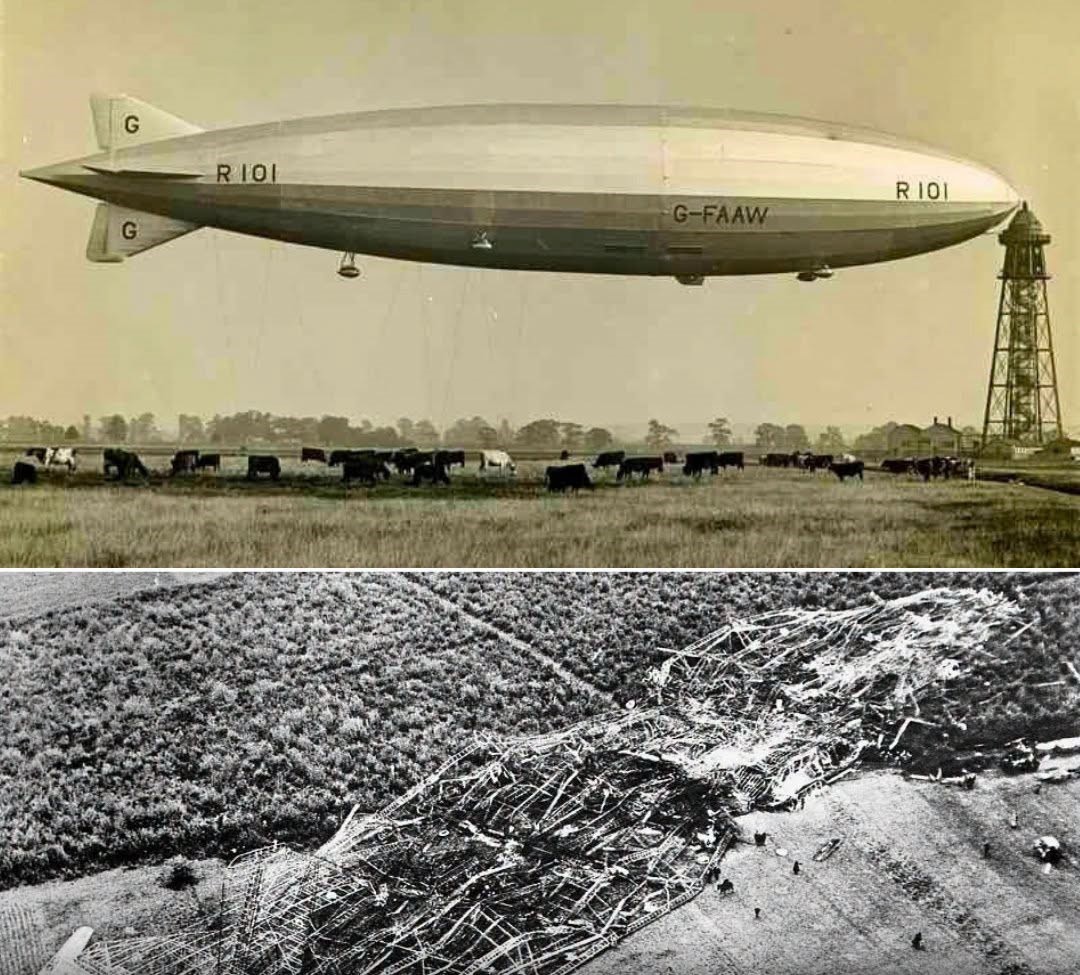
On October 4, 1930, Britain’s rigid airship R101 left Cardington at 6:24 p.m. on a proving flight to Karachi, then British India, via Egypt. It carried 54 people, including Lord Christopher Thomson and Sir Sefton Brancker.
R101 was already facing serious problems. It was heavier than planned. Earlier flights had revealed problems with its gas bags, valves and outer covering.
Modifications to increase lifting capacity also left gas bags vulnerable to chafing against the internal framework, where holes had been found.
After crossing the English Channel, R101 encountered worsening weather over northern France. Shortly after 2 a.m. on October 5, near Beauvais, survivors described a sudden steep dive. The nose dropped repeatedly as the crew struggled to regain altitude and released ballast.
The official inquiry concluded that the immediate cause was a substantial loss of lifting gas from one or more forward gas bags, probably connected with damage to the forward envelope. A strong downward air current and the damaged outer cover were also important factors.
The loss of buoyancy was critical because the airship was already heavy. Despite the crew’s efforts to raise the nose, R101 descended rapidly and struck a hillside near Allonne at about 2:08 a.m.
The impact was followed almost immediately by a massive fire. Escaping hydrogen ignited and flames rapidly consumed the airship. Of the 54 people aboard, 46 died at the scene and two survivors later died from their injuries, bringing the death toll to 48. Only six survived.
Investigators rejected the idea that the main airframe simply broke apart in flight. They focused on gas loss, the condition of the forward gas bags and envelope, weather and the airship’s handling.
The Court of Inquiry concluded that leakage culminating in a major loss of gas in the forward part of the ship was the most plausible immediate cause.
The investigators could not reconstruct every detail because the fire destroyed much of the evidence. The findings highlighted the danger of operating an experimental airship with limited lift and known technical problems while proceeding with a high-profile India flight in unfavourable conditions.
The R101 disaster devastated Britain’s Imperial Airship programme. Its rival R100 was withdrawn, effectively ending Britain’s long-range airship ambitions.










