

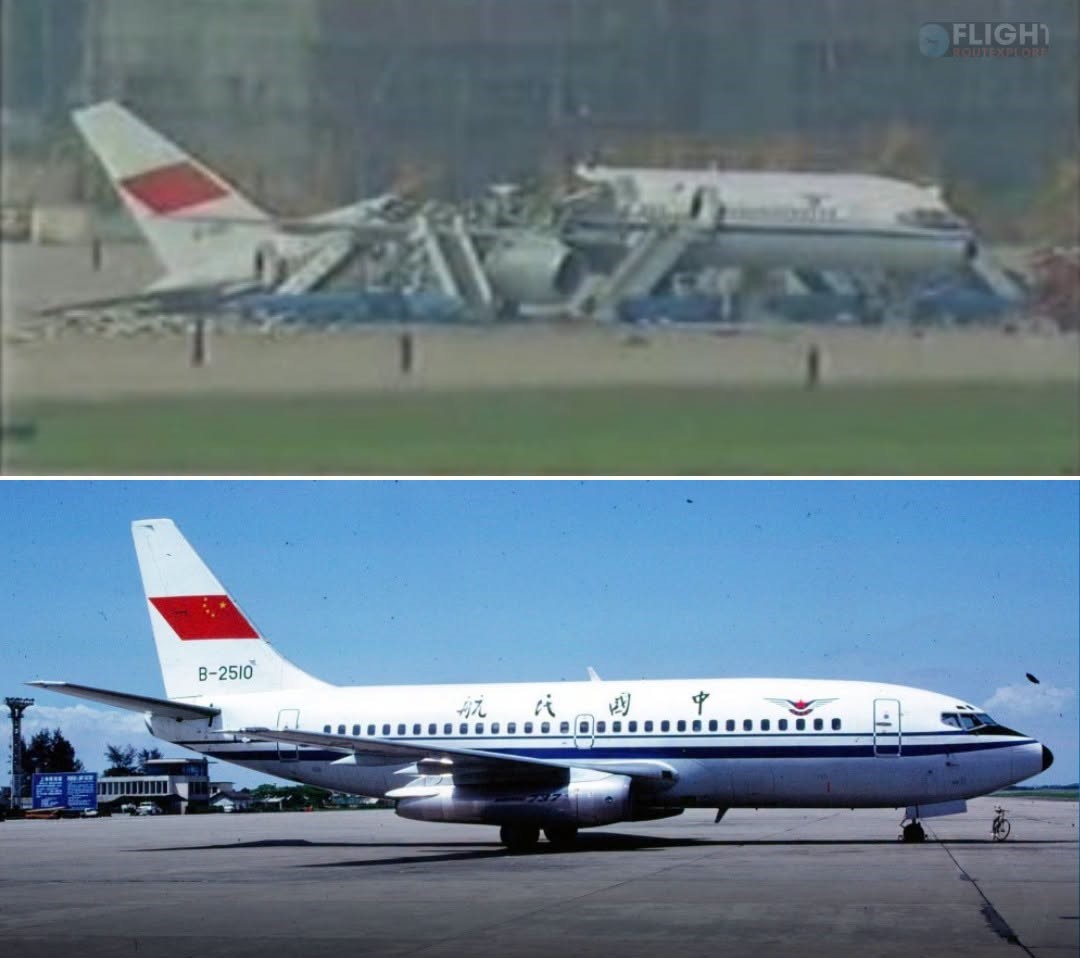
On October 2, 1990, one of China’s deadliest aviation disasters unfolded at Guangzhou Baiyun International Airport when a hijacked Xiamen Airlines Boeing 737 collided with two other aircraft, killing 128 people.
Xiamen Airlines Flight 8301, a Boeing 737-247 registered B-2510, was flying from Xiamen to Guangzhou with 93 passengers and nine crew members. During the flight, a hijacker named Jiang Xiaofeng seized control of the aircraft and demanded to be flown to Taiwan.
The hijacker reportedly threatened to blow up the aircraft if his demands were not met. The crew attempted to negotiate, while air traffic controllers explored options to divert the aircraft. Hong Kong was discussed as a possible stop for refuelling before proceeding to Taiwan, but the hijacker refused.
After circling Guangzhou for an extended period, the aircraft was running dangerously low on fuel. The crew eventually had little choice but to land at Baiyun Airport.
At approximately 9:04 a.m., the Boeing 737 touched down at the airport. During the landing roll, Jiang reportedly wrestled control from the pilot. The aircraft veered off course at high speed, briefly lifted its nose and struck a ground service vehicle before colliding with a parked China Southwest Airlines Boeing 707 operating Flight 4305. The impact damaged the 707’s nose and slightly injured its pilot.
The out-of-control 737 continued across the airport and slammed into a China Southern Airlines Boeing 757 operating Flight 3523, which was waiting to depart for Shanghai. The collision severely damaged the 757, splitting its fuselage and detaching an engine. The 737 then overturned, broke apart and came to rest in wreckage.
Fire erupted across the crash site, but nearby firefighters rapidly brought the flames under control, helping rescue survivors.
The disaster claimed 82 lives aboard Flight 8301, including the hijacker, and 46 passengers aboard Flight 3523. All 12 crew members of the 757 survived. The Boeing 707 sustained damage, but its sole occupant survived. Overall, 128 people died and 53 were injured.
Investigators identified the hijacking and the resulting loss of control during landing as the immediate causes of the collisions. A preliminary report released on October 10 acknowledged procedural failures in handling the hijacking. Authorities dismissed several lower-level employees, while questions remained over why passengers aboard nearby aircraft were not evacuated despite the prolonged emergency.
The tragedy prompted tighter airport security measures and a shift in China’s approach to hijackings, placing greater emphasis on protecting passengers and aircraft rather than encouraging direct confrontation with hijackers.










