
On September 17, 1961, Northwest Orient Airlines Flight 706 departed Chicago’s O’Hare International Airport for Tampa, with further stops planned at Fort Lauderdale and Miami.
The Lockheed L-188C Electra, registered N137US, carried 32 passengers and five crew members. Within minutes, a routine takeoff turned into a catastrophic loss of control that left no survivors.
The aircraft was cleared for takeoff at about 8:55 a.m. and initially climbed normally. When it reached roughly 100 feet above the ground, witnesses noticed a subtle change in the sound of its engines.
Almost immediately, the Electra began banking to the right, with its right wing slowly dropping. The bank continued to increase despite the pilots’ apparent attempts to regain control.
The aircraft climbed to approximately 300 feet, but the right bank became progressively steeper, eventually exceeding 50 degrees. A garbled transmission was heard by the control tower, believed to have come from the cockpit.
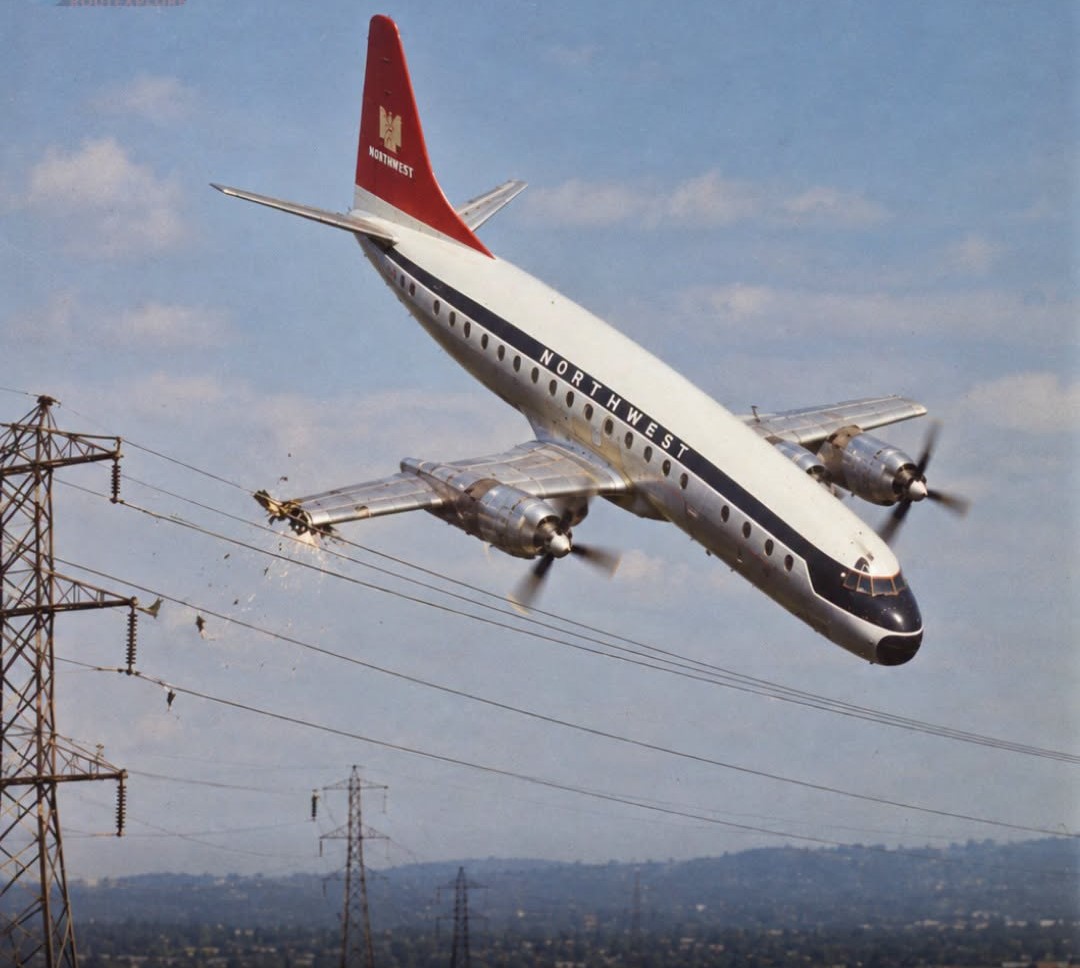
With the aircraft continuing toward the airport boundary, the right wing struck high-voltage power lines. The Electra then hit an embankment and began breaking apart.
The forward fuselage separated as the aircraft cartwheeled and skidded across the ground. The wreckage briefly became airborne before crashing nose-first and coming to rest inverted. A massive post-impact fire followed.
The entire sequence, from the beginning of the takeoff roll to the final impact, lasted less than two minutes.
All 37 people aboard were killed. The accident shocked investigators because there had been no obvious warning before the aircraft suddenly became difficult or impossible to control.
The investigation by the Civil Aeronautics Board eventually uncovered a maintenance-related failure in the aileron control system. A cable connecting the first officer’s control wheel to the aileron boost unit had become disconnected.
As a result, the ailerons moved the aircraft into a right-wing-down attitude, while the pilots were unable to use their controls effectively to counter the bank.
Investigators traced the problem to maintenance performed about two months earlier. The cables connecting the pilots’ control wheels to the aileron boost unit had been removed during routine work.
When the system was reassembled, a safety cable intended to secure part of the connection had not been replaced. The connection gradually separated until it finally failed during the takeoff.
The crash therefore was not caused by a sudden weather event or an engine failure, but by a concealed mechanical problem originating in maintenance. The investigation demonstrated how a small omission during routine servicing could remain unnoticed until a critical moment, when the aircraft needed full and precise flight-control authority.