
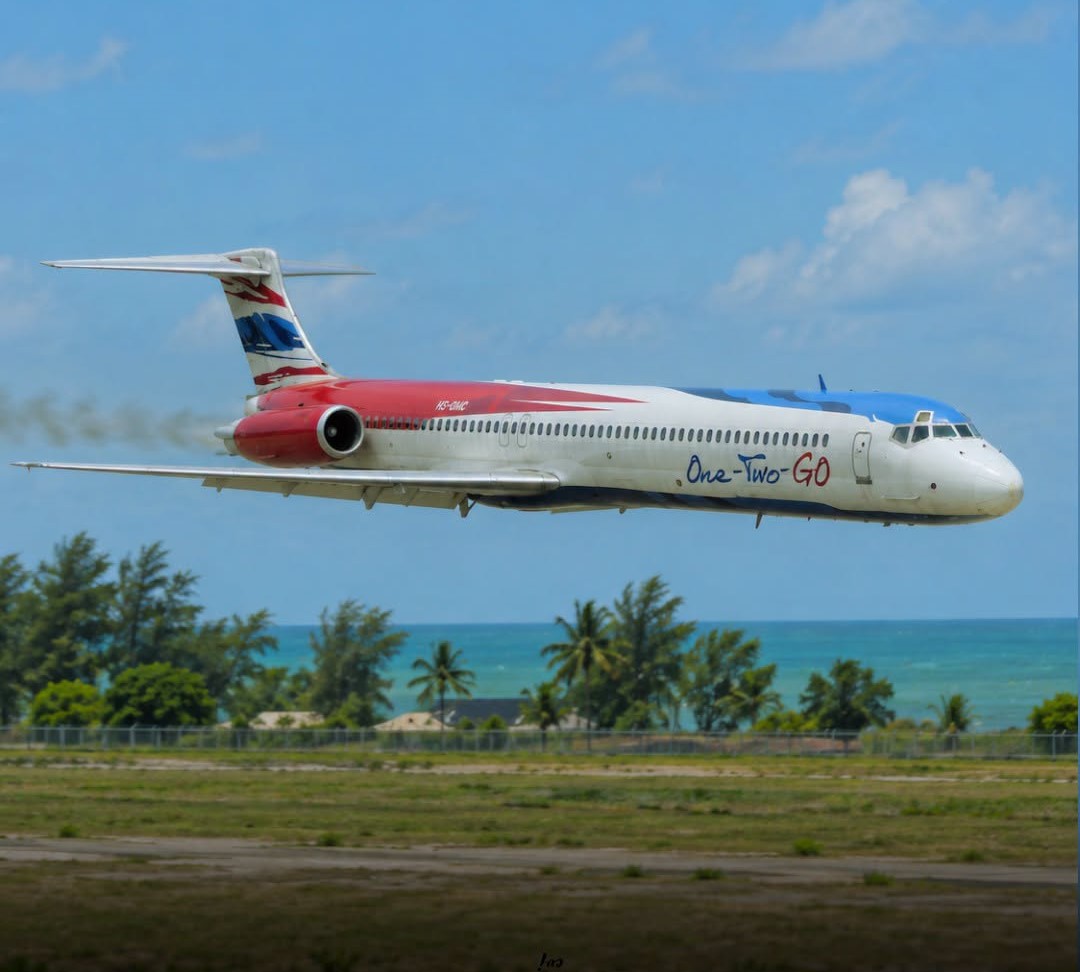
On September 16, 2007, One-Two-Go Airlines Flight 269 was approaching Phuket International Airport in Thailand after a scheduled flight from Bangkok.
The McDonnell Douglas MD-82, registration HS-OMG, was carrying 123 passengers and seven crew members. What appeared to be a routine landing quickly became a fight to regain control in deteriorating weather.
Flight 269 was being flown by First Officer Montri Kamolrattanachai, while Captain Arief Mulyadi was the pilot monitoring. As the aircraft approached Phuket, weather conditions around the airport worsened.
Another aircraft landing shortly before Flight 269 had reported wind shear and a cumulonimbus cloud near the airport. The incoming crew was therefore aware that conditions were changing.
The MD-82 initially continued toward Runway 27. During the approach, the aircraft encountered increasingly difficult weather conditions, and the crew decided to abandon the landing and perform a go-around. The critical sequence began at this point.
Instead of successfully climbing away, the aircraft failed to gain sufficient speed and altitude. The investigation later established that the pilots did not properly execute the go-around procedure.
The Takeoff/Go-Around, or TO/GA, switch was not activated, and the necessary engine thrust was not applied. The throttles remained at a low-power setting while the aircraft continued to lose energy.
The cockpit situation became increasingly confused. Investigators found serious crew-resource-management problems, including an attempted transfer of control at a critical moment.
There was also inadequate monitoring of the aircraft’s power and flight path. With the aircraft slowing, its nose was raised in an attempt to climb, but without sufficient thrust the MD-82 could not maintain altitude.
At about 3:40 p.m., the aircraft descended rapidly and struck an embankment beside Runway 27. The MD-82 broke apart and caught fire, with the wreckage becoming engulfed in flames. Emergency crews rushed to the scene as survivors escaped through parts of the burning fuselage.
Ninety of the 130 people aboard were killed, including members of the flight crew. Forty people survived, although many suffered serious burns and other injuries. The crash became one of Thailand’s deadliest aviation disasters.
The investigation by Thailand’s Aircraft Accident Investigation Committee, with significant assistance from the U.S. National Transportation Safety Board, examined the flight recorders, aircraft wreckage, cockpit communications and operational records.
Investigators initially considered wind shear as a possible major factor, but the recorded data ultimately showed that wind shear was not the direct cause of the loss of control.
Instead, investigators identified a combination of human and organizational factors. The crew had not followed required stabilized-approach and go-around procedures, cockpit coordination was inadequate, and the pilots failed to ensure that engine power increased during the maneuver. The investigation also identified fatigue, insufficient rest and excessive workload.
Investigators found that the airline’s operational system had serious weaknesses as well. Pilot proficiency checks and training practices did not consistently meet required standards, while simulator training did not adequately reproduce the MD-82 configuration or the relevant wind-shear alerting environment.
The crash therefore was not attributed to a single mistake or a simple weather event. The final findings pointed to a chain of failures involving deteriorating weather, an unstable approach, an improperly executed go-around, poor cockpit coordination, fatigue and weaknesses in the airline’s safety and training systems.
The accident became a major warning about how several seemingly manageable problems can combine during the few critical seconds of an emergency.