
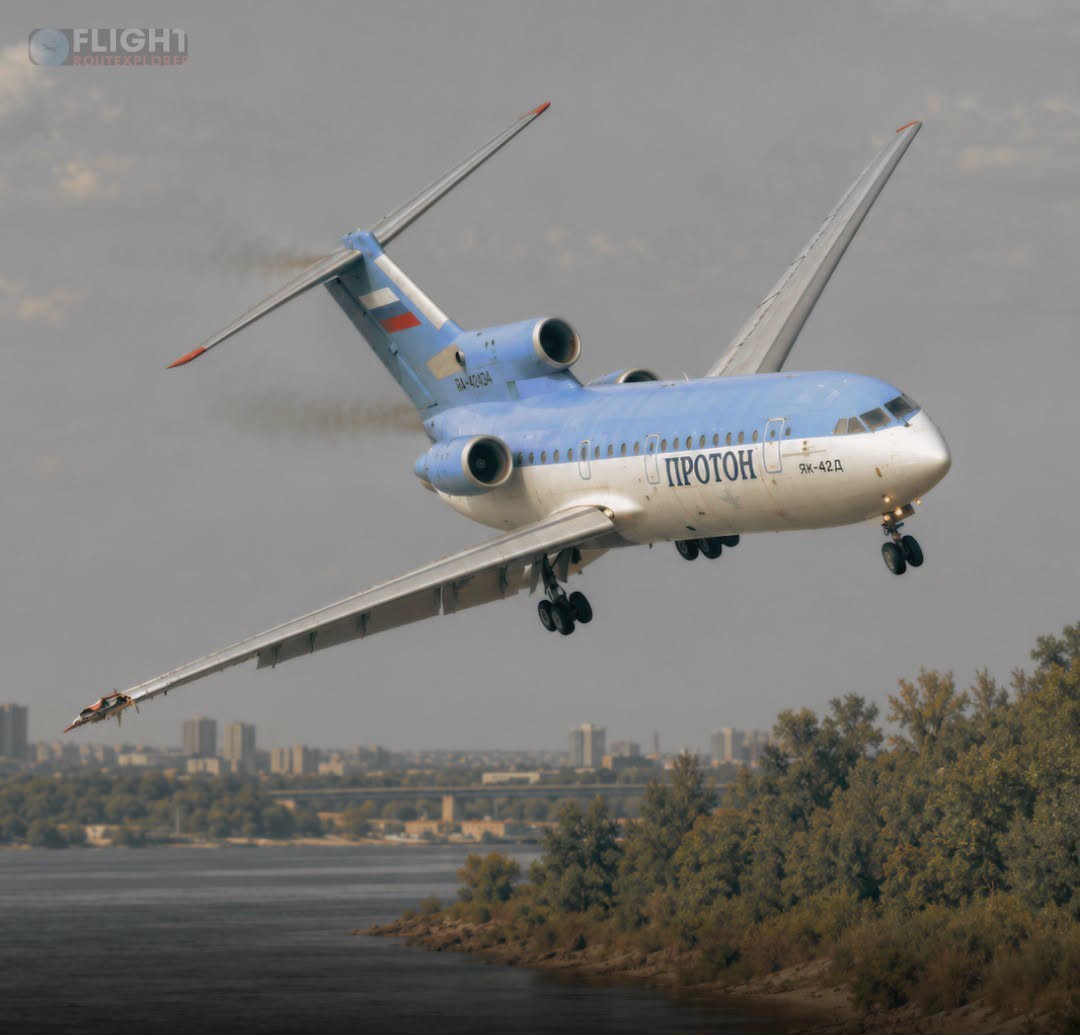
On September 7, 2011, YAK-Service Flight 9633 was preparing to carry Lokomotiv Yaroslavl, one of Russia’s leading ice hockey teams, from Tunoshna Airport near Yaroslavl to Minsk, Belarus.
The Yakovlev Yak-42D, registration RA-42434, carried 45 people: 37 passengers and eight crew members. Among those aboard were nearly the entire Lokomotiv roster, coaching staff and several internationally known players.
Weather conditions were good, with light winds, good visibility and a temperature of about 18°C.
The aircraft entered Runway 05/23 from a taxiway about 300 metres from the threshold, leaving approximately 2,700 metres of usable runway. The takeoff began with the engines at nominal thrust rather than full takeoff thrust.
Although the crew increased power several seconds into the run, the aircraft was not accelerating normally. It eventually reached about 230 km/h, but still failed to become airborne before reaching the runway end. The Yak-42 continued roughly 400 metres beyond the runway before finally lifting only a few metres above the ground.
At that point, the aircraft was already in an almost unrecoverable situation. As it struggled to climb, its left wing struck an airport antenna mast approximately 450 metres beyond the runway.
The impact damaged the aircraft and caused it to veer sharply left. The Yak-42 then crashed near the bank of the Tunoshonka River, close to its confluence with the Volga.
The aircraft broke apart, with the tail separating and coming to rest in the water while much of the fuselage remained on land. Witnesses reported flames after the collision.
The consequences were devastating. Forty-four of the 45 people aboard eventually died. The sole survivor was flight mechanic Alexander Sizov.
Hockey player Alexander Galimov initially survived with severe injuries but died several days later in hospital, leaving Sizov as the only person to survive the disaster. The crash destroyed almost the entire Lokomotiv Yaroslavl team and shocked the international hockey community.
Investigators initially examined numerous possibilities, including engine failure, contaminated fuel, aircraft malfunction, excessive weight and braking-system problems.
The engines were found to have continued operating until the aircraft struck the mast, the flight controls were functioning, the weather was not a factor, and the takeoff weight was initially reported within permitted limits. Tests also found no mechanical failure in the braking components themselves.
The decisive breakthrough came through flight-recorder analysis and full-scale simulator testing. Investigators determined that braking force had been applied during the takeoff run while the aircraft was simultaneously being accelerated.
The final investigation concluded that a pilot had inadvertently pressed the brake pedals because his feet were incorrectly positioned. This prevented the aircraft from accelerating sufficiently and produced the abnormally long takeoff roll. The crew then continued the takeoff instead of rejecting it at the appropriate point.
But the investigation revealed a much deeper safety failure. YAK-Service had not properly ensured that its pilots were adequately trained on the Yak-42, and investigators found that the crew had not correctly calculated the takeoff parameters.
The pilots had also changed engine thrust during the takeoff instead of establishing the proper takeoff configuration beforehand. Later investigations revealed that the pilots had falsified documents claiming they had completed the required Yak-42 training. The co-pilot was also found to have phenobarbital in his system.
The tragedy triggered major consequences in Russian aviation. Yak-42 operations were temporarily suspended for safety checks, and YAK-Service subsequently lost its operating licence.
Lokomotiv withdrew from the 2011–12 KHL season, while tributes were held across the hockey world for the players, coaches and staff who died. The crash ultimately became a stark example of how inadequate training, poor operational procedures and a seemingly small cockpit error can combine within seconds to produce a catastrophic accident.