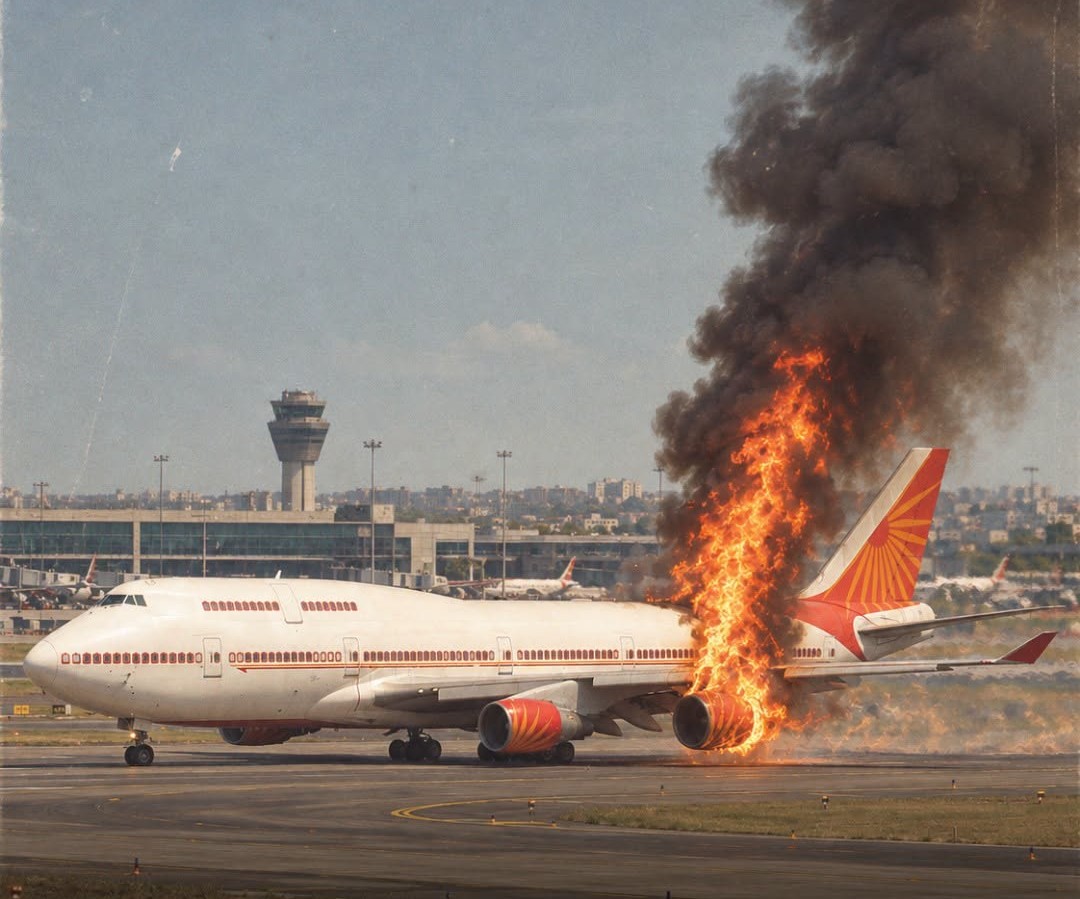
On September 4, 2009, Air India Flight AI-829 was preparing to depart Mumbai for Riyadh when a Boeing 747-400, registration VT-ESM, became engulfed in flames during taxi.
There were 213 passengers and 16 crew members aboard, and what initially appeared to be a routine departure turned into a desperate evacuation.
The flight had already suffered a major delay. The aircraft originally assigned to AI-829 had returned to its parking bay twice because of a recurring technical problem.
Passengers were eventually deplaned, and VT-ESM was brought in as the replacement aircraft, resulting in an approximately eight-hour delay.
VT-ESM had its auxiliary power unit unavailable under the aircraft’s minimum equipment provisions, so engine No. 4 was started before pushback.
The pushback itself then went wrong when the tow bar broke after the aircraft had moved only about 8 to 10 feet. After a replacement tow bar was arranged, the 747 was pushed onto the taxiway and engines No. 3, No. 2 and No. 1 were started.
As the aircraft taxied along Taxiway G, several people on the ground noticed something alarming: fuel was gushing from the area around the left-hand engines.
Another Air India crew reported the leak to dispatch, while an engineer working on another aircraft attempted to attract the 747’s attention by waving his jacket. The cabin crew saw the man signalling but did not understand the warning.
A Follow-Me vehicle driver also spotted the leak and informed air traffic control. Because AI-829 had already changed frequencies and its company radio channel was switched off, the warning did not immediately reach the cockpit.
Tower eventually established contact with the aircraft and instructed the crew to shut down the engines immediately.
But the fuel leak had already created a dangerous situation. Engine No. 1 caught fire, and flames began spreading toward engine No. 2. The captain started the emergency checklist and called the senior cabin crew member to the cockpit.
Before the captain ordered an evacuation, a cabin crew member saw the fire and independently initiated an evacuation through the right-hand exits.
Passengers rushed from the burning aircraft, while enormous flames rose alongside the left wing and fuselage. The right-side exits were used because the fire made the left side dangerous. Firefighters rapidly reached the aircraft, attacked the flames with foam and boarded to ensure nobody remained inside.
All 229 people aboard escaped alive, although 21 passengers suffered minor injuries such as scratches and bruises during the evacuation. The fire caused extensive damage to engine No. 1, its pylon and portions of the left wing, and the Boeing 747 was ultimately declared a total loss.
The investigation revealed that the fire was ultimately linked to a fuel-system failure. The No. 1 engine fuel-feed coupling had become compromised, allowing fuel to escape and reach the hot engine area. Investigators also discovered that the aircraft had undergone maintenance for a fuel leak involving the same engine before the flight.
DGCA concluded that the coupling had likely not been tightened to the required specification. It could subsequently rotate through repeated tightening and loosening cycles, eventually causing the coupling material to fracture. Boeing’s examination found extensive rubbing and wear around the locking-wire area but could not determine precisely when or why the damage occurred.
The investigation also identified failures in maintenance practices, communication and crew procedures. The incident became a dramatic example of how a fuel leak visible to multiple people on the ground could remain unnoticed in the cockpit until the aircraft was already facing an engine fire.